EasyManua.ls Logo

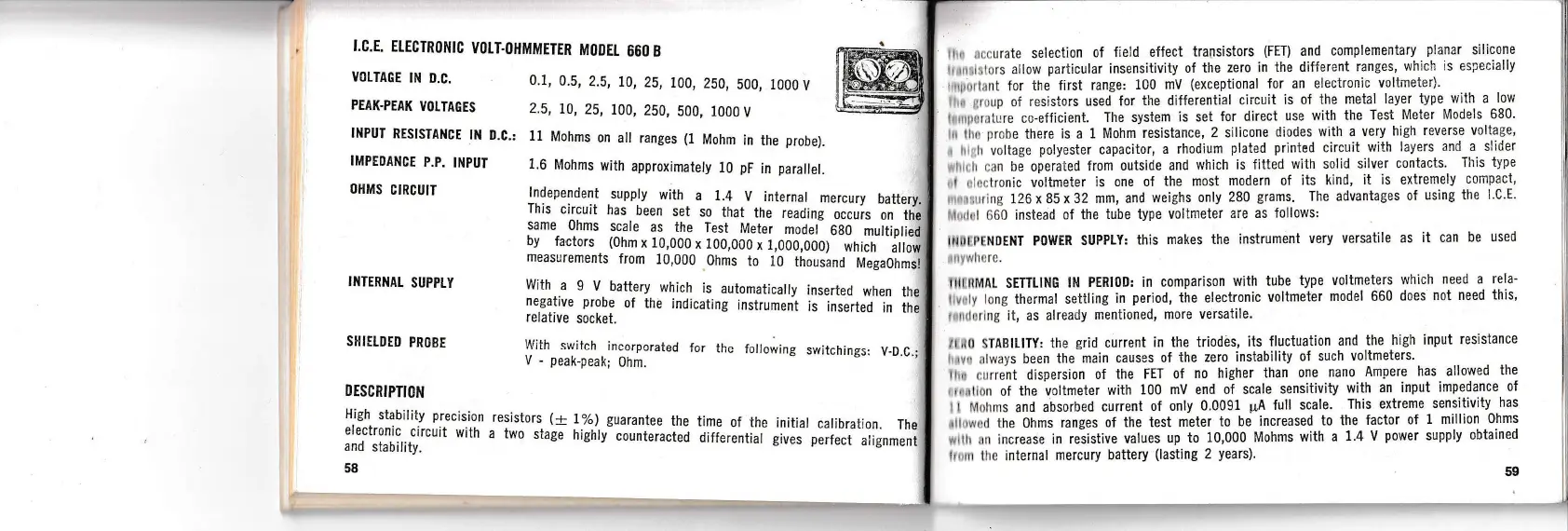
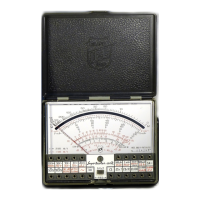
I.C.E Supertester 680 R - I.C.E. Electronic Volt-Ohmeter Model 660 B

I.C.E Supertester 680 R
39 pages
Print Icon
To Next Page IconTo Next Page
To Previous Page IconTo Previous Page
Loading...
I.C,E.
ETECTR()NIC
V()IT-()HMMETER
M()DET
660 B
VOLTAGE
IN
D.C.
PEAK-PEAK
VOTTAGES
INPUT
RESISTANCE
I}I
D.C.:
IMPEDANCE
P.P.
INPUT
OIIMS
CIRCUIT
0.1,
0.5,
2.5,
t0,
25,
100,
250,
500, 1000
v
2.5,
10,
25,
100,
250,
500, 1000
v
11
Mohms
0n
all
ranges
(1
Mohm
in
the
probe).
1.6
Mohms
with
approximately
10
pF
in
parallel.
INTERNAT
SUPPTY
SI{ITIDED
PR()BE
lndependent
supply
with
a 7.4
V
internal
mercury
battery.
This
circuit
has
been
set
so
that
the
reading
occuis
on
tfre
same
0hms
scale
as
the
Test
Meter
model
6g0
muitiplied
by
factors
(0hm
x 10,000
x 100,000
x
1,000,000)
wtrich
attow
measurements
from
10,000
0hms
t0
10
thousand
Mega0hrns!
With
a
g
V battery
which
is
automatically
inserted
when
the
negative
probe
0f
the
indicating
instrument
is
inserted
in
the
relaiive
socket.
Iryith
switch
incorporated
for
the
following
switchings:
V_D.C.;
V
- peak-peak;
0hm.
DESCRIPTl(}N
High
stability precision
resrstors
(+-
1%)
guarantee
the
time
of ihe
initiar
caribration.
The
electronic
circuit
with
a two
stage
rriehry
counteraciea
airterentiat gives
perfect
aiignment
and
stability.
58
n,,,,r(:;urate
selecti0n
of
field effect
transistors
(FET)
and
c0mplementary
planar
silicone
i,,r'.r,,t0rs
allow
particular
insensitivity
0f the
zero
in the different
ranges,
whlch
ls es:iecially
,',t,,,rlrrrrt
for
the first
range:
100
mV
(exceptional
f0r
an
electronic
voltmeter).
i',!
r,roup
0f resistors
used tor
the differential
circuit
is of the
metal
layer type
with
a low
r,,iltIirilLure
co-efficient.
The system
is set
{0r dlroct
use wiih
the
Test Meter
Models 680.
rr
ilr
probe
there
is
a 1
Mohm
resistance,
2
silicone
diodes
with a very
high
reverse voltage,
, rr,
,lr
v0ltage
polyester
capacitor,
a rhodium
plated
prinied
circuit
with layers
and a
slider
. ri
I
lr r:an
be operated
from outside
and
which
is fitted
with solid
silver
contacts.
This type
,t
,
irrr;tronic voltmeter
is 0ne 0f
the most
modern
of its
kind,
it is extremely
compact,
,,,,.r',rring
126 x
85
x
32 mm, and
weighs
only
280
grams.
The advantages
of
using
the
I'C'E'
t.1,,,tr,1
ti60 instead
0f the
tube type v0itmeter
are as f0llows:
lNIrlt,INDENT PoWER
SUPPLY:
this
makes the
instrument
very
versatile
as it
can
be
used
,,rywl[:fC.
IlllllMAL
SETTLING
lN
PERIoD: in
comparison
with
tube
type voltmeters
which
need a
rela-
Lvr.l\/
long thermal settling
in
period,
the electronic
voltmeter
model 660
does
n0t
need
thjs,
r,rrrllri[fl
it, as
already
mentioned,
more
versatile.
rr,rU
STABIIITY: the
grid
current
in the triodi;s,
its fluctuation
and
the high
input
resisiance
r'!v,,;rlways
been
the main
causes of
the zero
instability
of such
voltmeters.
rr,il
r:rrrrent
dispersion
of
the FET of
no
higher than
0ne
nano
Ainpere
has allowed
the
,r,,,rlrorr
of the v0ltmeter
with
100
mV
end
of scale
sensitivity
with
an input
impedance
of
I I
M0hms
and absorbed
current
of only
0.0091
y,A full
scale.
This extreme
sensitivity
has
rll,,w,r(l
the 0hms
ranges of
the test
meter
t0 be
increased
to the
factor
of
1 million
Ohms
wrllr
;rn increase in
resistive
values
up to
10,000 Mohrns
with
a
1.4 V
power
supply
obtained
Irrrrn
tlrc internal
mercury battery
(lasting
2
years).
59