30
31
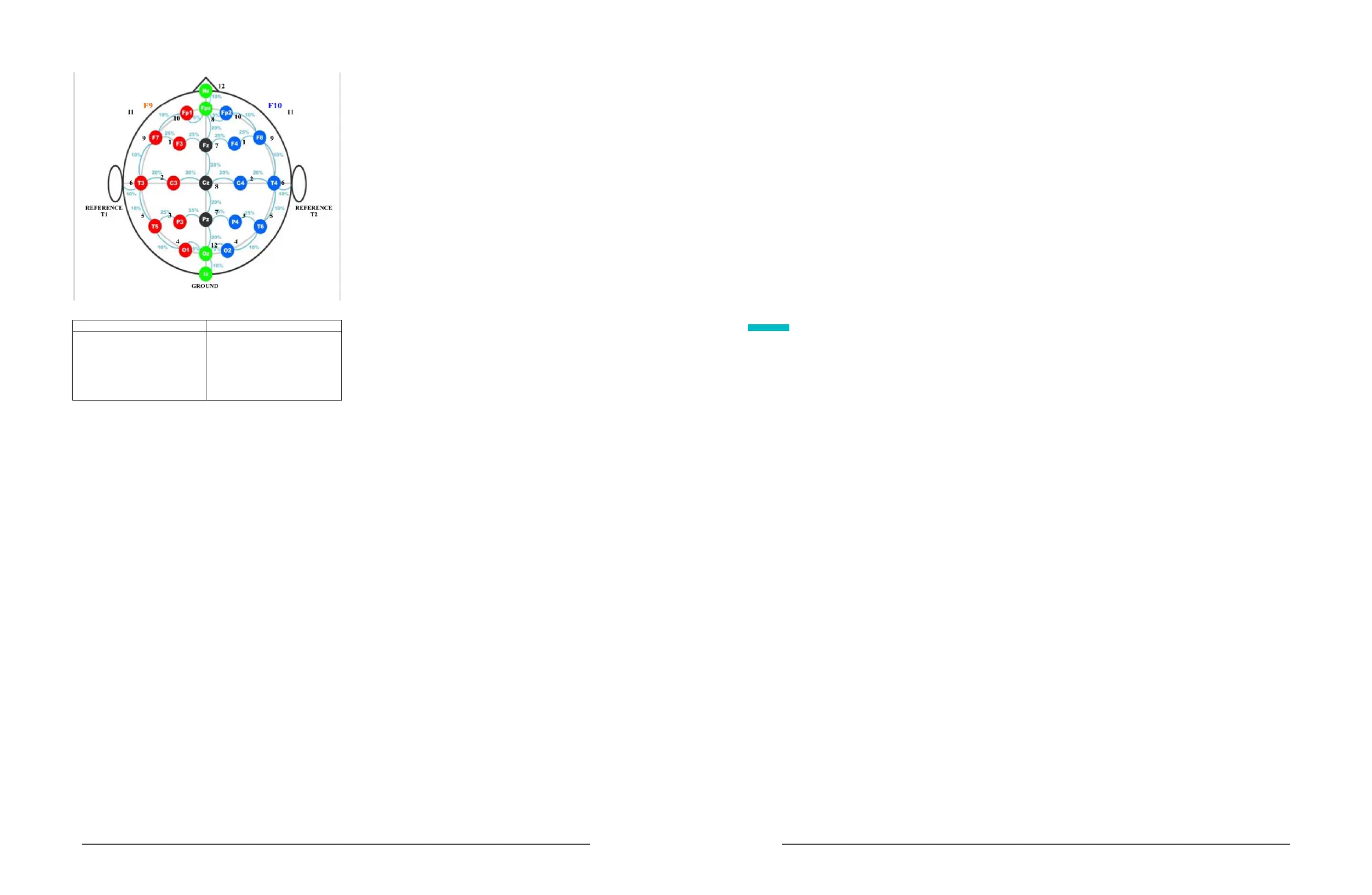
Associated Site Behaviors
(Potential)
Prefrontal and Frontal Lobes
Behaviors and Symptoms: Oppositional defiant and an-
tisocial behaviors. Clients with excessive fear resulting
from trauma, anxiety and neglect. Dysfunction dem-
onstrates as irresponsible behavior, lack of appropriate
affect, euphoria in some and incorrect expectation in
others. Look for clients appearing to be in a fog, unable
to concentrate. They get into trouble in school or with
community authorities, have diculty with ethical or
moral issues, lack empathy and/or social skills. Have dif-
ficulty completing administrative tasks; unmotivated,
disconnected, negative, depressed or anxious.
Sensory Motor Cortex
Behaviors and Symptoms: Stroke, epilepsy, paralysis,
ADHD, and disorders of sensory motor integration.
Clients have diculty seeing the logical sequence of
cognitive tasks.
Temporal Lobes
Behaviors and Symptoms: Diculties keeping up a con-
versation, episodic memory loss for functional tasks like
paying the bills and misplacing keys or glasses; possibly
angry or aggressive behavior; anxiety or panic displays.
Parietal Lobes
Behaviors and Symptoms: Clients may have diculty
seeing both sides of the visual field. This may mean
more car accidents, diculty playing computer games,
drawing complete pictures and following directions;
failure to recognize a simple tune or a friend’s face; gets
lost easily.
Occipital Lobes
Behaviors and symptoms: Diculty with visual memo-
ries and accurate reading; inability to perceive and draw
complete objects or to see multiple objects at the same
time. Possible problems with the physical act of writing,
cannot trace the outline of an object; diculty coloring
and with other visual spatial activities.
Deeper Brain Structures
and Their Functions
Limbic System
Sets the emotional tone; controls motivations and drive;
holds emotional memories.
Hypothalamus
Primarily manages homeostasis. Regulates hunger,
thirst, pain response, pleasure, sex drive and the Periph-
eral Nervous System.
Amygdala
Provides emotional affect to language, intonation and
sound of voice, and evaluates fear and sadness. Dysfunc-
tion displays as social disinhibition.
Hippocampus (beneath the temporal lobes)
Short- and long-term auditory and visual memory (LH).
Sound-voice intonation memory, and spatial-facial
memory (RH).
Septal Nucleus
Acts in conjunction with the hypothalamus and hip-
pocampus to regulate internal inhibition and to quiet
arousal and Limbic System function.
Cingulate Gyrus (FPZ, FZ, CZ, PZ)
Controls the ability to shift attention from one subject
to another and to adapt to changing circumstances;
manifests cooperative behavior in a social context.
Anterior Cingulate Gyrus
Helps oversee motivation, the social self and personality;
facilitates mental flexibility, attention and cooperation.
Posterior Cingulate Gyrus
Shares in the memory-making process, provides orien-
tation in space and eye and sensory monitoring.
Left Hemisphere of the Brain Right Hemisphere of the Brain
• Analyzes
• Thinks sequentially
• Thinks linguistically
• Thinks logically
• Synthesizes
• Thinks spatially and holistically
• Perceives, comprehends and
expresses visual and auditory social cues
• Experience and express emotion
Thank you from the bottom of my heart to these
individuals without whom IASIS would not exist:
Acknowledgments
Thalamus
Connects sensory organs to areas of primary sensory
processing. Sets the overall tone or excitation level for
the entire cerebral cortex.
Reticular Activating System
This is the center of the brain; it’s hypothesized that
this is the brain’s center for motivation and the key to
“turning on the brain.”
Gamma Brainwaves
Assist the brain in processing and binding information
from different areas of the brain
• Laura Bruder, IASIS Co-founder
• Ruby Bruder
• Skyler Bruder
• Harriett Ta, ICP
• Greg Gillispie, ICP
• Bob Rosen, MD, ICP
• David Carrasquillo, ICP
• Miche LaMarche, L.Ac., ICP
• eresa Horab, RN, ICP
• Susan Rohr, RN, ICP
• Linda Edwards, RN, ICP
• Carol Oliveira, ICP
• Frank Shallenberger, MD
• Jennifer McCallum, PhD, JD, ICP
• Mingxiong Huang, PhD
• Roland Lee, MD, ICP
• Annemarie Angeles, ICP
• Ashley Robb ICP
• David Dubin, MD
• Charles Adams, MD
• Julie Onton, PhD.
• Phil Sukel, DDS, ICP
• Rich Fisher, DDS, ICP
• Mahdis Keshavarz
• Shaahin Cheyenne
• Coleen Fisher, ICP
• Diana Durnell
• Steven Cavallero
• Gil Jansky
• Sean Pakbaz, MD, ICP
• Hugh Bruder, ICP
• Bob Levitan
• Rajean Moseley-LaRue, PA-C
• Dietrich Klinghart, MD
• Debbie Floyd
• Larry & Debbie Wedekind, ICP’s
• Ryan McWhorter, MD
• Wally Taylor, MD
• Greg Evans, LPC
• Beau Armistead, LPC
• Heather Parker, LPC
• Hugh Bruder, ICT, ICP
• Dudley Chewning, LPC
• Gloria Duke, RN, ICP, Research
• Gary Duke, LPC, ICP, Research
Barry Bruder
IASIS Chief Operating Ocer and co-founder


 To Next Page
 Loading...