11.9.22 357-00049-04 Rev A © Inovonics, 2022 - www.inovonics.com
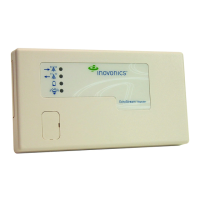
EN5040/EN5040-T/EN5040-20T High Power
Repeater with Transformer
Installation and Operation Manual
1 Overview
The Inovonics high power repeater receives, decodes and retransmits
signals at enhanced power from Inovonics devices. It acts as a range
expander for any valid Inovonics transmission, including signals from other
high power repeaters. High power repeaters can be layered as necessary,
allowing Inovonics systems to scale from small commercial sites to
complete campuses consisting of several buildings. The high power
repeater features AC power loss and jam detection, as well as case tamper
and wall tamper detection. Input power is provided by listed UL1310 class 2
transformer, MPI-NEO Co., Ltd. W48A-J1000-2T.
Note: For UL 2560 installations, refer to the EN6080 Area Control Gateway
Installation Instructions or the EN6040-T Network Coordinator Installation
Instructions; for other UL installations, refer to the EN4216MR Installation
and Operation Manual, the EN4232MR Installation and Operation Manual,
or the EN7290 Installation Instructions.
1.1 Maximum Number of Repeaters for a UL 2560
Installation
To achieve the 99.99% alarm message reliability required for UL 2560
compliance, system installations must operate within the following limits for
end device and repeater counts.
1.2 Installing an Inovonics Security System
An EchoStream survey kit must be used to establish a UL system. The
EchoStream survey kit measures the signal strength of high-power
repeater and sensor messages to help optimize your EchoStream system.
Figure 1 Sample EchoStream system
The EchoStream survey kit provides you with two signal strength
measurements: signal level and signal margin.
Signal level
The signal level is the measurement of the overall decibel level of the
message.
Signal margin
The signal margin is the measurement of the decibel level of the message,
minus the decibel level of any interfering signals. Inovonics Wireless
equipment should be placed within a facility such that all end-devices
produce signal margin readings of at least 4 decibels.
Both the signal level and signal margin are measured in decibels. Because
signal strength and signal margin are measured on a logarithmic scale, the
difference between a decibel level of 3 (Weak) and a decibel level of 4
(Good) is a much larger difference than it would be on a linear scale.
Note: For more information about the EchoStream survey kit, see the
EN7016SK EchoStream™ Survey Kit Installation and Operation Manual or
the EN7017 Survey Kit and App Installation and Site Survey Instructions.
Caution: The EchoStream system should be tested regularly to ensure
operation. To test: place the system in test mode, activate an end device,
and ensure an appropriate response.
1.3 RF Signal Propagation
While wood, drywall and glass usually let the RF signals pass, some
materials may inhibit or attenuate radio frequency (RF) signal propagation
by blocking, reflecting, deflecting or absorbing RF signals.
Consider anything between transmitters and repeaters and/or the receiver.
Is there concrete and steel construction? Are there earthen berms or hills?
Are there a lot of trees? Devices should be mounted such that they are
least affected by these elements.
For best results, transmitters and repeaters should be mounted at the
optimal height to achieve line of sight to repeaters and/or the receiver.
Usually this means they will be mounted as high as possible.
Following are some typical obstacles to RF signal propagation:
End Devices Maximum
Repeaters
150 397
250 386
350 375
500 360
1000 313
2000 238
3000 184
Material Affect Recommendation
Metal construction, including
ductwork; pipes; studs;
stucco, plaster or concrete
with wire mesh; satellite
dishes, metal-lined rooms
such as walk-in coolers or
freezers; metal siding, safes,
etc.
Can reflect, absorb
and/or disrupt RF
signals.
Perform a site survey
using an Inovonics
wireless survey kit to
verify the RF signal is
acceptable, and, when
necessary, to determine
where to locate
repeaters.
Completely enclosed metal
boxes/enclosures.
Can restrict RF
signals.
Solar panels, cinder block
walls, windows with built-in
solar tinting.
Can absorb and/or
reflect RF signals.
Vegetation. Can attenuate RF
signals. The RF
environment can
alter as trees shed
or sprout leaves.
Add repeaters as issues
arise.
Automobile and truck traffic. Can disrupt RF
signals.
Mount Inovonics devices
at a height sufficient to
achieve line of sight
above traffic.


 To Next Page
 Need help?
 General