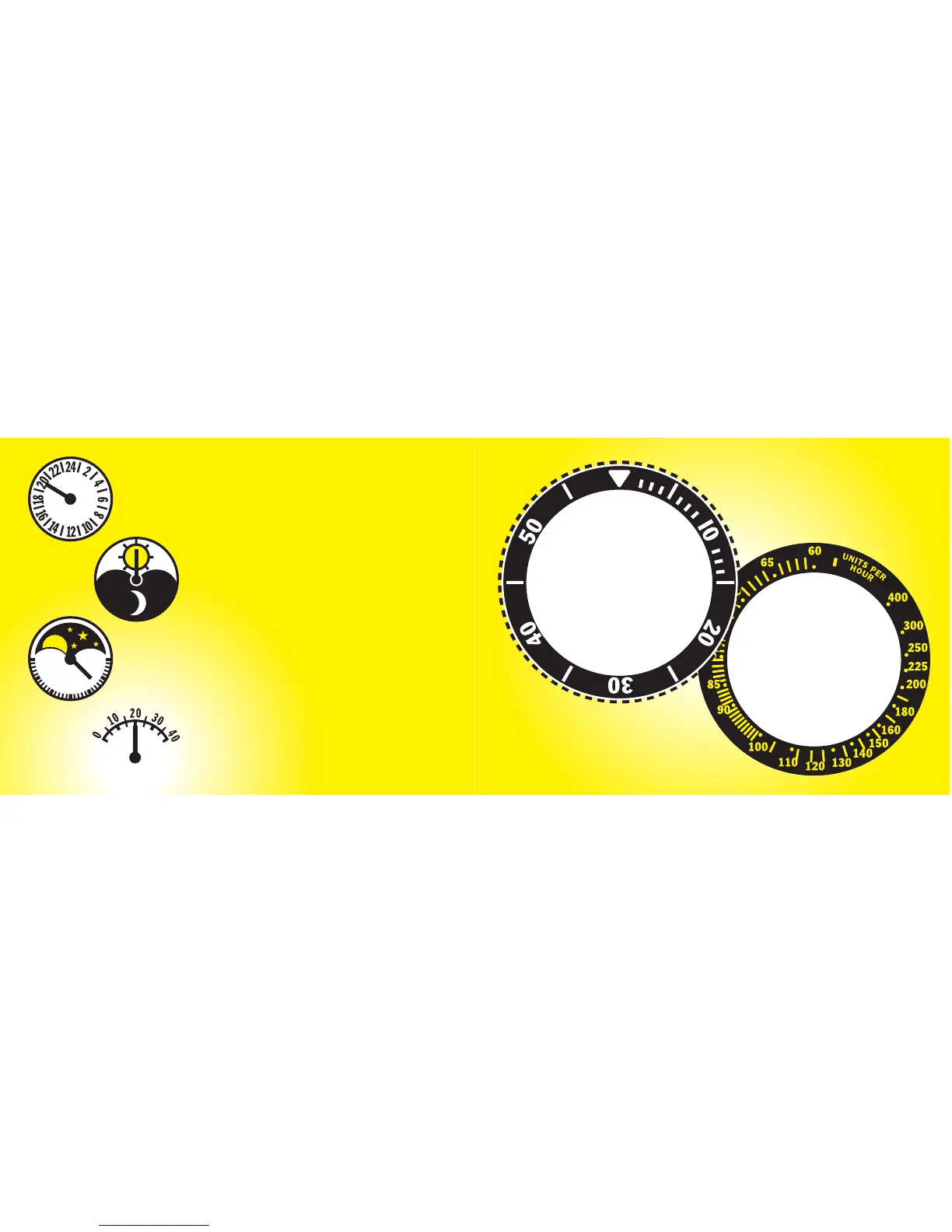
24-Hour: often called a GMT or second time zone indicator, the
hand of this counter makes a full rotation in a 24-hour period,
thereby also indicating whether it is a.m. or p.m. It is often coupled
with a Sun/Moon display.
Sun/Moon: indicates a.m. or p.m. through the dis-
play of the sun or moon. It is often coupled with a
24-hour indicator.
Moonphase: often combined with other calendar-related features,
this display assures near perfect synchronization with the lunation
period, and only needs adjusting every two and a half years should
the watch never stop in that time.
Power Reserve: found on automatic watches, this
zone displays the hours of autonomy remaining of a
movement after it has reached its winding peak.
WHAT DOES THIS INDICATE?
6 7
Diver’s Scale:
mainly found on the
turning bezel of a diver
watch, it allows a diver to
preset the time submerged in
minutes. It is sometimes found
beneath the watch crystal,
and can be turned by a
pusher at the 9 o’clock
position.
Tachymeter:
also called a ta-
chometer, it allows for the
wearer to measure the speed
at which he/she travels over a
given distance. It is frequently
used to determine the speed
of a car over a measured
distance.


 To Next Page
 Loading...