Need help?
Do you have a question about the JAMO Studio S 626 and is the answer not in the manual?
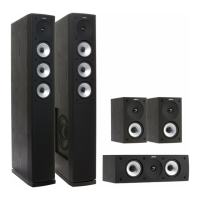
This document provides a comprehensive guide for the Jamo Studio 500 / 600 Series speakers, covering their placement, setup, system connection, and care. The series includes models such as S 628, S 626, S 526, S 622, S 522, S 62 CEN, and S 52 CEN, designed for various audio configurations, from stereo setups to multi-channel home cinema systems.
The manual begins with crucial safety instructions, emphasizing the importance of reading, keeping, and heeding all warnings and instructions. Users are advised not to use the apparatus near water, to clean it only with a dry cloth, and to avoid blocking any ventilation openings. Installation should always be in accordance with the manufacturer's instructions, away from heat sources like radiators, heat registers, stoves, or other heat-producing apparatus, including amplifiers. Only attachments and accessories specified by the manufacturer should be used. When using a cart, stand, tripod, bracket, or table, caution is advised during movement to prevent tip-over injuries. The apparatus should not be exposed to dripping or splashing liquids, and no liquid-filled objects, such as vases, should be placed on it.
Important safety symbols are explained: an exclamation point within an equilateral triangle alerts the user to important operating and maintenance instructions, while a lightning flash with an arrowhead symbol indicates the presence of uninsulated "dangerous voltage" that could pose a risk of electrical shock. Users are warned against exposing the apparatus to rain or moisture to reduce the risk of fire or electrical shock. Additionally, no naked flame sources, such as candles, should be placed on the product. A "CAUTION: RISK OF ELECTRIC SHOCK. DO NOT OPEN." warning is prominently displayed, advising that the equipment contains hazardous voltages and no user-serviceable parts inside, directing all servicing to qualified personnel.
The product is compliant with EU regulations, bearing the CE mark and conforming to European Union EMC Directive 2004/108/EC. A WEEE notice indicates that the appliance is labeled in accordance with European Directive 2002/96/EC, meaning it should not be disposed of with household waste but at an appropriate facility for recovery and recycling. This mark applies only to countries within the European Union and Norway.
The manual provides detailed diagrams for optimal speaker placement depending on the model and desired audio setup. For S 628 / S 626 / S 526 models in a stereo configuration, the speakers should be placed at least 2 meters (6 feet) from the listening position, forming an equilateral triangle for the best soundstage. The diagrams illustrate the speakers positioned on either side of a television, with the listener centrally located. For S 622 / S 522 models, which are typically bookshelf or satellite speakers, the placement also suggests a minimum distance of 2 meters (6 feet) from the listener, often on a stand or shelf. For center channel speakers like S 62 CEN / S 52 CEN, the placement is directly below or above the television, ensuring clear dialogue and central sound imaging. For home cinema systems (S 628 HCS / S 626 HCS / S 526 HCS), a more complex arrangement is shown, including front, center, and surround speakers. The front speakers (S 628, S 626) are placed at least 2 meters (6 feet) from the listening position, angled slightly inward (20 degrees). The center speaker is positioned centrally, and surround speakers (S 622, S 522) are placed to the sides or slightly behind the listening area. A table summarizes which speaker models are suitable for front, center, and surround positions within these home cinema setups.
The setup section details how to prepare the speaker wires and connect them to the speakers and amplifier. Speaker wire preparation involves stripping approximately 10mm (0.5 inches) of insulation from the ends of the wire. The connection process is illustrated with diagrams:
This section illustrates various wiring configurations for different speaker setups. Setup A - Single Wiring (S 628 / S 626 / S 526): This is the standard connection method where a single pair of speaker wires connects each speaker to the amplifier. The diagrams show the amplifier connected to the left and right speakers, ensuring correct polarity. Setup B - Bi-wiring (S 628 / S 626 / S 526): This advanced connection method uses two pairs of speaker wires for each speaker, separating the high-frequency and low-frequency signals. This typically involves removing the jumper bars on the speaker terminals and connecting one pair of wires to the high-frequency terminals and another to the low-frequency terminals, both originating from the same amplifier channel. Full System Connection (4 System Connection): A comprehensive diagram shows how to connect a complete 5.1 home cinema system.
The care section provides simple guidelines for maintaining the speakers.
For floorstanding models, the manual includes instructions for attaching the plinth (base) and spikes.
The manual concludes with contact information for Jamo Corporate Office, a wholly-owned subsidiary of VOXX International Corporation, and notes that Jamo is a registered trademark of Klipsch Group, Inc., with products engineered by Klipsch Group, Inc., USA, and manufactured in China.
 General
| Brand | JAMO |
|---|---|
| Model | Studio S 626 |
| Category | Stereo System |
| Language | English |

 To Next Page