21
OPERATION - TIG
Before starng any welding acvity ensure that you have suitable eye protecon and
protecve clothing. Also take the necessary steps to protect any persons within the welding
area.
TIG welding mode
Terms used: TIG – Tungsten Inert Gas, GTAW – Gas Tungsten Arc Welding.
TIG welding is an arc welding process that uses a non-consumable
tungsten electrode to produce the heat for welding.
The weld area is protected from atmospheric contaminaon by a
shielding gas (usually an inert gas such as argon or helium) and a
ller rod matching the base material is normally used, though
some welds, known as autogenous welds, are carried out without
the need for ller wire.
TIG process can be either DC or AC modes:
DC - Direct current for welding steel, stainless steel, copper etc.
AC - Alternang current for welding aluminium and it’s alloys.
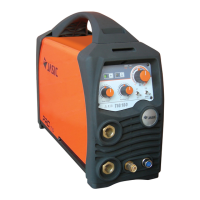
Connect the TIG torch connector to the “-” quick
socket on the machine panel and ghten it clockwise.
Connect the switch plug on the TIG torch to the
corresponding socket on the machine panel, this is a
quick connector so it is not necessary to turn the plug.
Insert the quick plug on the work return cable into the
“+” quick socket on the machine panel and ghten it
clockwise. Clamp the work clamp to the work piece.
Connect the gas hose of the TIG torch to the quick connector on the machine front.
Connect the gas hose to the gas inlet on the back panel of the machine. The other end of the supply hose
connects to the gas regulator on the cylinder.
Press the torch trigger briey, the solenoid valve will operate and gas will ow.
Adjust the welding current according to the thickness of the work piece to be welded (for a guide to
welding parameters, please refer to the table below).
Hold the torch 2-4mm away from the work piece and then press the torch trigger. Aer arc is ignited, the
HF discharge will cease, the current will
maintain the pre-set value and welding can
be carried out.
Aer releasing the torch trigger, the welding
arc stops but gas connues owing for the
post ow me and welding ends.
The amperage guide for TIG welding
tungsten sizes can vary depending on
material, work piece thickness, welding
posion and joint form.
Tungsten Size DC – Electrode Negave
1.0mm 15 – 80A
1.6mm 70 – 150A
2.4mm 150 – 250A
3.2mm 250A – 400A
4.0mm 400A – 500A
6.0mm 750A – 1000A



 To Next Page
 Loading...