40
GB
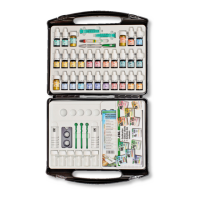
Nitrate Test Set (NO
3
)
Special features:
The JBL nitrate test set NO
3
is for the measurement and routine control of the nitrate content in saltwater and
freshwater as well as in garden ponds within the range 1-240 mg/l (ppm). Using the compensation method
specially developed by JBL, precise and reliable results can be obtained even in moderately discoloured
aquarium water, e.g. as a result of peat lters and disease treatment.
Why test?
The following applies to freshwater and saltwater as well as to garden ponds:
The process involved in the breakdown or the mineralization of organic matter in the water (feed and plant
debris, sh excrement) follows these stages: proteins - ammonium - nitrite - nitrate.
Certain bacteria are responsible for this process. Measuring the intermediate stages ammonium, nitrite and
nitrate allows certain conclusions to be made about the “function” of the system “aquarium” or the system
“pond”. Normally, ammonium and nitrite should not be allowed to enrich above concentrations of 0.2 mg/l (ppm).
If they do, the bacterial balance may be disturbed.
A continuous increase in the nitrate content, especially in the aquarium, accompanied by a low or undetectable
ammonium and nitrite content, is characteristic of a well-functioning bacteria balance but indicates at the same
time a insufcient balance in the aquarium (too many sh, not enough nitrate-consuming plants, too few water
changes).In garden ponds this often happens with highly populated koi ponds without ground-covering material
and marshy area, which works as a plant based purication system.
In heavily planted aquariums without sh or with only a few small sh the opposite may occur: Nitrate becomes
a deciency and needs dosed additions for the plants to thrive and grow. This is especially the case with so-
called aquascaping, a specialized trend to create underwater landscapes in the aquatic eld.
If phosphate is present in the water in addition to nitrate, levels of nitrate which are too high promote the growth
of unwanted algae. This is why the nitrate content of the water should be kept below 30 mg/l (ppm) in freshwater
and 20 mg/l (ppm) in saltwater. In garden ponds the nitrate level should not exceed 10 mg/l and ideally it
should not be measurable. In ponds which have not been correctly planned, nitrates from fertilisers used on the
surrounding area can often seep into the pond.
Remedy:
Levels too high:
Aquarium:
Regular partial changes of water, lter with JBL NitratEx (for freshwater only), or JBL BioNitrat Ex.
Garden pond:
When laying out a pond, sufcient gravel should be used on the ground as a substrate for plants which consume
nitrates and bacteria which breakdown nitrates. Select more nitrate-consuming plants. Plant marshy areas with
nitrate-consuming plants (particularly in koi ponds without ground-covering material).
Levels too low:
Aquarium:
Add a dose of: JBL ProScape NPK Macroelements or JBL ProScape N Macrelements.
Instructions:
1. Repeatedly rinse both test jars with the water to be tested.
2. Use the enclosed syringe to ll each of the test jars with 10 ml of sample water.
3. Add the reagents to one of the test jars as follows:
a) 2 large measuring spoonfuls (broad end of the enclosed double-ended spoon) of reagent 1;
b) 6 drops of reagent 2, seal and shake very vigorously* for 1 minute; (powder does not dissolve completely:
for better colour comparison, hold the test jar at an angle until the remaining powder collects on the side);
c) Allow to settle until the colouring develops fully (10 minutes).
*) For b) if the mixture is not shaken long enough or vigorously enough, the test results may be too low.
4. Place both test jars into the comparator block: the jar with added reagent into the smooth end of the comparator
block, the jar with the untreated test water (blank sample) into the notched end of the comparator block.
5. Move the comparator block together with the vessels backwards and forwards on the colour chart, with the
notched side of the block facing the scale, until the colour of the sample treated with reagent matches the
colour under the blank sample as closely as possible.
6. Read the nitrate content in the notch of the comparator block.


 To Next Page
 Loading...