There are different sizes and types of restraints
for children from newborn size to the child
almost large enough for an adult safety belt.
Children should ride rearward facing as long as
possible; this is the most protected position for a
child in the event of a crash. Always check the
child seat Owner’s Manual to make sure you
have the correct seat for your child. Carefully
read and follow all the instructions and warnings
in the child restraint Owner’s Manual and on all
the labels attached to the child restraint.
In Europe, children restraint systems are de-
fined by regulation ECE-R44, which divides
them into five weight groups:
Restraint Group Weight Group
Group 0 up to 10 kg
Group 0+ up to 13 kg
Group 1 9-18 kg
Group 2 15-25 kg
Group 3 22-36 kg
Check the label of your child restraint. All ap-
proved child restraints must include type-
approval data and the control mark on its label.
The label must be permanently secured to the
child restraint system. You should not remove
this label from the child restraint.
WARNING!
Extreme Hazard! Do not place a rear-facing
child restraint in front of an active air bag.
Refer to visor and door shut face mounted
labels for information. Deployment of the air
bag in an accident could cause fatal injuries
to the baby regardless of the severity of the
collision. It is advisable to always carry chil-
dren in a child restraint system on the rear
seat, which is the most protected position in
the event of a collision.
WARNING!
Should it be necessary to carry a child on the
passenger side front seat in a rear-facing
child restraint system, the passenger side
front airbag and side bag (for versions/
markets, where provided) must be deacti-
vated through the Setup menu. Deactivation
should be verified by checking whether the
warning light is switched on in the instrument
panel. The passenger seat must also be
positioned backward as far as possible to
avoid the child restraint system from coming
into contact with the dashboard.
“Universal” Child Restraint Systems
• The figures in the following sections are ex-
amples of each type of universal child re-
straint system. Typical installations are
shown. Always install your child restraint sys-
tem according to the child restraint manufac-
turer’s instructions, which must be included
with this type of restraint system.
• Child restraint systems with ISOFIX anchor-
ages are available for installing the child
restraint system to the vehicle without using
the vehicle’s seat belts.
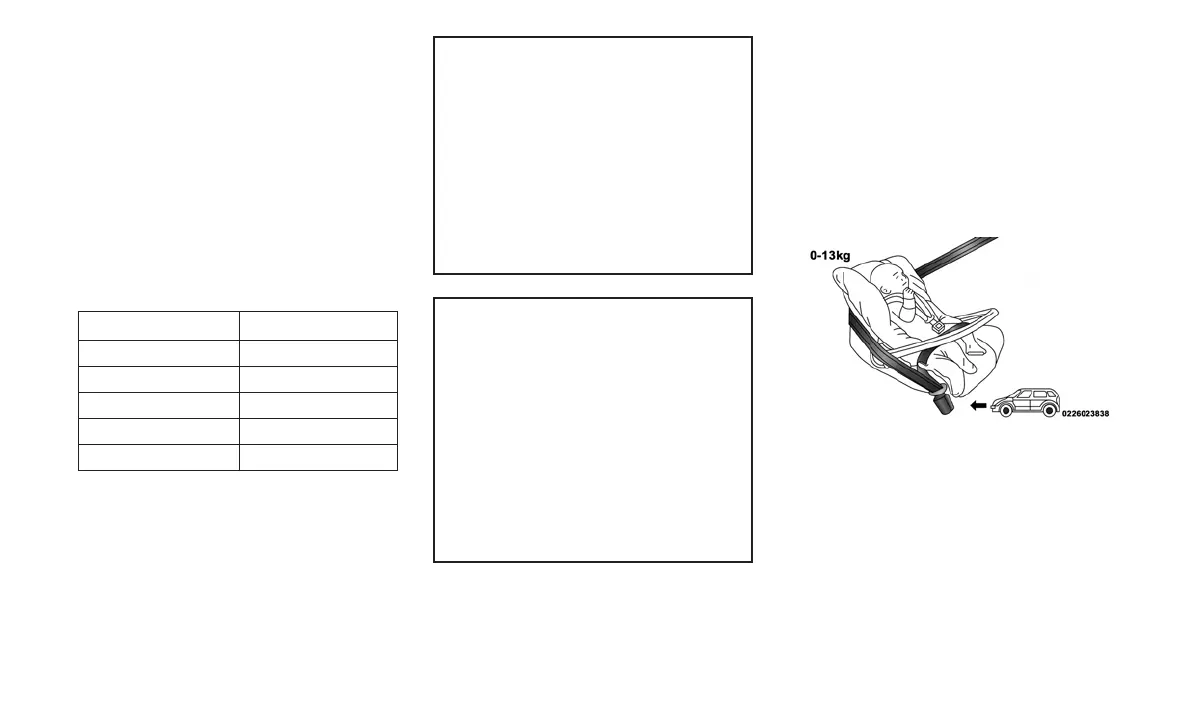
Group 0 And 0+
Safety experts recommend that children ride
rearward facing in the vehicle as long as pos-
sible. Infants up to 13 kg must be restrained in a
rear-facing seat like the child seat shown in fig.
A. This type of child restraint supports the child’s
head and does not induce stress on the neck in
the event of sudden decelerations or a crash.
Fig. A
126












 To Next Page