WARNING!
(Continued)
• Do not place anything on the seat or seat-
back that insulates against heat, such as a
blanket or cushion. This may cause the
seat heater to overheat. Sitting in a seat
that has been overheated could cause
serious burns due to the increased surface
temperature of the seat.
60/40 Split Folding Rear Seat With
Fold-Flat Feature
To provide additional storage area, each rear
seat can be folded flat. This allows for extended
cargo space and still maintains some rear seat-
ing room.
NOTE:
Prior to folding the rear seat, it may be neces-
sary to position the front seat to its mid-track
position. Also, be sure that the front seats are
fully upright and positioned forward. This will
allow the rear seat to fold down easily.
WARNING!
• It is extremely dangerous to ride in a cargo
area, inside or outside of a vehicle. In a
collision, people riding in these areas are
more likely to be seriously injured or killed.
(Continued)
WARNING!
(Continued)
• Do not allow people to ride in any area of
your vehicle that is not equipped with seats
and seat belts.
• Be sure everyone in your vehicle is in a
seat and using a seat belt properly.
To Lower The Rear Seat
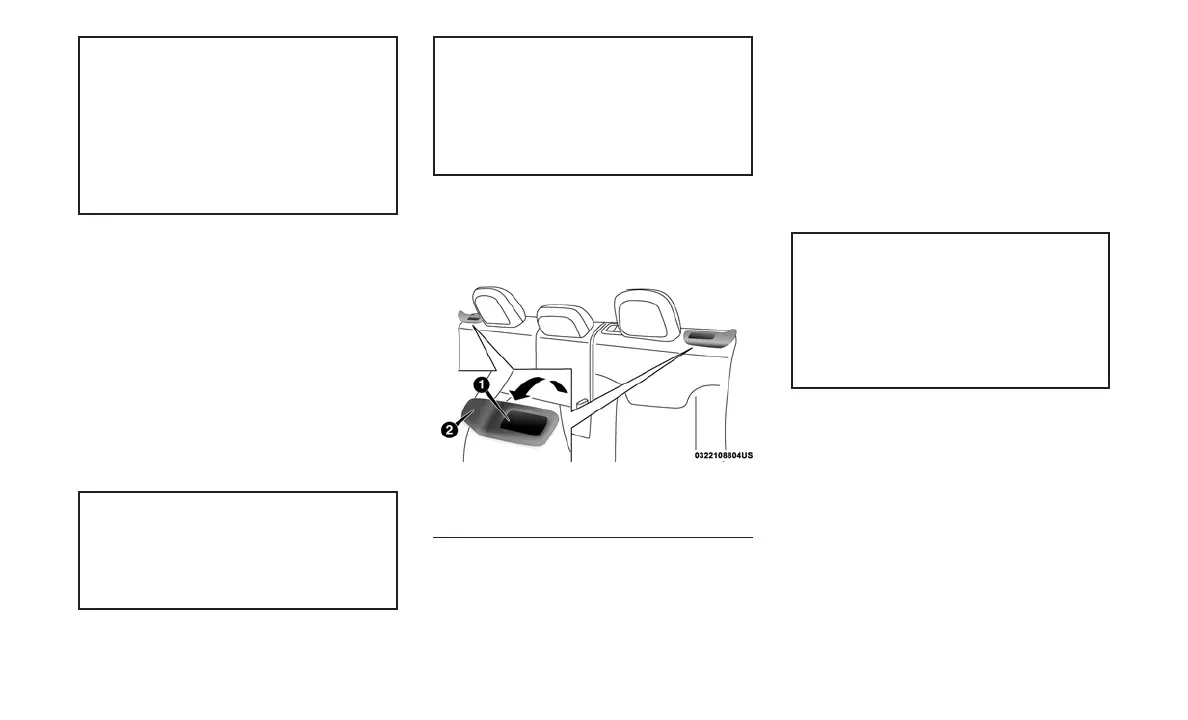
1. Pull the seatback release lever located on
either side of the upper outer edge of the
seat.
2. Fold that side of the rear seatback com-
pletely forward.
To Raise The Rear Seat
NOTE:
If interference from the cargo area prevents the
seatback from fully locking, you will have diffi-
culty returning the seat to its proper position.
Raise the seatback and lock it into place.
The release lever will show a red indicator while
in the unlocked position. Once the seat is locked
in, the red indicator will no longer be visible.
WARNING!
Be certain that the seatback is securely
locked into position. If the seatback is not
securely locked into position the seat will not
provide the proper stability for child seats
and/or passengers. An improperly latched
seat could cause serious injury.
HEAD RESTRAINTS
Head restraints are designed to reduce the risk
of injury by restricting head movement in the
event of a rear impact. Head restraints should
be adjusted so that the top of the head restraint
is located above the top of your ear.
Rear Seat Release Lever
1 — Seatback Release Levers
2 — Seat Belt Guide
32









 To Next Page