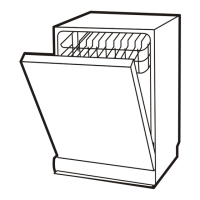
This document provides the user manual for the Jeken JLVFS14S-11 dishwasher, a 14-place setting appliance designed for household use.
Function Description
The Jeken JLVFS14S-11 is an automatic dishwasher designed to clean dishes and utensils. It features a control panel with various buttons and indicators for power, dual-zone washing (Alt), delayed start, child lock, program selection, function selection, and start/pause. The dishwasher offers several wash programs including Auto, Intensive, Standard, ECO, Glass, 90 mins, Rapid, and Pre-wash, catering to different levels of soiling and washing needs. It also includes an "Auto Open" feature where the door automatically opens at the end of the program to enhance drying results.
Important Technical Specifications
- Model: JLVFS14S-11
- Capacity: 14 place settings
- Dimensions (H x W x D1/D2): 845mm x 598mm x 600mm (door closed) / 1175mm (door opened 90°)
- Maximum Inlet Water Pressure: 1 MPa
- Minimum Inlet Water Pressure: 0.04 MPa
- Energy Efficiency Class (EEI): C (43.9)
- Cleaning Performance Index: 1.125
- Drying Performance Index: 1.065
- Energy Consumption (ECO program): 0.747 kWh/cycle
- Water Consumption (ECO program): 9.8 litres/cycle
- Program Duration (ECO program): 3:18 (h:min)
- Airborne Acoustical Noise Emissions: 42 dB(A) re 1 pW
- Airborne Acoustical Noise Emission Class: B
- Off-mode Power (W): -
- Standby Mode Power (W): 0.49
- Delay Start Power (W): 1.00
- Networked Standby Power (W): -
- Warranty: 24 months
Usage Features
Control Panel and Programs:
The dishwasher's control panel allows users to select from a variety of programs:
- Auto: For lightly, normally, or heavily soiled crockery, with or without dried-on food.
- Intensive: For very dirty dishes, pots, pans, and plates with dried-on food.
- Standard: For normally soiled loads like pots, plates, glasses, and lightly soiled pans.
- ECO: The standard program for normally soiled loads, optimized for combined energy and water consumption.
- Glass: For lightly soiled crockery and glass.
- 90 min: For normally soiled loads requiring a quick wash.
- Rapid: A shorter wash for lightly soiled loads that do not need drying.
- Pre-wash (Soak): To rinse dishes for later washing.
Functions:
- Alt (Dual Zone Wash): Allows selection of either the upper or lower basket for washing, optimizing water and energy use when the dishwasher is not fully loaded.
- Delay: Delays the start of a wash cycle by up to 24 hours.
- Child Lock: Locks control panel buttons (except Power) to prevent accidental operation. Activated by pressing Alt + Delay simultaneously for 3 seconds.
- Power Wash: For very dirty, hard-to-clean dishes (available with Intensive, Universal, ECO, Glass, 90 min modes).
- Turbo Speed+: Reduces program time (available with Intensive, Universal, ECO, Glass, 90 min modes).
- Auto Open: Automatically opens the door at the end of the program for improved drying.
Water Softener and Salt:
The dishwasher is equipped with a water softener to remove minerals from hard water, preventing deposits on dishes. Users must manually adjust salt consumption based on local water hardness and refill the salt container when the "Salt" indicator lights up. Special dishwasher salt must be used, and a short wash program should be run immediately after refilling to prevent corrosion.
Rinse Aid:
Rinse aid is dispensed during the final rinse to prevent water spots and streaks, and to improve drying. The "Rinse Aid" indicator signals when a refill is needed. The consumption level of rinse aid can be adjusted by the user.
Detergent Dispenser:
The dispenser has a larger cavity for the main wash and a smaller one for pre-wash. Only detergent specifically designed for dishwashers should be used.
Loading Baskets:
- Upper Basket: Designed for delicate and lighter items like glasses, cups, small bowls, and shallow pans. It can be adjusted in height to accommodate larger items in either basket.
- Lower Basket: For larger and harder-to-clean items such as pots, pans, lids, and serving dishes.
- Cutlery Basket: Cutlery should be placed separately, with sharp points facing down or horizontally, to ensure proper cleaning and prevent damage. The cutlery basket can be configured in three positions for flexibility.
Energy Saving Tips:
- Avoid manual pre-rinsing of dishes.
- Washing full loads (up to 14 place settings) saves energy and water.
- The ECO program is the most efficient in terms of combined energy and water consumption.
Changing a Program Mid-cycle:
A program can be changed if it has only been running for a short period. Otherwise, the dishwasher needs to be reset and the detergent dispenser refilled.
Adding a Forgotten Dish:
Dishes can be added before the detergent dispenser opens by pausing the cycle, waiting for spray arms to stop, opening the door, adding items, closing the door, and resuming the cycle.
Maintenance Features
External Care:
- Door and Door Seal: Regularly clean with a soft, damp cloth to remove food residues.
- Control Panel: Wipe with a soft, damp cloth only. Avoid spray cleaners or abrasive materials.
Internal Care:
- Filtering System: Regularly check and clean the coarse, main, and fine filters located at the base of the wash cabinet to prevent blockages.
- Spray Arms: Clean regularly to prevent hard water chemicals from clogging jets and bearings. Remove by rotating counter-clockwise (upper arm) or pulling upward (lower arm), then wash with soapy water and a soft brush.
Caring for the Dishwasher:
- Frost Precaution (Winter): Cut off electrical power and water supply, disconnect and drain the water inlet pipe, and remove water from the sump using a sponge.
- After Every Wash: Turn off water supply and leave the door slightly open to prevent moisture and odors.
- Remove the Plug: Always unplug before cleaning or maintenance.
- No Solvents or Abrasive Cleaning: Use only warm soapy water for exterior and rubber parts. For interior stains, use water with a little vinegar or a specialized dishwasher cleaning product.
- When Not in Use for a Long Time: Run an empty wash cycle, unplug, turn off water supply, and leave the door slightly open to preserve door seals and prevent odors.
- Moving the Appliance: Keep in a vertical position if possible; if necessary, it can be positioned on its back.
- Seals: Periodically clean door seals with a damp sponge to prevent odor formation from trapped food.
Troubleshooting Tips:
The manual provides a detailed troubleshooting guide for common issues such as the dishwasher not starting, water not draining, foam in the dishwasher, stained interior, white film on surfaces, rust stains on cutlery, knocking noises, and dishes not being clean or dry. It advises users to check simple solutions before calling for service.
Error Codes:
The dishwasher displays error codes (E1, E3, E4, E8, Ec, Ed) to indicate malfunctions, with corresponding descriptions and possible causes (e.g., water inlet issues, heating element malfunction, overflow, distribution valve errors, control system failures, communication failures). Users are warned to turn off the main water supply in case of overflow and to seek professional assistance for unresolved error codes.
Availability of Spare Parts:
Essential spare parts are available through after-sales service for a minimum of 10 years after the last unit of the model is placed on the market. This includes motors, pumps, heaters, hoses, valves, filters, structural parts, door assemblies, circuit boards, electronic displays, and sensors. Door hinges, seals, spray arms, drain filters, interior racks, and plastic peripherals are available for 10 years.

 Need help?
 General

 To Next Page