Rotating parts
Fan guards must be fitted at all times. Do not remove fan guards unless the power supply has been
isolated. If ductwork is to be fitted, requiring the wire fan guards to be removed, take alternative
safety measures to protect against the risk of injury from rotating fans.
Sharp edges
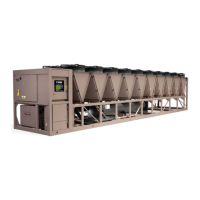
The fins on the air-cooled condenser coils have sharp metal edges. Take care and use gloves when
working in contact with the coils to avoid the risk of minor abrasions and lacerations.
Frame rails, brakes, and other components may also have sharp edges. Take care when working in
contact with any components to avoid risk of minor abrasions and lacerations.
Refrigerants and glycol
Use gloves and safety glasses when working on the unit. The buildup of refrigerant vapor, from a
leak for example, poses a risk of asphyxiation in confined or enclosed spaces and good ventilation
must be maintained.
Use the refrigerant specifically designated for the unit. Any other type of refrigerant may cause
damage to the equipment and voids the warranty.
To prevent freeze damage in chillers using glycol, the correct concentration of glycol solution that
is suitable for the site ambient conditions must always be used to fill the chiller. See the following
method to select the correct concentration of glycol for minimum local ambient conditions.
To determine the concentration, look at the local minimum ambient temperature for as many past
years that are available. You can find this history through a weather service. This is based on the
minimum ambient temperature for a buffer band of 10R (minimum) down. Use this temperature as
the freezing point of glycol according to its classification. Monitor the glycol density regularly with a
density meter to prevent problems.
The concentration, weight by volume, can be found in Table 3 for ethylene glycol (EG) and Table 4
for propylene glycol (PG). For example, if the local historical minimum ambient is 6°F (-14°C), then
the freezing point of glycol recommended should be -4°F (-20°C). The recommended concentration
is 36% for EG and 39% for PG.
CAUTION
Freeze damage due to insufficient glycol concentration is not covered by the manufacturer warranty.
CAUTION
Do not mix ethylene and propylene glycol in the same system.
CAUTION
To avoid lowering heat transfer efficiency, do not use automative-type glycol, which are formulated with
silicates that tend to gel.
13YVAM with OptiView Control Center



 To Next Page
 Loading...