EasyManua.ls Logo

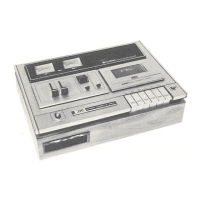
JVC NIVICO CD-1667 - User Manual

JVC NIVICO CD-1667
41 pages
Print Icon
To Next Page IconTo Next Page
Loading...
NivicoO
SERVICE
MANUAL
Fig.
1
MODEL
CD-1667
1667U
STEREO
CASSETTE
TAPE
DECK
Dimensions:
12.0
(H)
x
38
(W)
x
26.5
(D)
cm
(4-3/8"
x
14-15/16”
x
10-7/16")
Weight:
4.6
kg
(10
Ibs)
*
In
this
Service
Manual,
frequency
is
indicated
in
Hz.
*
In
this
tapedeck,
ISO
screws
are
used.
No.
4073
July,
1972
PUTTAR
TARTU
RLUCGLURORAAMAUUMERERRLUCRCGUORLUOMUCCUORALLUULLLOOR
MU
LULU
sd
po
=O
Mam
Ov
AWM
KODA
CSAIL
LUILILERALLLULTLOREEELLUULILLARLLULLLLURRLLUULLCLARLLLLULLECOOEL
LCL
Power
source:
AC
120V,
60Hz
(CD-1667)
AC
100V,
110
~
120V,
200V,
220
~
230V
(50,
60H,
)
(1667U)
Fuse
capacity:
1.8A,
0.8A
Power
consumption:
30W
(CD-1667)
15W
(1667U)
Track
system:
2-channel,
4-track
Cassette:
C-60,
C-90,
C-120
Tape
speed:
4.8cm/sec.
(1-7/8ips)
Recording
system:
AC
bias
95kHz
Erasure
system:
AC
erasure
Recording
time:
60
min.
for
double
pass
(C-60)
Fast
forward
time:
100
sec.
or
less
(C-60)
Rewinding
time:
100
sec.
or
less
(C-60)
Transistors:
20
:
IC:
4
30
~19,000Hz
(Chrome-tape)
0.7mV,
10ka
20mV
(Signal
source
80ka)
80mV,
330ka
0.5V,
5ka
1V,
3.3ka
Diodes:
17
Frequency
response:
Crosstalk:
60dB
or
more
S/N
ratio:
50dB
Total
harmonic
4%
ot
less
distortion
:
rievhuracteriste!
1590uS,
120uS
Input:
Microphone
DIN
input
AUX.
IN
Output:
DIN
LINE
OUT
Headphones
0.5mW/0.12mW,
82
FOOUVT
TTPO
ATTRA
ETT
TEA
TTT
VICTOR
COMPANY
OF
JAPAN,
CTD.
|IIMIIIIIIINNEILIIINONNILIU
NOE
ILI
HUTT
TERNI00
(TU
CCQNDIILUTIROETTHITT
=
CD-1667,
1667U
Question and Answer IconNeed help?

Do you have a question about the JVC NIVICO CD-1667 and is the answer not in the manual?

Summary

Features

Names of Main Parts

Removal and Replacement of Main Parts

Construction and Disassembly

Details on how to take apart the main unit and its components.

Electrical Circuits

Procedures for removing and replacing various electrical circuit boards.

Mechanism Parts

Removing the Motor

Step-by-step guide for removing the motor from the mechanism.

Removing the Flywheel

Instructions for detaching and removing the flywheel assembly.

Removing the Plunger

Procedure for the removal of the plunger mechanism.

Replacement and Adjustment of the Heads

Replacing the Head

Instructions for removing and installing the record/playback and erase heads.

Azimuth Adjustment

Procedure to adjust the head azimuth for optimal stereo separation and clarity.

Main Adjustments

Adjusting the Needle Deflection of the Level Meters

How to calibrate the level meter needles for accurate visual feedback.

Input Level Adjustment

Adjusting input signal levels to prevent distortion and ensure proper recording.

Recording Bias Current Adjustment

Setting the bias current for optimal tape recording performance.

Mechanism Adjustment

Adjustments related to pinch roller pressure, take-up, and rewind torque.

Auto-Ejector

Theory of Detecting the Stop of Tape

Explanation of how the auto-eject mechanism detects the end of the tape.

Theory of Control Circuit Operation

Details on the circuit operation that controls the auto-eject function.

Operation of Mechanism

How the plunger and slide bar movement control the mechanism's operations.

Symptoms causes by operation theory of this mechanism

Common issues and their causes related to the auto-eject and control circuits.

Check-ups and Adjustments

Procedures for checking and adjusting the auto-eject mechanism and related circuits.

Noise Reduction System

Theory of the ANRS circuit

Explanation of the ANRS circuit's function in reducing tape noise.

Adjusting the ANRS Circuit

Connection Diagram

1. Amplifier Circuit Board & Tape Select Circuit Board

Wiring diagram for the amplifier and tape select circuit boards.

2. ANRS Circuit Board

Wiring diagram for the ANRS circuit board.

3. Input;Output Circuit Board

Wiring diagram for the input and output circuit board.

4. Power Source Circuit Board

Wiring diagram for the power source circuit board.

5. Eject Circuit Board

Wiring diagram for the eject circuit board.

6. Oscillation Circuit Board

Wiring diagram for the oscillation circuit board.

Block Diagram

Playback System Block Diagram

Diagram illustrating the signal flow during playback operation.

Recording System Block Diagram

Diagram illustrating the signal flow during recording operation.

Trouble Shooting

Cleaning and Oiling

Appearance Parts

Circuit Board Parts

1. Amplifier Circuit Board

Component layout and voltage points for the amplifier circuit board.

2. ANRS Circuit Board

Component layout and voltage points for the ANRS circuit board.

3. Power Source Circuit Board

Component layout and voltage points for the power source circuit board.

4. Oscillation Circuit Board

Component layout and voltage points for the oscillation circuit board.

5. Eject Circuit Board

Component layout and voltage points for the eject circuit board.

6. Input;Output Circuit Board

Component layout and voltage points for the input/output circuit board.

7. Tape Select Circuit Board

Component layout for the tape select circuit board.

Electrical Parts Except Circuit Board

1. Chassis Front

Identification of electrical parts located on the front chassis assembly.

2. Chassis Rear

Identification of electrical parts located on the rear chassis assembly.

Mechanical Parts

1. Chassis

Diagram showing the main chassis assembly and its mechanical components.

2. Head Panel

Diagram illustrating the head panel assembly and its mechanical parts.

3. Chassis Rear

Diagram showing mechanical components on the chassis rear assembly.

JVC NIVICO CD-1667 Specifications

General IconGeneral
Track System4-track, 2-channel stereo
Wow and Flutter0.08% (WRMS)
Dimensions420 x 110 x 274mm
Weight5.7kg
Channels2
TypeStereo cassette deck
Heads1 x Record/Playback, 1 x Erase