Need help?
Do you have a question about the KAYO MOTO K4 and is the answer not in the manual?
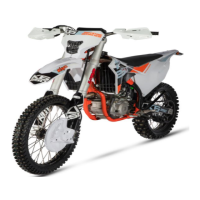
The Kayo K4 is a dirt bike designed for off-road riding, offering a blend of performance, durability, and ease of maintenance. This assembly manual provides detailed instructions for unpacking, assembling, and preparing the K4 for use, highlighting its user-friendly design and the tools required for setup.
The Kayo K4 serves as an off-road motorcycle, primarily intended for recreational riding on unpaved surfaces such as dirt tracks, trails, and motocross courses. Its robust construction and specialized components are engineered to withstand the rigors of challenging terrain, providing riders with an agile and powerful machine for adventure and sport. The bike is delivered partially assembled, requiring the user to complete several key steps to make it operational, including installing the handlebars, front fender, front wheel, and other accessories.
While the manual does not explicitly list all technical specifications such as engine displacement, horsepower, or suspension travel, it does provide crucial torque requirements for various assembly steps, which are indicative of the bike's structural integrity and performance considerations.
Torque Requirements:
Included Tools and Accessories: The manual details a comprehensive set of tools provided for assembly, including a torque wrench, needle nose pliers, various sockets (12mm, 21mm, 19mm), wrenches (No. 8-10, No. 12-14), 6mm hexagon socket, Phillips screwdriver, and No. 8 and No. 10 T-sleeves. This indicates that Kayo aims to provide users with everything necessary for initial setup, reducing the need for additional tool purchases.
Assembly Components: The manual lists specific parts to be installed, such as the accessory box, front fender, side stand, swing, bolt, nut, spacer, front wheel, handlebar foam & padding cover, cable tie, user's manual, and spark plug sleeve. These components highlight the modular design of the K4, allowing for efficient shipping and straightforward assembly.
The Kayo K4 is designed for ease of use and maintenance, even for those with limited mechanical experience, thanks to its clear assembly instructions and thoughtful design.
Out-of-Box Experience: The bike arrives in a cardboard box, secured by straps and an iron frame. The initial steps involve removing these packaging materials, which are designed to protect the bike during transit. The inclusion of an accessory box with smaller parts and a user's manual ensures that all necessary items are readily available for assembly.
Step-by-Step Assembly: The manual breaks down the assembly process into logical, numbered steps, each accompanied by illustrative images. This visual guidance is crucial for correctly identifying parts and performing tasks such as removing wire fixings, installing handlebars, attaching the front fender, and mounting the front wheel.
Handlebar Installation: A key usage feature is the precise handlebar installation process. The manual emphasizes the importance of aligning the handlebar locking clamps with a specific distance between the two ends of the mark, ensuring proper positioning and tightening to the specified torque. This detail is critical for ergonomic comfort and responsive steering.
Front Fender and Headlight Assembly: The instructions for installing the front fender and headlight bracket demonstrate a user-friendly approach. The headlight bracket is designed to be easily unscrewed, allowing for the installation of the headlight and subsequent tightening of screws, which simplifies a potentially complex electrical and mounting task.
Side Stand Installation: The manual guides the user to put the vehicle on the side stand after installing the front axle screw, indicating that the side stand is a standard feature for convenient parking and maintenance.
Fuel Tank and Seat Management: The process for removing and reinstalling the seat and adjusting the fuel tank switch is clearly outlined. This is important for accessing the battery and other internal components for maintenance or adjustments. The instruction to unscrew the fuel tank cap counter-clockwise and tighten it clockwise for adding gasoline is a standard but essential safety and operational detail.
The Kayo K4 incorporates design elements and instructions that facilitate routine maintenance and adjustments, contributing to the bike's longevity and performance.
Accessible Components: The manual's instructions for removing the seat and accessing the battery (located on the left and right sides of the seat cushion) highlight the accessibility of key electrical components. This design simplifies battery checks, charging, or replacement. The mention of red for positive and black for negative terminals is a standard safety reminder for electrical work.
Adjustable Fuel Tank Switch: The ability to adjust the fuel tank switch to the "up" position is a maintenance feature that allows for control over fuel flow, potentially useful for storage or specific operational scenarios.
User Manual Importance: The final instruction to "Please read the User's manual carefully before riding to better understand the performance of the vehicle" underscores the importance of ongoing education for optimal usage and maintenance. The user manual likely contains detailed information on routine checks, fluid levels, tire pressure, and other critical maintenance schedules.
Tool Provision: Providing a complete set of tools with the bike is a significant maintenance feature. It ensures that users have the necessary equipment for not only initial assembly but also for subsequent adjustments and minor repairs, promoting self-sufficiency in maintaining the K4.
Modular Design for Repairs: The breakdown of the bike into installable components (fenders, wheels, handlebars) suggests a modular design that could simplify future repairs or part replacements. If a specific component is damaged, it can likely be replaced without extensive disassembly of the entire bike.
In summary, the Kayo K4 is presented as an accessible and robust dirt bike, designed with the end-user in mind. Its assembly process is streamlined with clear instructions and provided tools, while its design facilitates both initial setup and ongoing maintenance, making it a practical choice for off-road enthusiasts.
 General
| Brand | KAYO MOTO |
|---|---|
| Model | K4 |
| Category | Motorcycle |
| Language | English |


 To Next Page