Driving your vehicle
1146
Special driving conditions
Special driving conditions
If driving conditions deteriorate due
to poor weather or road conditions,
you should pay even more attention
than usual to your driving.
Hazardous driving conditions
When hazardous driving conditions
are encountered such as water,
snow, ice, mud, sand, or similar haz
-
ards, follow these suggestions:
䳜 Drive cautiously and allow extra
distance f
or braking.
䳜 Avoid sudden braking or steering.
䳜 When braking with non-ABS
brakes
pump the brake pedal with
a light up-and-down motion until
the vehicle is stopped.
䳜 D
o not pump the brake pedal on a
v
ehicle equipped with ABS.
䳜 If stalled in snow, mud, or sand,
u
se the second gear. Accelerate
slowly to avoid spinning the drive
wheels.
䳜 Use
sand, rock salt, or other non
-
slip material under the drive
wheels to provide traction when
stalled in ice, snow, or mud.
Reducing the risk of a rollover
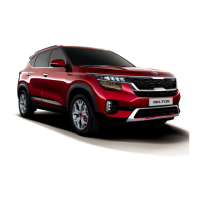
This multi-purpose passenger vehi
-
cle is defined as a Sports Utility
Vehicle (SUV). Utility vehicles have a
significantly higher rollover rate
than other types of vehicles. SUV's
have higher ground clearance and a
narrower track to make them capa
-
ble of performing in a wide variety
of offroad applications.
Specific design characteristics give
t
h
em a higher center of gravity than
ordinary vehicles. An advantage of
the higher ground clearance is a
better view of the road, which
allows you to anticipate problems.
They are not designed for cornering
at
t
he same speeds as conventional
passenger vehicles, any more than
low-slung sports vehicles are
designed to perform satisfactorily in
off-road conditions. Due to this risk,
driver and passengers are strongly
recommended to buckle their seat
belts.
In a rollover crash, an unbelted per
-
son is significantly more likely to die
than a person wearing a seat belt.
There are steps that a driver can
make to reduce the risk of a rollover.
If at all possible, avoid sharp turns
or
abr
upt maneuvers, do not load
your roof rack with heavy cargo,
and never modify your vehicle in any
way.


 To Next Page
 Loading...