Driving safety features
Special driving conditions
If driving conditions deteriorate due to poor weather or road conditions, you should
pay even more attention than usual.
Precautions
WARNING
• Your vehicle is equipped with tyres designed to provide safe ride and handling ca
pability. Do not use tyres and wheels that are different in size and type from the
originally installed ones. It can affect the safety and performance of your vehicle,
which could lead to steering failure or rollover and serious injury. When replacing
the tyres, be sure to equip all four tyres with the tyre and wheel of the same size,
type, tread, brand and load-carrying capacity.
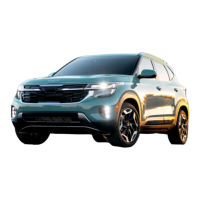
• As with other Sports Utility Vehicle (SUV), failure to operate this vehicle correctly
may result in loss of control, an accident or vehicle rollover.
◦ Utility vehicles have a significantly higher rollover rate than other types of vehicles.
◦ Specific design characteristics (higher ground clearance, narrower track, etc.) give
this vehicle a higher centre of gravity than ordinary vehicles.
◦ A SUV is not designed for cornering at the same speeds as conventional vehicles.
◦ Avoid sharp turns and abrupt manoeuvres.
◦ In a rollover crash, an unbelted person is significantly more likely to die than a per
son wearing a seat belt. Make sure everyone in the vehicle is properly buckled up.
• Do not attempt to rock the vehicle if people or objects are nearby. The vehicle may
suddenly move forward or backwards as it becomes unstuck.
• Always check the tyres for proper inflation before driving. Underinflated or overin
flated tyres can cause poor handling, loss of vehicle control, and sudden tyre fail
ure, leading to accidents, injuries, and even death. For proper tyre pressures, refer
to "Tyres and wheels" on page 827 .
• Always check the tyre tread before driving your vehicle. Worn-out tyres can result in
loss of vehicle control. Worn-out tyres should be replaced as soon as possible.
CAUTION
• Prolonged rocking may cause vehicle overheating, reduction gear damage or fail
ure, and tyre damage.
• Do not spin the wheels, especially at speeds more than 56 km/h (35 mph). Spinning
the wheels at high speeds when the vehicle is stationary could overheat and dam
age tyres, and the rotating wheels may fly away and injure bystanders.
NOTE
The Electronic Stability Control (ESC) should be turned OFF prior to rocking the vehi
cle.
471



 To Next Page
 Loading...