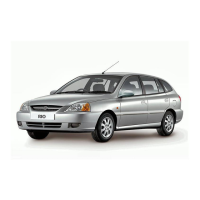
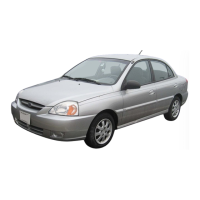
This document provides general information about a Kia vehicle, likely a Pride model from 2005 or 2006, covering identification numbers, caution labels, maintenance procedures, and technical specifications.
Identification Numbers
The vehicle identification number (VIN) is a 17-character alphanumeric code that provides specific details about the vehicle.
- Characters 1-3 (Make/Vehicle Type): KNE or KNA indicates a Kia Passenger Car.
- Characters 4-5 (Vehicle Line/Series): DE signifies the PRIDE model.
- Characters 6-7 (Body Type): 22 for a 4-Door Sedan, and 24 for a 5-Door Hatchback.
- Character 8 (Engine Type):
- 1: 1.4 Gasoline (G4EE)
- 2: 1.6 Gasoline (G4ED)
- 4: 1.5 Diesel (D4FA)
- Character 9 (Transaxle Type): This is a check digit.
- 2: 5-speed manual
- 3: Automatic
- Character 10 (Model Year): 5 for 2005, 6 for 2006.
- Character 11 (Plant Location): 6 indicates the Soha plant.
- Characters 12-17 (Sequential Number): A unique production number from 000001 to 999999.
The document also lists paint codes and their corresponding colors, such as UD (Clear White), 6C (Clear Silver), J1 (Polar Silver), J4 (Cashmere Beige), 2D (Soft Green), T5 (Sapphire), 06 (Sunset Orange), 08 (Tropical Red), 7V (Olive Gray), and 9B (Midnight Black).
Engine identification numbers provide further details:
- Character 1 (Engine Fuel): G for Gasoline.
- Character 2 (Engine Range): 4 for a 4-cycle, 4-cylinder engine.
- Character 3 (Engine Development Order): E for ALPHA Engine.
- Character 4 (Engine Capacity): D for 1,599cc, E for 1,399cc.
- Character 5 (Production Year): 5 for 2005, 6 for 2006.
- Characters 6-11 (Engine Production Sequence Number): 000001 to 999999.
Transmission identification numbers are provided for both manual and automatic transaxles.
For manual transaxles:
- Character 1 (Model): R for M5CF1, P for M5CF2.
- Character 2 (Production Year): 5 for 2005, 6 for 2006.
- Character 3 (Gear Ratio/Tooth Number): For example, 1873 indicates a differential drive gear tooth number / output shaft gear tooth number of 73/18, resulting in a ratio of 4.056.
- Character 4 (Transaxle Production Sequence Number): 000001 to 999999.
For automatic transaxles:
- Character 1 (Model): T for A4AF3.
- Character 2 (Production Year): 5 for 2005, 6 for 2006.
- Character 3 (Gear Ratio): N for 4.041.
- Character 4 (Detailed Classification): UD for 1.4 DOHC, WD for 1.6 CVVT.
- Character 5 (Spare): (Unspecified).
- Character 6 (Transaxle Production Sequence Number): 000001 to 999999.
Caution Labels and Warnings
The document highlights several warning and caution labels located throughout the vehicle, emphasizing safety and proper handling.
- Radiator Cap Caution: Indicates potential hazards associated with the radiator cap.
- Fan Caution: Warns about the cooling fan.
- Battery Caution: Advises on safe handling of the battery, including keeping flames away, wearing eye protection, ensuring ventilation, proper lifting techniques, and avoiding contact with sulfuric acid. It also warns about high voltage in the electrical ignition system.
- Airduct Warning: Specific warning related to the airduct system.
- Side Airbag Information: States that the car is equipped with a supplemental restraint system (SRS) and a side airbag system. It advises against using accessory seat covers, installing accessories near the side airbag, or applying excessive force to the seal. It also recommends servicing or replacing certain SRS elements after ten years and refers to the owner's manual for more information.
- Airbag Module Cautions:
- General Airbag Caution: Handling is limited to trained personnel, and the device should only be used in prescribed vehicles. Improper installation can make it a dangerous projectile.
- Drive Module Caution: Warns against opening, removing, or transferring the drive module to another vehicle due to risk of malfunction and bodily injury. It specifies that installation/dismantling should only be done by trained personnel and notes that the item contains an explosive igniter.
- Passenger Module Caution: Similar warnings regarding opening, removing, or transferring the passenger module, and the presence of an explosive igniter.
- Supplemental Restraint System (Airbag) Information (D): Explains that the airbag is an SRS, emphasizes wearing seat belts, describes normal SRS lamp behavior (flashes 6 times after ignition and then turns off), and lists conditions requiring system service (SRS lamp not lighting up, staying lit, flashing continuously, or airbag inflation). It also reiterates the ten-year inspection requirement by an authorized dealer.
Maintenance Features
The manual outlines general service information and best practices for vehicle maintenance.
- Protection of the Vehicle: Always cover fenders, seats, and floor areas before starting work.
- Hood Support Rod Caution: Emphasizes inserting the support rod into the designated hole to prevent the hood from falling and causing injury. It also reminds to release the rod before closing the hood and to ensure the hood is firmly latched before driving.
- Preparation of Tools and Measuring Equipment: Ensure all necessary tools and equipment are available.
- Special Tools: Use special tools when required.
- Removal of Parts: Identify the problem cause and determine necessary removal/disassembly before starting.
- Disassembly: For complex procedures, arrange all disassembled parts carefully for reassembly. Inspect each part for malfunction, deformation, or damage.
- Cleaning Parts for Reuse: Clean all reusable parts thoroughly using appropriate methods.
- Replacement: Use genuine Kia Motors parts. Always replace oil seals, gaskets, O-rings, lock washers, and cotter pins with new ones. Observe standard torques and adjustments.
- Plastic Nuts: (No specific instruction provided, but implies careful handling).
- Sealant and Oil Application: Apply sealant to gaskets and oil to moving components. Apply specified oil or grease to prescribed locations (e.g., oil seals) before assembly.
Electrical System Servicing:
- Disconnect the battery ground cable before servicing.
- Never pull on wires when disconnecting connectors.
- Ensure locking connectors click securely.
- Handle sensors and relays carefully; avoid dropping them.
- Attach wiring harnesses with clamps, allowing some slack for vibrating parts to prevent contact with surrounding components.
- Wrap sections of wiring harnesses that interfere with edges or corners to protect them from damage.
- Be careful not to pinch or damage wiring harnesses during installation.
- Remove electronic parts (computer, relays) if service operations may cause temperatures to exceed 80°C (176°F) as they are heat-sensitive.
- Ensure connectors are securely fastened to prevent problems from loose connections.
- Grip only the connector, not the wires, when disconnecting.
- Connectors with catches should click when inserted.
- When using a circuit tester, insert the test probe into the harness side, through the rubber cap if sealed, to avoid damaging insulation.
- Wiring Overload Prevention: Consider the electrical current load of optional equipment and determine appropriate wire size using the provided permissible current table (e.g., 0.3mm² AWG 22 for 5A in other areas, 5.0mm² AWG 10 for 31A in engine compartment and 54A in other areas).
Rubber Parts and Tubes: Prevent gasoline or oil from touching rubber parts or tubing.
Adjustment: Use gauges and testers to adjust parts to standard values.
Precautions for Catalytic Converter:
- Caution: Large amounts of unburned gasoline can overheat the converter and cause a fire hazard.
- Use only unleaded gasoline.
- Avoid prolonged engine running at rest, especially at fast idle (over 10 minutes) or idle speed (over 20 minutes).
- Perform start-jump tests only when absolutely necessary, rapidly, and without racing the engine.
- Measure engine compression rapidly.
- Avoid coasting with ignition turned off and prolonged braking.
- Do not dispose of used catalytic converters with gasoline or oil-contaminated parts.
Technical Specifications
-
Tightening Torque Table of Standard Parts: Provides torque values in Nm (kg.cm, lb.ft) for bolts with head marks 4 and 7, across various nominal diameters (M5 to M24) and pitches (0.8 to 1.5mm).
- Conditions for Standard Values: Nuts and bolts made of galvanized steel, galvanized plain steel washers inserted, and all nuts, bolts, and plain washers are dry.
- Conditions Where Table is Not Applicable: When spring washers, toothed washers, plastic parts, self-tapping screws, self-locking nuts, or oil-coated threads/surfaces are used.
- Reduced Torques: If spring washers are used, reduce torque to 85%. If threads and bearing surfaces are stained with oil, reduce torque to 85%.
-
Lubricants:
- Recommended Lubricants:
- Engine Oil: API SL(SJ) or ABOVE, ILSAC GF-3 and ABOVE.
- Manual Transaxle: GENUINE PART MTF 75W90 (API GL-4).
- Automatic Transaxle: DIAMOND ATF SP-III, SK ATF SP-III.
- Brake: DOT 3, DOT 4 or equivalent.
- Coolant: Ethylene glycol base for aluminum radiator.
- Transaxle linkage, parking brake cable mechanism, hood, door latch, seat adjuster, tailgate latch, door hinges, tailgate hinge: Multipurpose grease NIGL grade #2.
- Power Steering: PSF -3.
- Warning: Always use Genuine Hyundai parts and recommended fluid to avoid serious damage.
- Selection of Engine Oil: Recommended ILSAC classification GF-3 or ABOVE, API classification SL(SJ) or ABOVE.
- Recommended SAE Viscosity Grades: A chart shows recommended SAE viscosity numbers (20W-50, 15W-40, 10W-30, 5W-20) based on anticipated ambient temperature range. 5W-20 is recommended regardless of environment. For best performance, select lubricants satisfying API classification requirements and proper SAE grade for the temperature range. Do not use lubricants without both SAE grade and API service classification.
-
Lubricants Capacities:
- Engine Oil:
- Oil pan: 3.0 liters (3.17 U.S. qts, 2.64 Imp. qts)
- Oil filter: 0.3 liters (0.32 U.S. qts, 0.26 Imp. qts)
- Total: 3.3 liters (3.49 U.S. qts, 2.90 Imp. qts)
- Cooling System: 5.5-5.8 liters (5.81-6.13 U.S. qts, 4.84-5.10 Imp. qts)
- Manual Transaxle: 2.0 liters (2.11 U.S. qts, 1.76 Imp. qts)
- Automatic Transaxle: 6.1 liters (6.45 U.S. qts, 5.37 Imp. qts)
- Power Steering: 0.75-0.8 liters (0.79-0.85 U.S. qts, 0.66-0.70 Imp. qts)
-
Body Dimensions (Unit: mm):
- 4-Door Model:
- Overall length: 4240 mm
- Wheelbase: 2500 mm
- Overall width: 1695 mm
- Overall height: 1460 mm (1475 mm)
- Front overhang: 830 mm
- Rear overhang: 910 mm
- Front track: 1470 mm (1485 mm)
- Rear track: 1470 mm
- 5-Door Model:
- Overall length: 3990 mm
- Wheelbase: 2500 mm
- Overall width: 1695 mm
- Overall height: 1460 mm (1475 mm)
- Front overhang: 830 mm
- Rear overhang: 660 mm
- Front track: 1470 mm (1485 mm)
- Rear track: 1470 mm
-
Measuring Body Dimensions:
- Measurements are primarily taken with a tracking gauge.
- Check measuring tape for elongation, twisting, or bending.
- Both projected and actual measurement dimensions are used.
- Projected Dimensions: Measured when points are projected from the vehicle's surface, used for body alterations.
- Actual Dimensions: Linear distance between measurement points, used as reference with a tracking gauge.
- Note: Check probes and gauge for free play.
- Measurement Point: Measurements should be taken at the center of the hole.
This document serves as a comprehensive guide for understanding and maintaining the specified Kia vehicle, providing essential information for owners and service personnel.

 Need help?
 General

 To Next Page