109
©2021 Kimberley Kampers Manufacturing Pty Ltd
creates a preload, which is what
serves to clamp the wheel securely
to the hub. If undertightened, the
nut (or bolt) can gradually loosen,
and we all know the consequences
of that. If overtightened, the stud or
bolt can exceed its “elastic” range,
and can permanently stretch
(fatigue), which destroys its ability
to provide clamping load. If this
happens, the stud or bolt can either
loosen on its own or can break dur-
ing operation. Especially when deal-
ing with today’s lightweight alloy
wheels and sometimes light (and
thin) rotor mounting faces, severe
wheel vibrations under braking can
occur if wheels are improperly or
unevenly tightened.
REASONS TO NOT USE
AN IMPACT GUN ON
ALLOY WHEELS
An impact gun (especially when
installing wheels) can wreak havoc
on alloy wheels. Fastener damage
can occur as a result of a socket
banging against a nut’s c
hrome plat-
ing. If aftermarket spline-drive
“tuner” nuts are used, the narrow
splines can be burred. Probably the
biggest area of concern is inaccurate
and/or excessive clamping loads,
which can distort the wheel and its
mated hub/rotor, leading to vibra-
tion complaints. Additional wheel
cosmetic damage can result if sock-
et-to-fastener recess is minimal, or
if a thick-walled socket is used that
minimizes clearance, the outer wall
of the socket can abrade against the
wheel’s nut recess.
If the socket is dirty, abrasive
damage to both the fastener and
wheel are possible. In addition,
excessive tightening can cause the
nut or bolt seat to pound into the
aluminum wheel’s seat pocket,
displacing the aluminum (goug-
ing/deforming the alloy). This can
lead to eventual
fastener loosening,
since the seat base integrity has
been deformed
or reduced.
Excessive tightening can also stress
the wheel stud, permanently
stretching the threaded shank
INSTALLING ALLOY WHEELS
10
While the use of a torque wrench is preferred for tightening an alloy
wheel, if an impact gun must be used, be sure to employ torque
sticks, which feature a pre-set torsional limiting range to prevent
over-tightening.
Any busy shop should have their torque wrenches periodically re-
calibrated in order to maintain accuracy and consistency.
beyond its elastic point, weakening
the stud considerably. When this
happens, the stud may eventually
break or allow the nut to loosen.
WHEEL FASTENER
TORQUE VALUES
Always refer to the Toyota tighten-
ing specifications for proper wheel
fastener torque values. Listed here is
a broad generalization of torque
values, based on fastener size, for
example only.
TORQUE WRENCHES
PREFERRED
While the use of a calibrated
torque wrench is always preferred
for wheel fastener tightening, an
option (if your shop decides that it
simply must use an air gun)
involves the use of “torque sticks,”
which are available individually or
in sets.
Each tool is essentially a short tor-
sion bar with a 1/2-inch drive at one
end and a hex socket at the other
end. Using this tool on the air gun
allows
you to pneumatically tighten
the wheel fastener to within a theo-
retically acceptable range. Each
“stick” is color coded and labeled in
terms of its hex size and its torque
range.When the stick is subjected
to its pre-set torque range, the cen-
ter section of the tool begins to
twist (similar to a torsion bar
spring), theoretically preventing
tightening the fastener beyond that
pre-set range. If you can’t convince
your shop to take the time to use a
torque wrench, at the very least be
sure to use a torque stick.
CHECK WHEEL
CENTERING
Wheels are designed to center onto
the vehicle hubs by one of two meth-
ods: lug-centricity or hub-centricity.
A lug-centric wheel relies on cen-
tering via the fastener locations
only. As the lug nuts (or wheel bolts)
are tightened, the wheel is centered
onto the hub,
guided by the wheel
studs and the seating of the wheel
nuts. This requires precise location
of both wheel bolt holes and the fas-
tener locations on the hub.
A hub-centric wheel is centered
onto the hub via the fit of the wheel
center hole at the hub face. The hub
face will feature a center lip that
engages into a recess on the wheel’s
hub face. Hub-centric designs more
precisely locate the wheel onto the
hub, to minimize the chance for
installed-radial-runout.All later-
model Toyota wheels and hubs are
designed for hub-centric fitments.
However, some earlier Toyotas (1989
and older) may feature lug-centric
designs, wherein the wheel is cen-
tered onto the hub as the wheel nuts
are tightened.
It’s important to recognize which
type of centering you have. I
f the
hub design calls for a hub-centric
T OYOTA ’S S UPPORT T O A UTOMOTIVE R EPAIR
INSTALLING ALLOY WHEELS
11
If the customer brings in aftermarket wheels, pay attention to the
hubcentric fit of the wheel’s center hole to the hub’s center flange
lip. Since the vast majority of Toyota vehicles use a hubcentric fit,
make sure that the wheel closely centers itself at the hub. Some
aftermarket wheels may be made to fit a variety of vehicles, in which
case the wheel’s center hole may be larger than is required for prop-
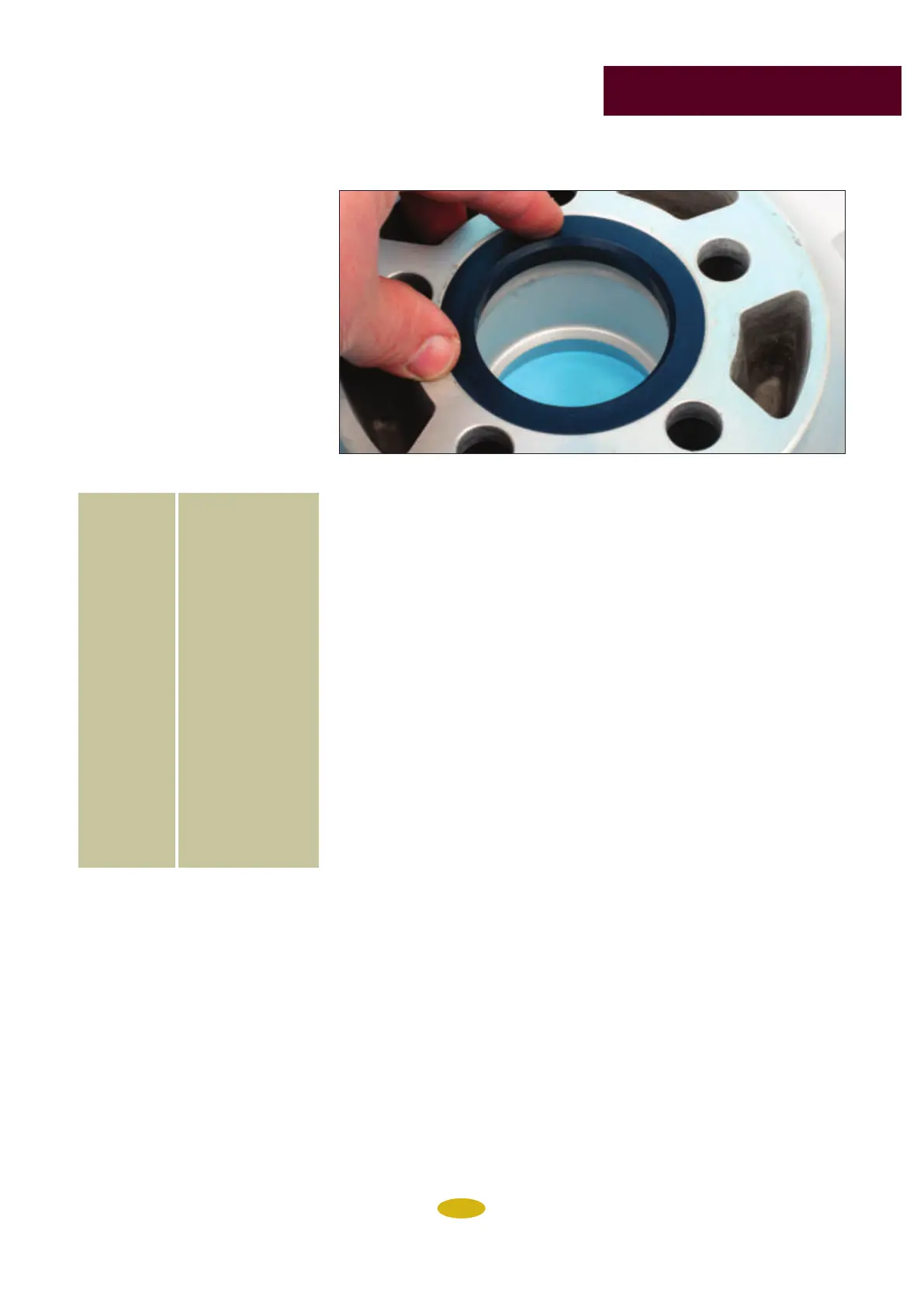
er fit. In these cases, hubcentric adapter rings will be needed. Here a
hubcentric ring is installed onto an aftermarket wheel. The inside
diameter of this ring will match the required size for the customer’s
Toyota vehicle.
Vehicle
RAV4
MR2
Avalon
Camry
Solara
Celica
Echo
Scion tC
Prius
Sienna
Highlander
Scion xB
Scion xA
Corolla
Matrix
4Runner
Tacoma
Tundra
Sequioa
Land Cruiser
Torque
76 ft-lbs (103N-m)
76 ft-lbs (103N-m)
76 ft-lbs (103N-m)
76 ft-lbs (103N-m)
76 ft-lbs (103N-m)
76 ft-lbs (103N-m)
76 ft-lbs (103N-m)
76 ft-lbs (103N-m)
76 ft-lbs (103N-m)
76 ft-lbs (103N-m)
76 ft-lbs (103N-m)
76 ft-lbs (103N-m)
76 ft-lbs (103N-m)
76 ft-lbs (103N-m)
76 ft-lbs (103N-m)
83 ft-lbs (110 N-m)
83 ft-lbs (110 N-m)
83 ft-lbs (110 N-m)
83 ft-lbs (110 N-m)
97 ft-lbs (131 N-m)


 To Next Page
 Loading...