KING gates
di Antoniolli Mario & C. sas
Via A. Malignani, 42
33077 Sacile (PN) ITALY
Tel. +39 0434 737082
Fax +39 0434 783382
P.I. 01285110936
info@king-gates.com
www.king-gates.com
1
3
2
A
INFORMAZIONI GENERALI
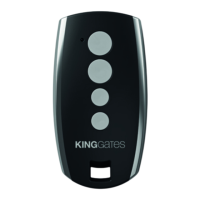
Il trasmettitore
Stylo
trasmette
la codifica di sicurezza Rolling sulla frequenza 433 MHz ed
è dotato di una funzione per l’autoapprendimento a distanza
sul ricevitore. E’ alimentato tramite una batteria al litio 3 V
(tipo “CR2032”).
INSERIMENTO DEL TRASMETTITORE NELLA
MEMORIA DEL RICEVITORE
1. Premere il pulsante di programmazione sul ricevitore: il
LED rosso si accende.
2. . Premere uno qualsiasi dei pulsanti del trasmettitore: Il
codice viene inserito in memoria. Durante l’inserimento il
LED del ricevitore lampeggia per circa due secondi, poi
torna allo stato di accensione fissa per segnalare che è
possibile inserire un nuovo trasmettitore.
Al termine dell’operazione premere di nuovo il pulsante di
programmazione sul ricevitore per uscire dalla procedura. Il
LED si spegne. L’uscita dalla procedura avviene comunque
in modo automatico dopo 10s dall’ultimo inserimento di un
trasmettitore.
INSERIMENTO A DISTANZA DI NUOVI TRASMETTITORI
NELLA MEMORIA DEL RICEVITORE
1. Avvicinarsi al ricevitore (1-2 m) con un trasmettitore già
programmato.
2. Premere contemporaneamente e rilasciare i pulsanti 1 e
2 del trasmettitore. Attendere che il LED del trasmettitore
si spenga e si accenda nuovamente. Premere di nuovo i
pulsanti 1 e 2 finché il LED lampeggia: al termine del
lampeggio il ricevitore entra nella fase di programmazione.
3. Premere uno dei pulsanti del trasmettitore che si vuole
inserire nella memoria del ricevitore. Il ricevitore lo
memorizza rimanendo nella fase di programmazione per
almeno 10 s dall’ultima trasmissione.
4. Attendere circa10 secondi: il ricevitore esce dalla
programmazione.
SOSTITUZIONE DELLA BATTERIA
1. Svitare la vite A (fig.1) e aprire il radiocomando (fig.2).
2. Rimuovere la batteria e sostituirla, rispettando la
polarità (fig.3)
DIDCHIARAZIONE DI CONFORMITA'
Antoniolli Mario & C. sas dichiara che i
dispositivi Stylo sono
conformi ai requisiti della direttiva 99/05/EC (R&TTE). L'utilizzo in
Italia del dispositivo come apriporte esonera l'utente dal
pagamento di qualsiasi canone di licenza.
I
GENERAL INFORMATION
The
Stylo
transmitter
transmits the rolling security code at 433MHz. The
transmitter is equipped with the RPA remote self-learning
function. It is powered by 3V lithium battery (“CR2032”).
ENTERING NEW TRANSMITTERS INTO THE MEMORY
OF THE RECEIVER
1. Press the programming pushbutton in the receiver. The
red LED lights up.
2. Press any of the transmitter’s keys: the code is now
entered in the memory. While loading is in progress, the
LED flashes then stops flashing and becomes fixed. A new
code can now be entered.
At the end, press again the pushbutton in the receiver to exit
from programming mode. The LED will go off. In any case,
the system will automatically exit from programming mode
after 10 seconds having elapsed since last loading.
REMOTELY ENTERING NEW TRANSMITTERS INTO THE
MEMORY OF THE RECEIVER
1. Approach the receiver (1-2m) with an already
programmed transmitter.
2. Press buttons 1 & 2 at the same time then release them;
the LED lights up and after about 2 seconds goes out.
3. When the LED lights up again, press buttons 1 & 2 at the
same time again and keep them pressed until the LED starts
flashing alternatively red-green.
4. At the end of flashing, the TX sends a transmission which
activates the learning function of the receiver
5. The receiver waits 10 seconds for transmissions from new
transmitters. Press one of the buttons of the transmitter to
be learned. The receiver stores the new transmitter into its
memory.
6. During the learning procedure, the 10 seconds learning
timeout is restored at any new transmitter learned.
HOW TO CHANGE THE BATTERY
Loosen screw A (fig.1) and open the remote control (fig.2).
Fit new batteries taking care of aligning polarity correctly
(fig.3).
DECLARATION OF CONFORMITY Antoniolli Mario & C.
sas declares that the transmitters Stylo are in accordance
with the 99/05/EC (R&TTE) directive.
GB
“CR2032”


 To Next Page
 Need help?
 General