INSTALLATION REQUIREMENTS
The microwave oven is set for recirculation installation. For external (wall or roof) venting, see "Venting Design Specifications" section.
Tools Needed
Gather the required tools and parts before starting installation.
Read and follow the instructions provided with any tools
listed here.
• Measuring tape • Diagonal cutting pliers
• Pencil • Stud finder
• Masking tape or thumbtacks • 7/16" socket wrench
(or box wrench) for 1/4" x 2"
• Scissors lag screws
• T10 TORX ®tscrewdriver
• lr/=" (3.8 cm) diam. hole drill
• No. 3 Phillips screwdriver for bit for wood or metal
1/4-20 x 3" bolts cabinet
• Electric drill • Keyhole saw
• 3/16" (5 mm) and 3/8" • Caulking gun and
(10 mm) drill bits weatherproof caulking
compound
• 3/4" (19 mm) hole saw
Duct tape
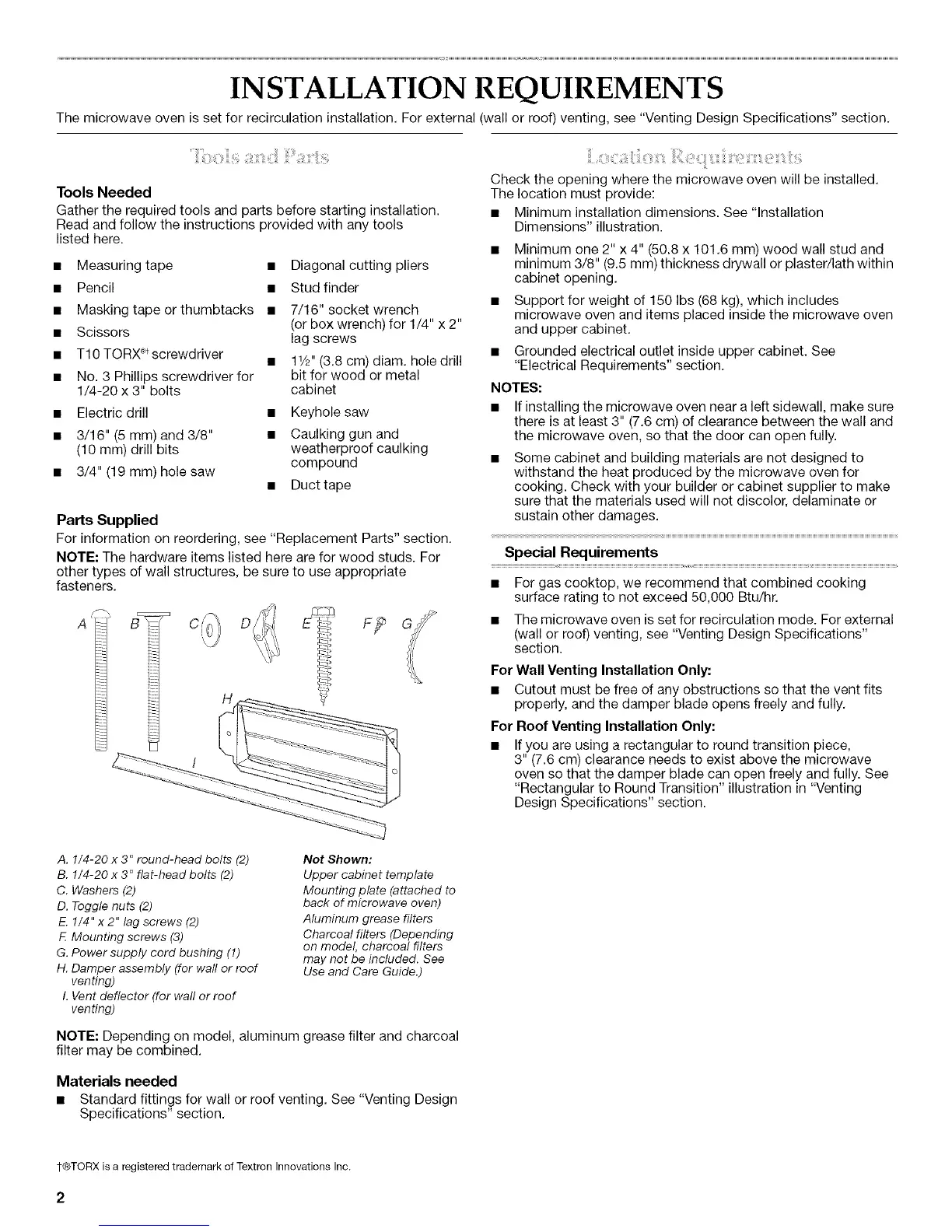
Parts Supplied
For information on reordering, see "Replacement Parts" section.
NOTE: The hardware items listed here are for wood studs. For
other types of wall structures, be sure to use appropriate
fasteners.
A
iz:z: H
Check the opening where the microwave oven will be installed.
The location must provide:
• Minimum installation dimensions. See "Installation
Dimensions" illustration.
• Minimum one 2" x 4" (50.8 x 101.6 mm) wood wall stud and
minimum 3/8" (9.5 mm) thickness drywall or plaster/lath within
cabinet opening.
• Support for weight of 150 Ibs (68 kg), which includes
microwave oven and items placed inside the microwave oven
and upper cabinet.
• Grounded electrical outlet inside upper cabinet. See
"Electrical Requirements" section.
NOTES:
• If installing the microwave oven near a left sidewall, make sure
there is at least 3" (7.6 cm) of clearance between the wall and
the microwave oven, so that the door can open fully.
• Some cabinet and building materials are not designed to
withstand the heat produced by the microwave oven for
cooking. Check with your builder or cabinet supplier to make
sure that the materials used will not discolor, delaminate or
sustain other damages.
Special Requirements
• For gas cooktop, we recommend that combined cooking
surface rating to not exceed 50,000 Btu/hr.
• The microwave oven is set for recirculation mode. For external
(wall or roof) venting, see "Venting Design Specifications"
section.
For Wall Venting Installation Only:
• Cutout must be free of any obstructions so that the vent fits
properly, and the damper blade opens freely and fully.
For Roof Venting Installation Only:
• If you are using a rectangular to round transition piece,
3" (7.6 cm) clearance needs to exist above the microwave
oven so that the damper blade can open freely and fully. See
"Rectangular to Round Transition" illustration in "Venting
Design Specifications" section.
A. 1/4-20 x 3" round-head bolts (2)
B. 1/4-20x3" flat-head bolts (2)
C. Washers (2)
D. Toggle nuts (2)
E. 1/4" x 2" lag screws (2)
F. Mounting screws (3)
G. Power supply cord bushing (!)
H. Damper assembly (for wall or roof
venting)
I. Vent deflector (for wall or roof
venting)
Not Shown:
Upper cabinet template
Mounting plate (attached to
back of microwave oven)
Aluminum grease filters
Charcoal filters (Depending
on model, charcoal filters
may not be included. See
Use and Care Guide.)
NOTE: Depending on model, aluminum grease filter and charcoal
filter may be combined.
Materials needed
• Standard fittings for wall or roof venting. See "Venting Design
Specifications" section.
1-®TORX is a registered trademark of Textron Innovations Inc.


 To Next Page
 Loading...