IV - 4
Use
4.4 Wrapping and Depositing Bales
• Just before the net is fed, make certain you are driving
the swath in the centre. This will ensure that the net is
drawn along evenly over the edges.
• Start the tying and/or wrapping process (cf. chapter
on operation), in the process always keep to the
rated speed of 540 1/min until the tying process is
completed.
• Stop the tractor and wait until the twine or net wrapping
process is complete.
• Eject round bales by opening the bale chamber.
• Close the bale chamber and start the next baling
process simultaneously.
Distorted and thick round bales are
detrimental to proper silage production.
The binding process should be started at the
latest when the density indicators reach the
red range (the buzzer sounds if the comfort
control equipment is fitted).
To prevent overload on the round baler when
handling certain types of crop (e.g. wet silage),
the binding process should already be started
at an earlier point.
Permanent overload can drastically reduce
the service life of the round baler.
Distorted and thick round bales are
detrimental to proper silage
production.
In difficult operating conditions (e.g.
when handling wet silage), baling
pressure should be reduced to prevent
any risk of overload. Baling pressure
should by no means exceed 160 bar.
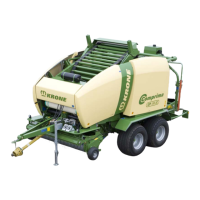
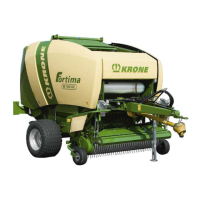
(COMPRIMA F 125, F 155)
(COMPRIMA V 150, V 180)
4.3.1.2 Assembly of additional supporting
plates in the tailgate
RPN00107
1
If the finished bales do not drop out of the front press
chamber, it is possible to install two supporting plates (1)
right and left in the tailgate of the machine.
• The supporting plates (1) can be ordered from the spare
parts storage warehouse under the spare parts number:
275 479 0
Assembly view for Comprima F125/F155


 To Next Page
 Loading...