6 EN
INSTRUCTIONS FOR PROTECTING THE
ENVIRONMENT
(WEEE, the waste electrical and electronic
equipment directive, applicable in EU member
states)
Your product has been manufactured
using high quality materials and
components which can be recycled and
used again. At the end of its service life, this
product cannot be disposed of in normal
domestic waste, but must be taken to a special
collection point for recycling electrical and
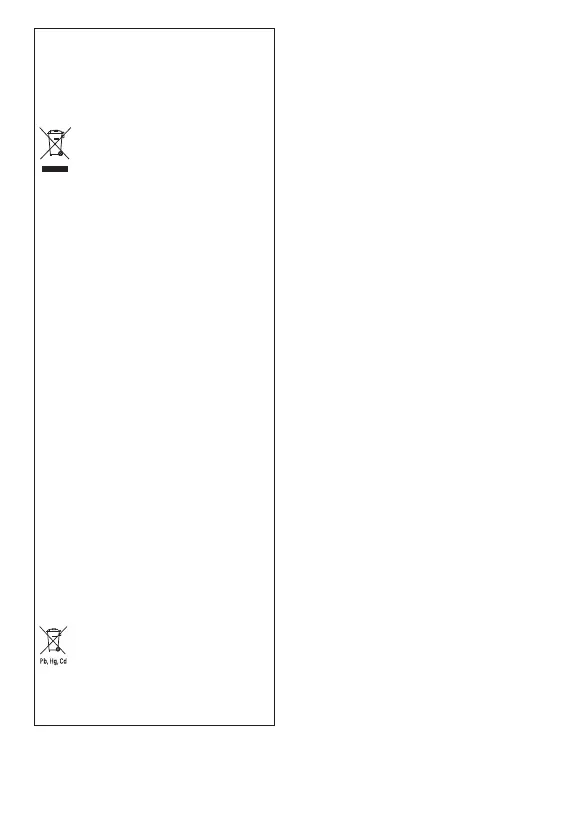
electronic equipment. This is indicated in the
user manual and in the packaging by the
crossed-out wheeled dust bin symbol. Used raw
materials are suitable for recycling.
You can ask your local competent council about
the location of your nearest collection point.
By recycling used appliances or raw materials,
you are playing an important role in protecting
our environment.
Correct disposal ensures that waste electrical
and electronic equipment (which may content
hazardous substances) is recycled and reused
appropriately. It helps avoid potential damage to
the environment and human health, wildlife and
to preserve natural resources.
Batteries:
Do not dispose batteries in your household
waste. Dispose of batteries by taking them to
your local recycling station. Contact your local
competent government oices for details.
Following information is only valid for EU
member states.
If the battery contains more than the
values of lead (Pb), mercury (Hg) and/or
cadmium (Cd) as defined in the Battery
Directive (2006/66/EC), then the chemical
symbols for Pb, Hg and/or Cd will appear below
the crossed-out wheeled dust bin symbol.
Lab31 B.V.
Geert Scholtenslaan 12
1687 CL Wognum
The Netherlands
www.dayes.eu
service@dayes.eu


 To Next Page
 Loading...