This document describes the Landia Submersible Mixer, available in various models including POP-I, POPR-I, POPL-I, POD-I, and PODR-I, each designed for specific applications and with distinct technical specifications.
Function Description
The Landia Submersible Mixers are horizontal submersible units primarily used for flow creation, mixing, and homogenization of liquids. They are designed for applications involving high or low dry matter content, such as wastewater, sludge, paper pulp, chemical liquids, and manure. The mixers are intended for operation only when fully submerged below liquid level in square or circular tanks.
The mixing process is driven by an electric motor coupled to a propeller via a planetary gear. The oil-filled coupling/oil chamber between the motor and gear is in open connection with the gear, facilitating cooling and lubrication of the gear and the mechanical shaft seal between the oil chamber and the motor. The propeller is mounted on the output shaft of the gear.
A unique feature of the POPL-I model is its adjustable propeller blades, which allow for fine adjustments to optimize energy consumption and liquid velocity in the tank. The POD-I and PODR-I models are compact, direct-drive mixers, meaning the propeller speed is the same as the motor speed. They feature self-cleaning propellers and a sealing system consisting of two mechanical shaft seals.
Important Technical Specifications
The mixers are available with various motor powers, propeller speeds, and propeller diameters, depending on the model.
POP-I / POPR-I (IE1 and IE2 models):
- Motor Type: 3-phase AC motor
- Nominal Voltage: 460 V
- Minimum Voltage Allowed: 415 V
- Nominal Frequency: 60 Hz
- VFD-operation: Suitable
- Cage Class: IP 68
- Insulation Class: F
- ATEX Classification: Class I, Groups C & D (option for selected models)
- Variable-speed drives: Inverter Duty Rated
- Propeller RPM: 180 rpm (gear 1:6 or 1:7.25) or 360 rpm (gear 1:4.5 or 1:5)
- Power Range: 1.8 HP to 30.2 HP
- Materials of Construction (POP-I):
- Motor housing and oil chamber: Cast iron AISI A48-40B
- Propeller: Steel A 570 GR 36, Domex 700 (optional), Stainless steel AISI 304 (optional), Steel AISI 316 (optional)
- Gear: Cast iron AISI A48-40B
- Output shaft gear: Shaft steel AISI 9840 (no contact with the liquid)
- Bolts: Steel AISI 316
- Exterior sealing system: Nitrile oil sealing rings, Stainless steel wear bush AISI 304 (ceramic coating optional), Steel wear bush AISI A2
- Interior sealing system: Mechanical shaft seal (silicon carbide/silicon carbide)
- Materials of Construction (POPR-I):
- All surfaces in contact with the medium are made of stainless steel.
- Motor housing and oil chamber: AISI 316
- Propeller: Stainless steel AISI 304, Steel AISI 316 (optional)
- Protection jacket over gear box: Steel AISI 316
- Gear: Cast iron AISI A48-40B (no contact with the liquid)
- Output shaft gear: Shaft steel AISI 9840 (no contact with the liquid)
- Bolts: Steel AISI 316
- Exterior sealing system: Nitrile oil sealing rings, Stainless steel wear bush AISI 304 (ceramic coating optional), Steel wear bush AISI A2
- Interior sealing system: Mechanical shaft seal (silicon carbide/silicon carbide)
POPL-I:
- Motor Type: 3-phase AC motor
- Nominal Voltage: 460 V
- Minimum Voltage Allowed: 415 V
- Nominal Frequency: 60 Hz
- VFD-operation: Suitable
- Cage Class: IP 68
- Insulation Class: F
- Start Function: Soft starter required
- ATEX Classification: Class I, Groups C & D (option for selected models)
- Variable-speed drives: Inverter Duty Rated
- Propeller RPM: Variable, between 19–49 rpm (specific RPM listed under Overall Dimensions)
- Power Range: 1.8 HP to 12.2 HP
- Materials of Construction:
- Motor housing: Cast iron AISI A48-40B
- Propeller hub: Cast iron AISI A48-40B
- Propeller blades: Stainless steel AISI 304
- Gear: Cast iron AISI A48-40B
- Output shaft gear: Shaft steel AISI 9840 (no contact with the liquid)
- Bolts: Acid-proof steel AISI 316
- Exterior sealing system: Nitrile oil sealing rings, Stainless steel AISI 304 wear bush w/hardened surface
- Interior sealing system: Mechanical shaft seal (silicon carbide/silicon carbide)
- Sealing system: Triple sealing system with a grease chamber in the propeller hub.
POD-I / PODR-I (1200 and 1800 rpm models):
- Motor Type: 3-phase AC motor
- Nominal Voltage: 460 V
- Minimum Voltage Allowed: 415 V
- Nominal Frequency: 60 Hz
- VFD-operation: Suitable
- Cage Class: IP 68
- Insulation Class: F
- ATEX Classification: Class I, Groups C & D (option for selected models)
- Variable-speed drives: Inverter Duty Rated
- Propeller RPM: 1,200 rpm or 1,800 rpm (direct drive, same as motor speed)
- Power Range: 1.8 HP to 30.2 HP
- Materials of Construction (POD-I):
- Motor housing and oil chamber: Cast iron AISI A48-40B
- Propeller: Stainless steel AISI 304
- Protection collar: Plastic PE-HD 1000
- Shaft: AISI 4340
- Bolts: Acid-proof steel AISI 316
- Sealing set: Mechanical shaft seals (silicon carbide/silicon carbide)
- Materials of Construction (PODR-I):
- Motor housing and oil chamber: Steel AISI 316
- Propeller: Stainless steel AISI 304
- Protection collar: Plastic PE-HD 1000
- Shaft: AISI 316
- Bolts: Steel AISI 316
- Sealing set: Mechanical shaft seals (silicon carbide/silicon carbide)
Electrical Cable:
- Resistant to abrasion, oil, and UV radiation.
- Available in SOOW 7AWG14 and SOOW 10AWG10.
- Standard length: 23’ (other lengths available upon request).
Monitoring Functions:
- Bimetal thermal sensors (248 °F) are standard.
- Moisture detection system (optional).
Surface Treatment:
- Machinery enamel: RAL 9005 (Jet Black)
- 2-component coating: RAL 7005 (Mouse Grey) (optional)
Usage Features
The mixers are designed for robust and continuous operation (Duty type S1). They are installed with a conic stop console or stop bracket fixed to a guide pipe for stability. The POPL-I model offers adjustable propeller blades, allowing for optimization of liquid velocity and energy consumption.
Safety Precautions:
- Submerged Operation: The mixer must always be fully submerged below liquid level during operation.
- Electrical Connection: Only a certified electrician is allowed to connect the unit. A protective motor switch must be applied.
- Pre-Installation Check: Prior to installation and start-up, ensure all equipment is correctly mounted to the mixer and in the tank.
- Propeller Rotation: Before the first start or after a long period of inactivity, the propeller shaft must be rotated manually.
- Cable Protection: The electrical cable must always be secured (e.g., with a chain or cable mesh) to prevent contact with the propeller.
- Clearance: Ensure the propeller cannot touch the tank under any circumstances.
- Thermal Control: Connect the thermal control to prevent motor burning due to overheating. If activated, do not restart until the cause is determined (e.g., low voltage, propeller blockage, or overheated motor). Allow up to 1 hour for cooling.
- Service/Repair: It is imperative to switch off or lock out the electrical connection before hoisting the mixer for service/repair. The mixer should be thoroughly cleaned beforehand. When hoisting or lowering, keep the cable and chain outside the work area. For mixers in hazardous environments (explosion danger/toxic gases), refer to ANSI regulations.
Maintenance Features
Regular and preventive service is crucial for maintaining high operating safety and a long service life. Maintenance should be performed according to the intervals specified in the manual, using only Landia-recommended spare parts.
Service Intervals:
- Recommended Service Interval/Oil Change: Maximum 4,300 operating hours or a minimum of once a year. Under difficult conditions, more frequent changes (every 6 months) may be necessary.
- Motor: Lifetime lubricated bearings (no maintenance required).
- Gear: Periodic oil change; calculated service life >100,000 operating hours.
- Propeller: Periodic grease lubrication.
Inspection and Lubrication:
- Outer Sealing System: Lubricate with grease during each inspection or oil exchange. For ms 80 and ms 90, the grease nipple is fixed. For other models, remove the stop screw behind the propeller hub and pump grease through the nipple. Fill the hub with grease prior to re-mounting the propeller.
- Oil Level Check: Remove the upper oil plug (pos. A for ms.100-180 on oil chamber, pos. G for ms.80-90 on gear). The oil should be clean and reach the plug hole. Refer to the spare parts list for oil type. If dirty, exchange the oil.
- Oil Drainage: Drain oil by dismounting plugs (pos. B and C for ms.100-180, or pos. C for ms.80-90). If oil is dirty, inspect seals and wear bushings.
- Oil Filling: When filling oil through plug pos. A (ms.100-180), remove plug pos. G to vent the gear casing. For ms.80-90, oil is filled at plug pos. G on the gear.
- Motor Casing Inspection: Remove inspection plug pos. D beneath the motor to check for oil or liquid seepage. Abnormal seepage requires checking the oil chamber seal. If motor windings need drying, contact an electric motor repair shop.
- Wear Bushing: Check outer wear bushing for wear during inspection and replace if needed. Two types exist: stainless steel and ceramic-coated.
- Stainless Steel: If deep wear traces are present, remove the propeller. A spacer can be mounted to move the wear area. If this is not possible or the wear area is too wide, install a new wear bushing.
- Ceramic-Coated: Dismount propeller and check if the surface is mat/porous. If so, the wear bushing is worn and must be changed. Control the oil sealing ring for wear.
- Interior Wear Bushing: After dismounting the propeller, check for wear traces. This bushing can be turned once for a new wear area.
- Oil Sealing Rings: Control for wear and change if necessary. Allow 15 minutes for new rings to settle before adding grease.
- Mechanical Shaft Seals: These are precision products and must be handled with care. Protect slide faces during installation. Push the stationary sealing ring into place carefully. Put the rotating sealing ring over the shaft using soap water (no silicone, PTFE lubricants, or oil). Use a mounting arbor. Press the locking ring until it snaps into the groove. Inspect by turning the motor shaft.
- Leakage Test: Submerge the mixer and pressurize the motor casing and oil chamber to approximately 1 bar (15 PSI). No air bubbles should appear.
- Surface Coating: Repair any surface coating damage before operation.
Equipment Maintenance:
- Inspect winch for wear and corrosion, lubricate with grease.
- Inspect brake and lock.
- Retighten screws; if loose, dismount and lubricate with Loctite 243 before re-mounting.
Mounting/Dismounting:
- Major repairs should be performed by a specialized workshop.
- Handle mechanical seals with care as they are not shock-resistant.
- Clean all sealing surfaces, check and change O-rings if necessary, before remounting.
- Apply adhesive (Loctite 243) to all bolt joints and tighten with a torque wrench as specified in the table.
- Axial Clearance: After mounting the bearing flange, control the axial clearance as specified in the table (e.g., ms.80: 0.028 ± 0.002 inch).
- End Cover/Oil Chamber/Gear: Turn anti-clockwise as much as possible (seen from the propeller end) to balance bolt hole clearance before final tightening.
- POPL-I Propeller Adjustment: If liquid velocity needs changing, adjust propeller blades. Remove hub cover, loosen blades with a wrench (46 mm), remove pins, make new adjustment according to hub and blade markings, and tighten. Counter-hold the blade with a large wrench and apply adhesive substance. Secure blades with 6 mm tightening pins. Mount hub cover and check power consumption. Do not overtighten hub cover screws or apply adhesive to them.

 Need help?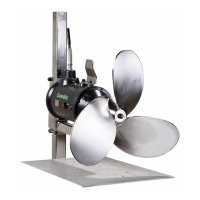

 To Next Page
 General