Device description
Leuze electronic GmbH + Co. KG RSL 420P 15
3.1.1
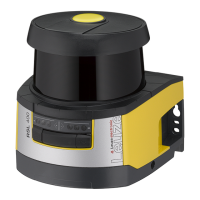
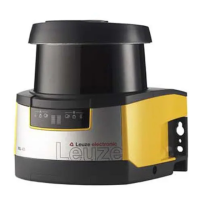
Protective function of RSL400 safety sensors
The safety sensor transmits periodic light pulses via a rotating deflection unit. The light pulses are scattered
in all directions by obstacles, e.g. persons. A part of the light pulses is received again by the safety sensor
and evaluated. The safety sensor calculates the precise position of the object from the propagation time of
the radiated light and the current angle of the deflection unit at that time. If the object is within a predefined
area, the protective field, the safety sensor performs a safety-related switching function. It switches the
safety-related switching outputs off.
Only when the protective field is free again does the safety sensor reset the safety-related switching func-
tion, either automatically or following acknowledgment, depending on the operating mode.
The safety sensor can even detect people when they are wearing very dark clothes, which have a very
weak diffuse reflectance.
3.1.2
Device and monitoring functions
• Monitoring and release of field pair changeover
3.2 USB connection
The safety sensor features a Mini-B type USB socket as a service interface for configuration and diagnosis.
This interface can be used with a device firmware version V4.5 and higher.
NOTICE
Ä Use the USB connection only temporarily for configuration or diagnosis of the safety sensor.
Ä For permanent connection, connect the safety sensor to the Ethernet connection of the con-
nection unit.
NOTICE
Ä After use, seal the USB connection using a protection cap. Make sure that the protection
cap is felt to engage when sealing. The IP degree of protection specified in the technical
data is only achieved when the protection cap is closed.
3.3 Connection units
The safety sensor is mounted, connected and aligned using the connection unit.
Functions of connection unit:
• Attachment point for mounting, either directly or using an optional mounting system.
When devices are swapped out, the connection unit remains mounted and aligned.
• EMC wiring for signal inputs/outputs and supply using connection cable
• Connector bushing and EMC for the Ethernet TCP/IP communication and configuration interface to the
PC/laptop
• Memory for the configuration files and automatic parameter transfer in the event of device swap-out
• Quick-release connection to the scanner unit for easy device swap-out (see "Quick Start Guide
RSL400").
NOTICE
To ensure the IP protection and leak tightness of the devices, the supplied protection caps must
always be placed on unused connections.



 To Next Page
 Loading...