Operation
GA09420_002_C0 – (2016-10) –
Leybold
25
4 Operation
4.1 Measuring Principle, Measuring Behavior
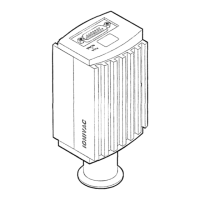
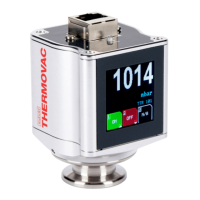
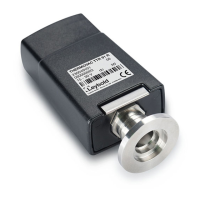
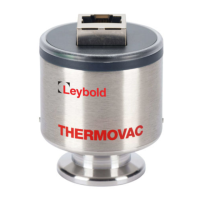
The ITR 90 vacuum transmitters consist of two separate measuring systems (hot
cathode Bayard-Alpert (BA) and Pirani).
Bayard-Alpert
The BA measuring system uses an electrode system according to Bayard-Alpert
which is designed for a low x-ray limit.
The measuring principle of this measuring system is based on gas ionization.
Electrons emitted by the hot cathode (F) ionize a number of molecules proportional
to the pressure in the measuring chamber. The ion collector (IC) collects the thus
generated ion current I
+
and feeds it to the electrometer amplifier of the
measurement instrument. The ion current is dependent upon the emission current
I
e
, the gas type, and the gas pressure p according to the following relationship:
I
+
= I
e
× p × C
Factor C represents the sensitivity of the transmitter head. It is generally specified
for N
2
.
The lower measurement limit is 5×10
-10
mbar (transmitter metal sealed).
To usefully cover the whole range of 5×10
-10
mbar … 10
-2
mbar, a low emission
current is used in the high pressure range (fine vacuum) and a high emission cur-
rent is used in the low pressure range (high vacuum). The switching of the emis-
sion current takes place at decreasing pressure at approx. 7.2×10
-6
mbar, at in-
creasing pressure at approx. 3.2×10
-5
mbar. At the switching threshold, the ITR 90
can temporarily (<2 s) deviate from the specified accuracy.
Diagram of the BA measuring system
F hot cathode (filament)
IC ion collector
EC anode (electron collector)
IC
200V40V
+– +–
(Degas 250V)
ECF
F
EC
IC


 To Next Page
 Loading...