Operation
GA09420_002_C0 – (2016-10) –
Leybold
27
4.2 Operational Principle of the Transmitter
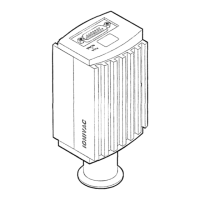
The measuring currents of the Bayard-Alpert and Pirani sensor are converted into
a frequency. A micro-controller converts this frequency into a digital value repre-
senting the measured total pressure. After further processing this value is available
as analog measurement signal (0 … +10 V) at the output (sensor cable connector
Pin 2 and Pin 12). The maximum output signal is internally limited to +10 V (
≙
atmosphere). The measured value can be read as digital value through the
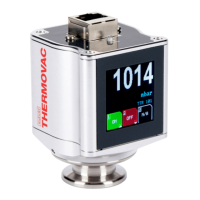
RS232C interface (Pins 13, 14, 15) (→ 29). transmitters with a display show the
value as pressure. The default setting of the displayed pressure unit is mbar. It can
be modified via the RS232C interface (→ 29).
In addition to converting the output signal, the micro controller's functions include
monitoring of the emission, calculation of the total pressure based on the meas-
urements of the two sensors, and communication via RS232C interface.
4.3 Putting the Transmitter Into Operation
When the operating voltage is supplied (→ Technical Data), the output signal is
available between Pin 2 (+) and Pin 12 (–) of the sensor cable connector
(Relationship output signal – pressure → Appendix A).
Allow for a stabilizing time of approx. 10 min. Once the transmitter has been
switched on, permanently leave it on irrespective of the pressure.
Communication via the digital interface is described in a separate section.
4.4 Degas
Contamination
Transmitter failures due to contamination or wear and tear as well as
expendable parts (filaments) are not covered by the warranty.
Deposits on the electrode system of the BA transmitter can lead to unstable
measurement readings.
The degas process allows in-situ cleaning of the electrode system by heating the
electron collector grid to approx. 700 °C by electron bombardment.
Depending on the application, this function can be activated by the system control
via a digital interface. The ITR 90 automatically terminates the degas process after
3 minutes, if it has not been stopped before.
The degas process should be run at pressures below 7.2×10
-6
mbar
(emission current 5 mA).
For a repeated degas process, the control signal first has to change from ON
(+24 V) to OFF (0 V), to then start degas again with a new ON (+24 V) command. It
is recommended that the degas signal be set to OFF again by the system control
after 3 minutes of degassing, to achieve an unambiguous operating status.


 To Next Page
 Loading...