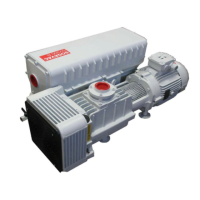
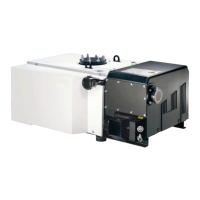
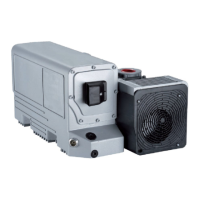
Description
23GA02411_002_C0 - 10/2016 - © Leybold
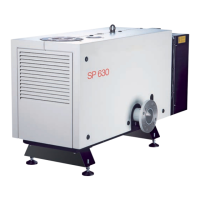
SP 630 F - Water Cooled
The areas of application for the SP 630 F are smaller and air-conditioned
rooms so as to not unnecessarily heat up the ambient air.
The water cooled pump is also used under ambient conditions which involve
much contamination since here at a rapid contamination of the air heat
exchanger must be expected.
The SP 630 F is equipped with a water cooled heat exchanger to cool the
oil.
Principle of Operation
In the screw vacuum pumps of the SP 630 line the pump chamber is formed
by two synchronised displacing rotors and the casing.
A pair of tightly intermeshing right-handed and left-handed threads is used to
implement with only very few components a large number of stages and thus
very low ultimate pressures.
Figures 1.1 and 1.2 show how by the two rotors and the housing several
chambers are created which allow the gas to be compressed. Since the
rotors turn in opposing directions, the chambers “move” steadily from the
intake to the delivery side of the pump (Fig. 1.2) so that the gas is conveyed
in a low-pulsation manner.
The continuous pumping action for the gas without the need of having to
deflect the gas will also allow pumping of particles entrained in the gas and
also vapours to a limited extent.
As in the case of other dry compressing (slot sealed) vacuum pumps, also in
the case of screw pumps very tight slots need to be maintained between the
components. Otherwise the leaks caused by the pressure drop would have a
negative effect on both pumping speed and attainable ultimate pressure.
Moreover, the pump might heat itself up too much due to unfavourable ther-
modynamic processes.
During operation the design of the SP 630 ensures that the slots are main-
tained within the operational limits of the pump. In order to limit the tempera-
tures attained by the components, the housing of the pump chamber is air-
cooled. Also the rotors themselves are cooled: by oil which is pumped
through bores in the rotor shafts and which also lubricates the bearings and
the toothed wheels of the pump’s synchronising gear. Thus an even tempera-
ture spread is attained within the pump.
The amount of “inner compression” has a significant influence on the tem-
perature level within a vacuum pump. In the case of a foreline pump, most of
the work on compression is done while the gas is being ejected against the
delivery pressure, i.e. in the last stages of the pump. For this reason in the
case of the SP 630 the volume of the gas is already significantly reduced at
pressures which are as low as possible so as to minimise this work done on
compression. In this way the power requirement of the pump is reduced and
less heat needs to be dissipated.
Gas compression
Slots



 To Next Page
 Loading...