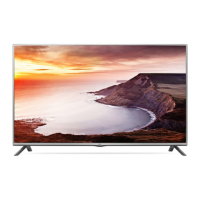
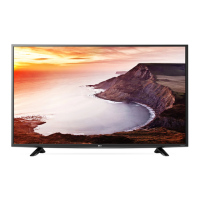
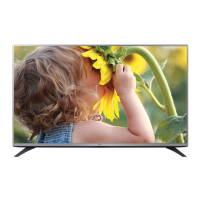
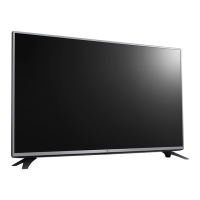
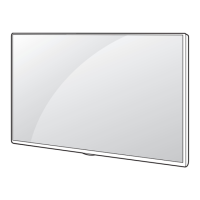
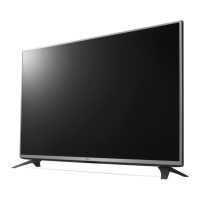
This document is a service manual for the LG LED TV models 49LF550T/550Y/551V, specifically for chassis LB55T. It provides comprehensive information for servicing, maintenance, and repair, intended for training and service purposes.
Function Description:
The LG LED TV is a display device designed for entertainment and information consumption. It supports various broadcasting systems, including PAL, SECAM, NTSC, DVB-T, DVB-T2, and DVB-S2, catering to different regional standards across Asia, Oceania, Africa, and the Middle East. The TV offers multiple input options, including composite video, component video, HDMI, and USB, allowing connection to a wide range of external devices. It also features SPDIF out for digital audio and a headphone jack for private listening. The manual details the internal architecture, including the Main SOC (M1A-256MB), which integrates key functionalities, and various peripheral components like serial flash memory, system EEPROM, and audio amplifier.
Important Technical Specifications:
General Specifications:
- Chassis: LB55T
- Models Covered: 49LF550T/550Y/551V (including sub-models 49LF550T/550Y-TA and 49LF551V-TC)
- Operating Temperature: 25 °C ± 5 °C (77 °F ± 9 °F) for standard tests; 40 °C ± 5 °C for CST.
- Relative Humidity: 65% ± 10%.
- Power Voltage: Standard input voltage (AC 100-240 V~, 50/60 Hz).
- Broadcasting Systems:
- Analog: PAL B/G/D/K/I, SECAM B/G/D/K, NTSC-M.
- Digital: DVB-T, DVB-T/T2, DVB-T/T2/S2.
- Channel Storage:
- DVB-T & Analog TV: 1500EA
- DVB-T/T2 & Analog TV: 1500EA
- DVB-T/T2/S2 & Analog TV: 6000EA
- Receiving System:
- Analog: VHF, UHF, CATV
- Digital: DVB (detailed specifications for DVB-T, DVB-T2, DVB-S, DVB-S2 including guard interval, modulation, code rate, and symbol rate are provided).
- Video Input:
- Composite: PAL, SECAM, NTSC
- Component: Y/Cb/Cr, Y/Pb/Pr
- HDMI: HDMI1-DTV/PC, HDMI2-DTV/MHL (supports HDCP 1.4, LF54 cannot support MHL).
- Audio Output: SPDIF out (model dependent), Headphone.
- USB Input: For My Media (Movie/Photo/Music List) and SVC.
The manual lists various resolutions, H-freq, V-freq, and pixel clock values for different SDTV and HDTV standards, including 720*576, 720*480, 1280*720, and 1920*1080.
Detailed specifications for HDMI input in DTV mode and PC(DVI) mode are provided, covering resolutions from 640*350 up to 4096*2160, with corresponding H-freq, V-freq, and pixel clock values. UHD resolutions (3840*2160 and 4096*2160) are supported.
Power Block Diagram:
The power section includes several DC-DC converters (IC405, IC400) and LDOs (IC404) to generate various voltage rails:
- +13.2V (main input)
- 3.3V_Normal
- AVDD_NODIE
- AVDD_DMPLL
- AVDD_AU33
- Tuner 3.3V
- +1.10V_VDDC
- +5V_Normal
- +1.5V_DDR
- +13.2V_AMP
- PANEL Vcc
These power rails are critical for the operation of the Main SOC, tuner, amplifier, and display panel.
Usage Features:
The TV is designed for ease of use with a remote control for various functions, including power, channel selection, volume, and menu navigation. The service manual highlights specific remote control keys for adjustment and service modes, such as "ADJ" for entering adjustment mode and "IN-START" for memory initialization and tool option settings. The TV supports USB for software updates and media playback.
Maintenance Features:
The service manual provides extensive guidelines for maintenance and repair, emphasizing safety precautions.
Safety Precautions:
- Important Safety Notice: Highlights special safety-related characteristics of electrical and mechanical parts, identified by a triangle symbol in diagrams. These parts must be replaced with manufacturer-specified components to prevent shock, fire, or other hazards. Original design modifications are prohibited without manufacturer permission.
- Leakage Current Hot Check: Details procedures for measuring leakage current to ensure safety, specifying limits and corrective actions if exceeded.
- Servicing Precautions:
- Always unplug the AC power cord before removing/reinstalling components, disconnecting electrical plugs, or connecting test substitutes.
- Use appropriate high voltage meters for testing.
- Avoid spraying chemicals on or near the receiver.
- Clean electrical contacts with a specified acetone/isopropyl alcohol mixture.
- Do not defeat B+ voltage interlocks.
- Ensure heat sinks are correctly installed before applying AC power.
- Connect test receiver ground lead to chassis ground first and remove it last.
- Use specified test fixtures.
- Electrostatically Sensitive (ES) Devices: Provides detailed instructions for handling ES devices to prevent damage from static electricity, including:
- Draining body static charge before handling components.
- Placing assemblies on conductive surfaces.
- Using grounded-tip soldering irons and anti-static solder removal devices.
- Avoiding freon-propelled chemicals.
- Keeping replacement ES devices in protective packaging until installation.
- Minimizing bodily motions when handling unpackaged devices.
- General Soldering Guidelines: Recommends using grounded-tip, low-wattage soldering irons, specific solder types, and proper cleaning and soldering techniques to avoid overheating circuit board foil.
- Component Removal/Replacement: Step-by-step procedures for removing and replacing ICs, "small-signal" discrete transistors, power output transistors, diodes, fuses, and conventional resistors. Emphasizes maintaining original spacing and preventing excessive component temperatures.
- Circuit Board Foil Repair: Techniques for repairing damaged copper patterns at IC connections and other points, using jumper wires and ensuring proper insulation and dressing.
Adjustment Instruction:
- Application Range & Requirement for Test: Specifies conditions for testing, including temperature, humidity, power voltage, and warm-up time.
- Model General Specification: Lists various specifications for different regions and models.
- ADC Process: Instructions for ADC calibration using service mode and RS232 protocol, including entering adjustment mode, selecting options, and performing automatic adjustments.
- Total Assembly Line Process: Details for White Balance (W/B) adjustment using a color analyzer (CA210) and RS-232C communication. Includes W/B tables for different aging times and module types (LGD, AUO/INX/COST/SHARP/BOE).
- DDC EDID Write (HDMI 256Byte): Instructions for writing EDID data to EEPROM via HDMI, including auto-download procedures.
- Outgoing Condition Configuration: Specifies procedures for setting the TV to outgoing condition, including using the "IN-STOP" key.
- GND and HI-POT Test: Procedures for auto-checking ground and high-potential insulation, including test voltage, time, and points.
Troubleshooting Guide (Repair Process):
The manual includes a detailed troubleshooting guide for various error symptoms, categorized by high-level and mid-level categories. Each symptom has a flow chart for diagnosis and repair.
- A. Video error: Covers "No video/Normal audio," "Picture broken/Freezing," and "Color error."
- No video/Normal audio: Checks for back light, power board voltages (3.5V, 12V, 24V), T-con board/module, inverter/module, and main board. Emphasizes checking and recording S/W Version and White Balance value before replacing the main board.
- Picture broken/Freezing: Checks RF signal level, external equipment, S/W Version, tuner soldering, and main board. Includes procedures for DVB-S2 LNB settings.
- Color error: Checks color by input, link cable (LVDS) and contact condition, external device and cable, and main board/module. Utilizes test patterns for diagnosis.
- Vertical/Horizontal bar, residual image, light spot, external device color error: Similar checks as color error, focusing on screen condition by input and external device.
- B. Power error: Covers "No power" and "Off when on, off while viewing, power auto on/off."
- No power: Checks power LED, power cord, ST-BY 3.5V, and power board output voltages.
- Off when on, off while viewing, power auto on/off: Checks "Power Off Mode" in service menu, CPU abnormal status, and power board voltage. Provides a list of "Power off List" explanations.
- C. Audio error: Covers "No audio/Normal video" and "Wrecked audio/discontinuation/noise."
- No audio/Normal video: Checks user menu (speaker off), audio B+ 24V of power board, speaker disconnection, and main board.
- Wrecked audio/discontinuation/noise: Checks input signal, speaker/connector, audio B+ voltage, external device, and main board.
- D. Function error: Covers "Remote control & Local switch checking" and "External device recognition error."
- Remote control & Local switch checking: Checks R/C operation, cable connection, connector solder, B+ 3.5V on main board, IR output signal, and IR B/D.
- External device recognition error: Checks technical information, S/W Version, and external input/component/HDMI recognition.
- E. Noise: Covers "Circuit noise, mechanical noise." Identifies noise type, checks location, and recommends replacing PSU (with LED driver) or LED driver for circuit noise. For mechanical noise, suggests module replacement or checking KMS fix information.
- F. Exterior defect: Covers "Exterior defect." Recommends replacing module, cabinet, remote control, or stand based on the damage.
Appendix (Exchange Procedures):
Provides visual examples of various display defects (solder defects, abnormal power sections, short/cracks, gradation, noise, panel mura, light leakage, press damage, crosstalk, vertical/horizontal blocks/lines, source/gate TAB IC defects) and indicates whether they are repairable by exchanging the T-Con Board, PSU (LED driver), or the entire Module. Un-repairable cases typically require module exchange.

 Need help?

 To Next Page
 General