Need help?
Do you have a question about the LG LP1015WNR and is the answer not in the manual?
General safety guidelines, symbols, and installation precautions.
Grounding, outlets, circuit breakers, and cord safety.
Identifies and describes main parts like the control panel, air discharge, and filter.
Details on using the power, mode, fan, timer, and temperature controls.
Common issues and their solutions before contacting support.
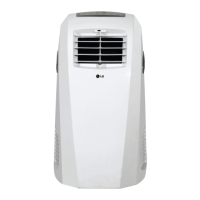
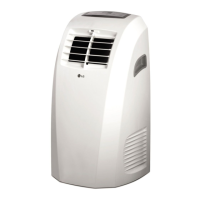
This document is an owner's manual for an LG portable air conditioner, model LP1015WNR. It provides comprehensive instructions for installation, operation, maintenance, and troubleshooting, ensuring users can effectively utilize and care for their appliance.
The LG portable air conditioner is designed to provide high-efficiency cooling with the added convenience of portability. It functions as a consumer comfort appliance, primarily intended for household use to cool rooms. The unit works by drawing in air, cooling it, and then discharging the conditioned air into the room, while venting exhaust air outside through a window installation kit. It also features a dehumidifying mode to remove excess moisture from the air. The air conditioner is equipped with an integrated circuit breaker for safety, which should be tested periodically.
The air conditioner is designed for ease of use, featuring an intuitive control panel and a remote controller. The digital display on the control panel shows the set temperature and operating mode, while simple push buttons allow for quick setting adjustments. The remote controller provides the convenience of adjusting temperature and operating functions from a distance.
Key operational modes include:
The unit's portability is enhanced by swiveling casters and integrated handles, making it easy to move across various floor surfaces. For optimal performance, it is recommended to maintain at least 20 inches of air space on all sides of the unit for good air circulation. The air discharge louver can be manually adjusted horizontally and vertically to direct airflow where needed.
Installation involves preparing the unit, selecting an appropriate location near a window, and attaching the exhaust hose and diffuser to a window installation kit. The manual provides detailed instructions for installing the window vent panel and extensions in both vertical sliding windows and casement style windows. It emphasizes that the exhaust hose length is specifically designed for the product and should not be replaced or extended to prevent malfunctions.
Regular maintenance is crucial for the air conditioner's longevity and efficient operation. The manual outlines several key maintenance tasks:
The manual also includes a troubleshooting section to help users diagnose and resolve common issues before calling for service, such as the unit not starting, not cooling properly, or displaying error codes like "FL" (full water tank) or "E1," "E2," "E4" (thermistor or coil sensor issues).
 General
| Cooling Capacity | 10, 000 BTU |
|---|---|
| Fan Speeds | 3 |
| Power Consumption | 1150 W |
| Refrigerant | R410A |
| Voltage | 115V |
| Operating Temperature | 64°F - 90°F |
| Power Supply | 115V / 60Hz |
| Coverage Area | 300 sq. ft. |
| Noise Level | 53 dB |

 To Next Page