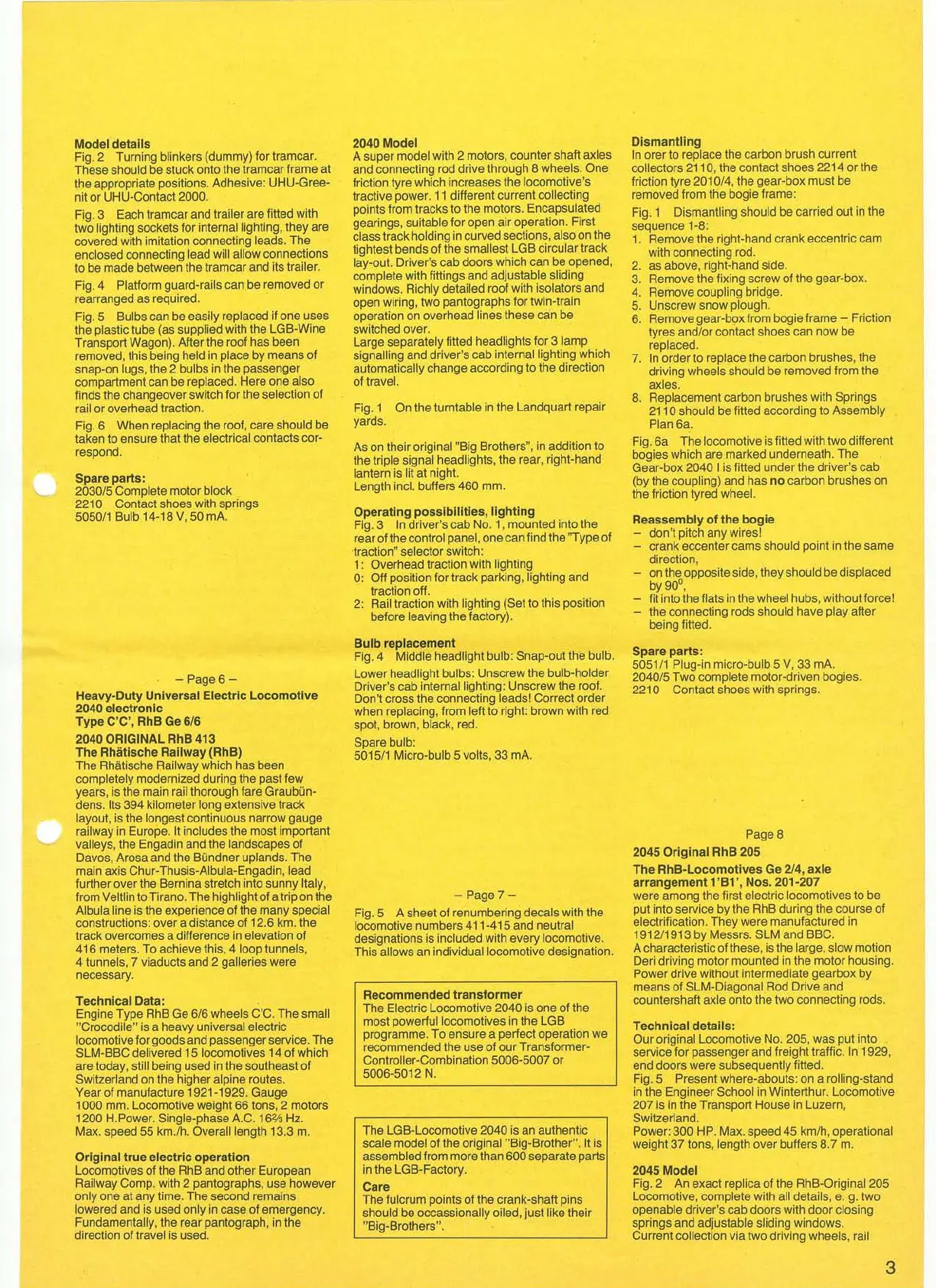
Model details
Fig.2 Turning blinkers (dummy) for tramcar.
These should be stuck onto the tramcar frame at
(he appropriate positions. Adhesive: UHU-Gree-
nit or UHU-Contact 2000.
Fig.3 Each tramcar and trailer are fitted with
two lighting sockets for internallighting, they are
covered with imitation connecting leads. The
enclosed connecting lead will allow connections
to be made between the tramcar and its trailer.
Fig. 4 Platform guard-rails can be removed or
rearranged as required.
Fig.5 Bulbs can be easily replaced if one uses
the plastic tube (as supplied with the LGB-Wine
Transport Wagon). After the roof has been
removed, this being held in place by means of
snap-on lugs, the 2 bulbs in the passenger
compartment can be replaced. Here one also
finds the changeover switch for the selection of
rail or overhead traction.
Fig.6 When replacing the roof, ca re should be
taken to ensure that the electrical contacts cor-
respond.
Spare parts:
2030/5 Complete motor block
2210 Contact shoes with springs
5050/1 Bulb 14-18 V, 50 mA.
~ Page 6 -
Heavy-Duty Universal Electric Locomotive
2040 electronic
Type
C'C',
RhB Ge
6/6
2040 ORIGINAL RhB 413
The Rhätische Railway (RhB)
The Rhätische Railway which has been
completely modernized during the past few
years, is the main rail thorough fare Graubün-
dens. Its 394 kilometer long extensive track
layout, is the longest continuous narrow gauge
railway in Europe. It includes the most important
valleys, the Engadin and the landscapes of
Davos, Arosa and the Bündner uplands. The
main axis Chur- Thusis-Albula-Engadin, lead
further over the Bernina stretch into sunny Italy,
from Veltlin to Tirano. The highlight of a trip on the
Albula line is the experience of the many special
constructions: over a distance of 12.6 km. the
track overcomes a difference in elevation of
416 meters. To achieve this, 4 loop tunnels,
4 tunnels, 7 viaducts and 2 galle ries were
necessary.
Technical Data:
Engine Type RhB Ge
6/6
wheels C'C. The small
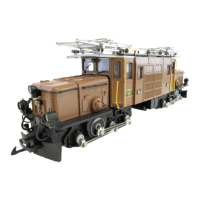
"Crocodile" is a heavy universal electric
locomotive lor goods and passenger service. The
SLM-BBC delivered 15 locomotives 14 of which
are today, still being used in the southeast of
Switzerland on the higher alpine routes.
Year of manufacture 1921-1929. Gauge
1000 mm. Locomotive weight 66 tons, 2 motors
1200 H.Power. Single-phase A.C.
16'V3
Hz.
Max. speed 55 km./h. Overaillength 13.3 m.
Original true electric operation
Locomotives of the RhB and other European
Railway Comp. with 2 pantographs, use however
only one at any time. The second remains
lowered and is used only in case of emergency.
Fundamentally, the rear pantograph, in the
direction of travel is used.
2040 Model
A super model with 2 motors, counter shaft axles
and connecting rod drive through 8 wheels. One
friction tyre wh ich increases the locomotive's
tractive power. 11 different current collecting
points from tracks to the motors. Encapsulated
gearings, suitable for open air operation. First
class track holding in curved sections, also on the
tightest bends of the smallest LGB circular track
lay-out. Driver's cab doors which can be opened,
complete with fittings and adjustable sliding
windows. Richly detailed roof with isolators and
open wiring, two pantographs for twin-train
operation on overhead lines these can be
switched over.
Large separately fitted headlights for 3 lamp
signalling and driver's cab internallighting wh ich
automatically change according to the direction
of travel.
Fig. 1 On the turntable in the Landquart repair
yards.
As on their original "Big Brothers", in addition to
the tripie signal headlights, the rear, right-hand
lantern is lit at night.
Length incl. buffers 460 mm.
Operating possibilities, lighting
Fig.3 In driver's cab No. 1, mounted into the
rear of the control panel, one can find the "Type of
·traction" selector switch:
1: Overhead traction with lighting
0: Off position for track parking, lighting and
traction off.
2: Rail traction with lighting (Set to this position
before leaving the factory).
Bulb replacement
Fig.4 Middle headlight bulb: Snap-out the bulb.
Lower headlight bulbs: Unscrew the bulb-holder
Driver's cab internallighting: Unscrew the roof.
Don't cross the connecting leads! Correct order
when replacing, from left to right: brown with red
spot, brown, black, red.
Spare bulb:
5015/1 Micro-bulb 5 volts, 33 mA.
-:- Page 7 -
Fig.5 A sheet of renumbering decals with the
locomotive numbers 411-415 and neutral
designations is included with every locomotive.
This allows an individuallocomotive designation.
Recommended transformer
The Electric Locomotive 2040 is one of the
most powerfullocomotives in the LGB
programme. To ensure a perfect operation we
recommended the use of our Transformer-
Controller-Combination 5006-5007 or
5006-5012 N.
The LGB-Locomotive 2040 is an authentic
scale model
01
the original "Big-Brother". It is
assembled from more than 600 separate parts
in the LGB-Factory.
Care
The fulcrum points of the crank-shaft pins
should be occassionally oiled, just like their
"Big-Brothers".
Dismantling
In orer to replace the carbon brush current
collectors 2110, the contact shoes 2214 or the
friction tyre 2010/4, the gear-box must be
removed from the bogie frame:
Fig. 1 Dismantling should be carried out in the
sequence 1-8:
1. Remove the right-hand crank eccentric cam
with connecting rod.
2. as above, right-hand side.
3. Remove the fixing screw of the gear-box.
4. Remove coupling bridge.
5. Unscrew snow plough.
6. Remove gear-bQx from bogie frame - Friction
tyres and/or contact shoes can now be
replaced.
7. In order to replace the carbon brushes, the
driving wheels should be removed from the
axles.
8. Replacement carbon brushes with Springs
2110 should be fitted according to Assembly
Plan 6a.
Fig. 6a The locomotive is fitted with two different
bogies which are marked underneath. The
Gear-box 2040 I is fitted under the driver's cab
(by the coupling) and has no carbon brushes on
the friction tyred wheel.
Reassembly of the bogie
~ don't pitch any wires!
- crank eccenter cams should point in the same
direction,
- on the opposite side, they shoUld be displaced
by900,
- fit intotheflats in the wheel hubs, withoutforce!
the connecting rods should have play after
being fitted.
Spare parts:
5051/1 Plug-in micro-bulb 5 V, 33 mA.
2040/5 Two complete motor-driven bogies.
2210 Contact shoes with springs.
Page8
2045 Original RhB 205
The RhB-Locomotives Ge
2/4,
axle
arrangement 1'B1', Nos. 201-207
were among the first electric locomotives to be
put into service by the RhB during the course of
electrification. They were manufactured in
1912/1913 by Messrs. SLM and BBC.
A characteristic of these, is the large, slow motion
Deri driving motor mounted in the motor housing.
Power drive without intermediate gearbox by
means of SLM-Diagonal Rod Drive and
countershaft axle onto the two connecting rods.
Technical details:
Our original Locomotive No. 205, was put into
service for passenger and freight traffic. In 1929,
end doors were subsequently fitted.
Fig.5 Present where-abouts: on a rolling-stand
in the Engineer School in Winterthur. Locomotive
207 is in the Transport House in Luzern,
Switzerland.
Power: 300 HP. Max. speed 45 km/h, operational
weight 37 tons, length over buffers 8.7 m.
2045 Model
Fig.2 An exact replica of the RhB-Original205
Locomotive, complete with all details, e. g. two
openable driver's cab doors with door closing
springs and adjustable sliding windows.
Current collection via two driving wheels, rail
3


 To Next Page
 Loading...