This document serves as a user guide for a clothes rack, providing essential information for its assembly, use, and maintenance. The clothes rack is designed to offer a practical and versatile storage solution for garments, suitable for various indoor environments. Its structure suggests a focus on durability and ease of use, making it a functional addition to homes, offices, or retail spaces.
Function Description:
The primary function of this device is to provide a portable and adjustable hanging and storage solution for clothes. It features two parallel hanging rails at different heights, allowing for the organization of various types of garments, such as shirts, dresses, trousers, and coats. The dual-rail design maximizes hanging capacity within a compact footprint. Below the hanging rails, a wire mesh shelf is integrated, offering additional storage space for folded clothes, shoes, bags, or other accessories. The inclusion of universal wheels, both with and without brakes, enhances its portability, allowing users to easily move the rack to different locations as needed. The brakes on two of the wheels ensure stability and prevent unintended movement once the rack is positioned. This design makes the clothes rack ideal for temporary storage, laundry rooms, bedrooms, or even for displaying clothing in a retail setting. Its open design allows for easy access to stored items and promotes air circulation, which can be beneficial for clothes.
Important Technical Specifications:
Based on the provided components list and installation diagram, the clothes rack appears to be constructed primarily from metal tubing, likely steel, given its common use in such products for strength and stability.
- Components: The rack consists of various tubes (A, B, C, D, E, F, G, H), a wire mesh shelf (I), universal wheels without brakes (J), universal wheels with brakes (K), and screws (L).
- Tube Quantities:
- Tube A: 2 pieces
- Tube B: 2 pieces
- Tube C: 2 pieces
- Tube D: 2 pieces
- Tube E: 2 pieces
- Tube F: 2 pieces
- Tube G: 2 pieces
- Tube H: 2 pieces
- Other Components:
- Wire Mesh (I): 1 piece
- Universal Wheels (without brakes) (J): 2 pieces
- Universal Wheels (with brakes) (K): 2 pieces
- Screws (L): 16 pieces
The symmetrical nature of the tube quantities (mostly in pairs) indicates a balanced and sturdy construction. The presence of 16 screws suggests that many connections are secured with fasteners, contributing to the overall rigidity of the assembled unit. The use of universal wheels implies a standard diameter and attachment mechanism, designed for smooth movement across various floor types. The wire mesh shelf is likely made of a robust metal grid, capable of supporting a reasonable amount of weight. While specific dimensions are not provided, the visual representation suggests a rack of standard height and width, suitable for adult clothing. The two different heights of the hanging rails (indicated by tubes E, F, G, H) offer flexibility for hanging longer garments on one rail and shorter items on the other, or for simply increasing overall hanging capacity.
Usage Features:
- Portability: Equipped with four universal wheels (two with brakes, two without), the clothes rack can be easily moved from one location to another. This is particularly useful for cleaning, redecorating, or transporting clothes.
- Stability: The inclusion of brakes on two of the wheels allows the user to lock the rack in place, ensuring it remains stationary when desired, even on slightly uneven surfaces.
- Dual Hanging Rails: The design features two distinct hanging rails at different heights. This allows for efficient organization of various clothing lengths, preventing longer items from dragging on the floor and maximizing the use of vertical space.
- Integrated Storage Shelf: A wire mesh shelf at the bottom provides additional storage for items that cannot be hung, such as shoes, folded clothes, storage bins, or accessories. This enhances the rack's utility as a comprehensive storage solution.
- Easy Assembly: The "Installation" section, although only showing a diagram, implies a straightforward assembly process using the provided components and screws. The safety advice suggests that assembly can be managed by individuals, though two people might make certain parts easier.
- Versatile Placement: Due to its design and portability, the rack can be used in various settings, including bedrooms, laundry rooms, entryways, walk-in closets, or even as a temporary wardrobe for guests.
- Space-Saving Design: While offering ample storage, the vertical orientation and dual rails help to optimize space, making it suitable for smaller rooms or apartments where traditional wardrobes might be too bulky.
Maintenance Features:
The "Care and Maintenance" section outlines simple yet effective practices to ensure the longevity and appearance of the clothes rack.
- Cleaning:
- Method: Only clean using a damp cloth and mild detergent. This gentle approach prevents damage to the finish and material.
- Avoid Abrasives: Users are explicitly advised not to use abrasive cleaners, which could scratch or corrode the metal surfaces.
- Drying: For general cleaning, a dry cloth is recommended. Furniture polish is not advised, suggesting that the material's finish is designed to be low-maintenance and may not benefit from such products.
- Structural Integrity Check:
- Regular Inspection: It is important to periodically check for any loose screws, nuts, or bolts. This proactive measure helps maintain the rack's stability and prevents potential accidents or damage from structural weakness.
- Re-tightening: If any fasteners are found to be loose, they should be re-tightened immediately to restore the rack's structural integrity.
- Disposal:
- Environmental Responsibility: The product should not be discarded with general household waste. This indicates that the materials used (likely metal) are recyclable and should be disposed of responsibly.
- Local Authority: Users are instructed to take the product to their local authority waste disposal centre, ensuring proper recycling or disposal in accordance with environmental regulations.
Safety and Care Advice (General):
The manual emphasizes several safety precautions and best practices for assembly and use:
- Component Check: Before starting assembly, verify that all components and tools listed are present.
- Fittings Organization: Remove all fittings from plastic bags and separate them into groups to simplify the assembly process.
- Child and Animal Safety: Keep children and animals away from the work area, as small parts pose a choking hazard.
- Adequate Space: Ensure sufficient space to lay out all parts before beginning assembly.
- Weight Distribution: Do not stand or put excessive weight on the product during assembly to prevent damage.
- Proximity to Final Position: Assemble the item as close to its final intended position as possible to minimize moving a fully assembled, potentially heavy, unit.
- Soft Assembly Surface: Assemble on a soft, level surface to protect both the unit and the floor from scratches or damage.
- Two-Person Assembly: Some parts of the assembly will be easier with two people, highlighting the potential for larger or more awkward components.
- Power Drill Torque Setting: If using a power drill, set it to a low torque setting to prevent over-tightening and damaging the product.
In summary, this clothes rack is a practical, portable, and versatile storage solution designed for ease of assembly and maintenance. Its dual hanging rails and integrated shelf offer ample storage capacity, while the universal wheels with brakes ensure both mobility and stability. The emphasis on safety during assembly and simple care instructions contribute to a user-friendly experience and the product's longevity.

 Need help?
 General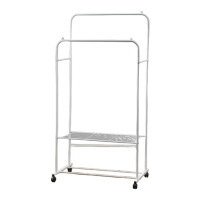

 To Next Page