Super Revolt #20021-6
Thank you for purchasing the Super Revolt electornic call. To see more Lucky Duck™ products please visit your local
Sporting Goods dealer or online at www.luckyduck.com.
Directions for use: Unpack the box and make sure all parts are present.
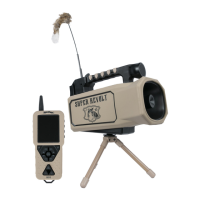
1 – Super Revolt Electronic Call
1 – LD3X Super Revolt Remote Control
1 – SD Card (installed)
1 – Tripod, Decoy and Antenna
1 – Rechargeable Battery and Charger
Battery Installation: The call includes a 12 volt 3,700 mAH lithium ion battery and charger. The battery compartment is
located on the back of the call. Simply remove the battery cover, plug the battery into the call, set the battery in the battery
compartment and replace the battery cover. The remote control uses 3AA batteries (not included). Remove the battery
cover on the back of the remote control and install the batteries.
Antenna: The antenna will either be in the box or installed on the call. If the antenna is in the box, simply locate the
antenna port on the back left of the caller and screw the antenna onto the caller.
Decoy: The decoy will either be in the box or stored on the side of the call. Insert the decoy into the hole on the top of the
handle. Make sure to aling the groove on the decoy with the slot on the decoy joint located in the handle. A strong magnet
holds the decoy in place. The decoy can be stored on the left side of the call.
Tripod Base: Install the tripod base on the bottom of the Super Revolt. The tripod base allows the caller to rotate to
broadcast sound. Make sure to aling the groove on the bottom of the Super Revolt with the slot on the tripod stand. A
strong magnet holds the tripod to the caller. The tripod base can be disassembled to adapt to most standard camera
tripods or any other base system that utilizes a ¼ 20 thread. This may be helpful if you want to elevate the call depending
on the hunting terrain.
Electronic Call Operation: Slide the power switch on the electronic call to the “on” position. A red LED light on the back
of the call will illuminate when the power is on. Hold down the power button on the remote control. The remote will turn on.
The remote screen will display “Finding Caller”, “Waiting”, “Communication OK” while it searches for the caller. Once
connected to the caller the remote screen will be displayed. On the second line of the home screen it should have an SD
icon confirming the remote and caller are connected and in sync. DO NOT PRESS ANY BUTTONS WHEN REMOTE IS
SEARCHING FOR THE CALLER.
Reboot: A reboot function is available to resync the remote and call if the connection between the two is lost while
hunting or the sound files are not displayed correctly. Simply press and hold the “auxillarary” button to reboot the remote
and resync. The remote screen should turn blue and go through the “Finding Caller”, “Waiting”, “Communication OK”
proces as described in the Electronic Call Operation section above. DO NOT PRESS ANY BUTTONS WHEN REMOTE
IS SEARCHING FOR THE CALLER.
Remote Control Operation:
Sound Selection – Use the up/down arrows to highlight the folder you want to select. Press the play/pause button to select
the folder. Use the up/down arrows to highlight the sound you want to play. Press the play/pause button to play the sound.
Holding the up/down arrows down for 1 second will cycle through the folders/sounds faster.
Play Two Sounds At Once – Pressing the “S” button on the bottom of the remote will cycle between Sound 1 (S1) channel
and Sound 2 (S2) channel. S1 or S2 will be displayed on the second line from the top of the remote screen. This indicates
which sound channel is being controlled when using the remote buttons. To play two sounds at once, first select a sound
to play. Once a sound is playing press the “S” button and S2 will be displayed. Then select a different sound to play. Now
two sounds are playing at once. There are two speaker icons on the second line from the top of the remote screen that
indicate which channels are playing sounds. Note sounds using different sampling rates cannot be played together.


 To Next Page
 Need help?
 General