23
ON THE ROAD
CHANGING A WHEEL
1
. Leave caravan hitched to towing vehicle and
ensure handbrake is applied.
2. Lower corner steadies (as safety measure) on
the side that the wheel is being changed to
stabilise the caravan.
3. Use wheel brace to slacken off wheel nuts on
the wheel to be changed.
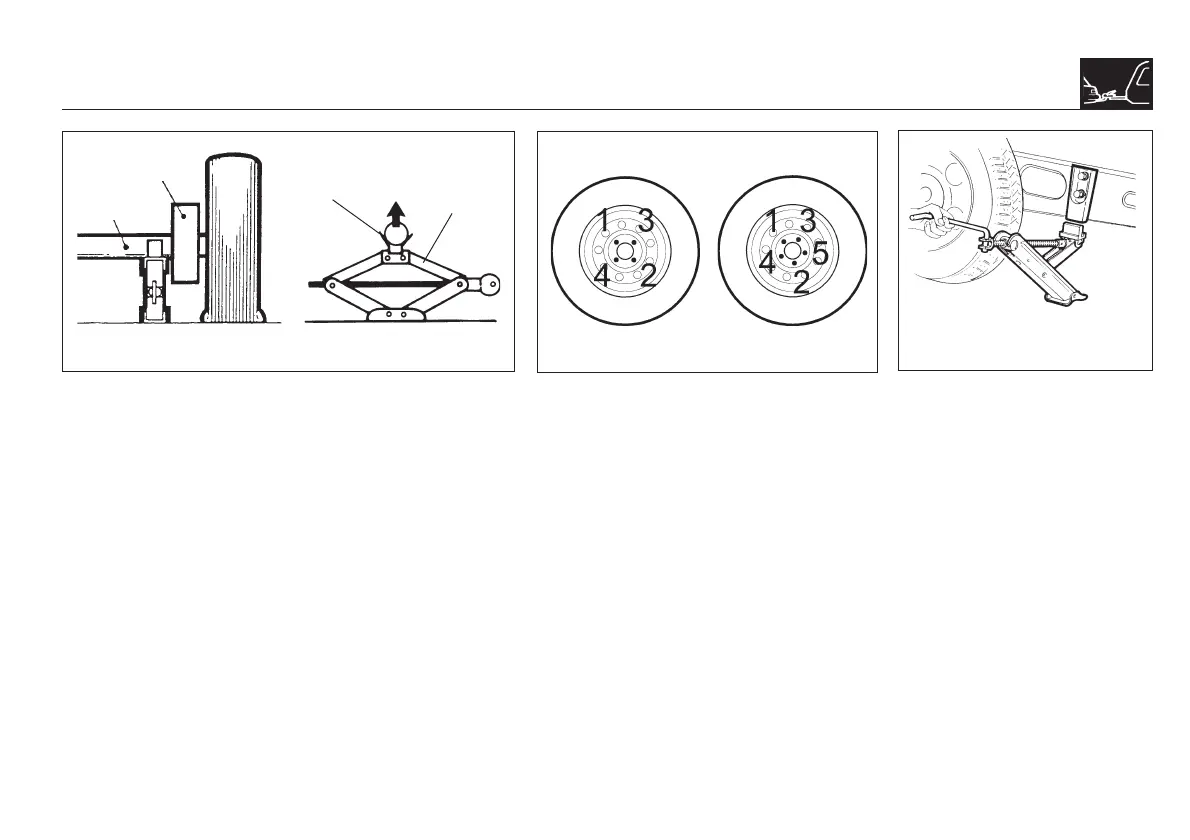
4. Position jack under the axle at the appropriate
jacking point (see fig. A).
5. Jack up the caravan until the wheel for removal
is just off the ground.
6. Remove the wheel bolts, wheel trims and
remove the wheel.
7. Fit spare wheel and reverse the above
procedure.
8. When replacing the wheels you should tighten
the nuts in rotation diagonally. Tighten all nuts
equally, according to Fig. B, to 88Nm (65 lb/ft)
for steel wheels and 115Nm (85lbs/ft) for alloy
wheels using a torque wrench or have
checked as soon as possible.
Note: When changing a wheel ensure:
a) that the correct wheel fixings are used.
b) that there are clean, dry mating surfaces
and clean, dry bolt/nut area.
NB: Special nuts are supplied with alloy
wheels and these can be used where a
steel wheel is used as a temporary spare.
If replacing an alloy wheel nut, a nut to the
following reference should be purchased:
M12 x 1.5 pitch, 26mm thread, 10.9 grade,
60 degree conical fixing, 19mm hexagon bolt
head.
IMPORTANT
When a wheel has been removed and
replaced the torque of the wheel nuts should
be re-checked after approximately 15 miles
of running.
JACKING POINTS
It is recommended that the jack is located in
the correct position i.e. on the axle tube
inside the chassis member (Fig. A). The re-
inforced axle mounting plate can be used as
an alternative but the chassis- member itself
MUST NEVER be used as a jacking point.
Alko Side Jack
The Alko chassis is provided with the facility
to fit an Alko side jack which can be fitted as
an optional extra (Fig. C).
AXLE
CHASSIS
50mm
”V” HEAD
SCISSOR
JACK
Fig. A Jacking Point
Fig. B Wheel Nut Tightening
Fig. C Alko Side Jack
4 STUD WHEEL
5 STUD WHEEL


 To Next Page