9
PREPARING FOR THE ROAD
STABILITY
The most common causes of poor stability
include:
(a) Incorrect tyre pressures on car or
caravan.
(b) Worn springs or loose spring fixings on
the towing vehicle.
(c) Towing vehicle shock absorbers too soft.
(d) Insufficient noseweight.
(e) Nose of caravan is towing too high.
(f) Incorrect loading
Stabilisers. There are many proprietary
brands of stabiliser available. Your Lunar
dealer will be pleased to advise you of the
most suitable. They are an aid to stability and
should not be considered as a cure for a
stability problem.
Note: It is expressly forbidden by the
chassis manufacturer for holes to be
drilled into the 'A' frame to accommodate
a stabiliser bracket. A clamp must be
used. Similarly, holes should not be
drilled into the coupling head.
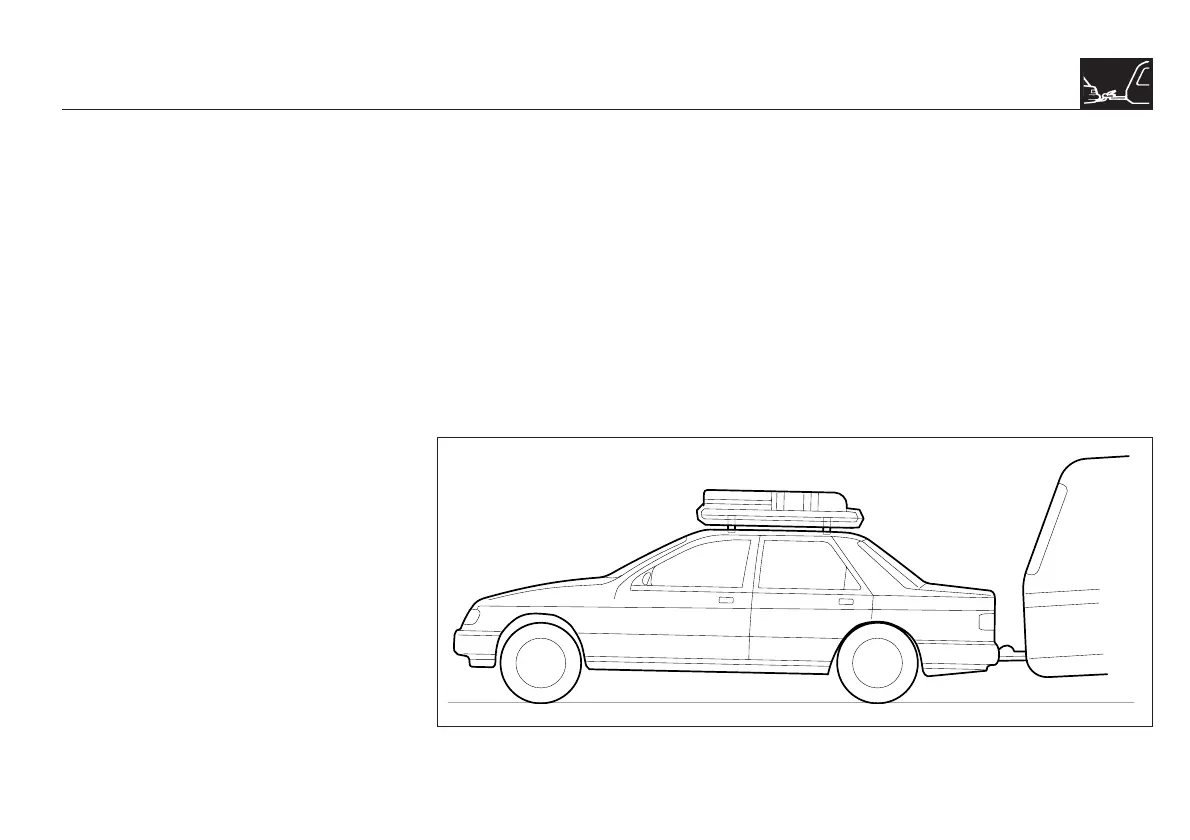
Towing vehicle’s rear suspension
It is important that the towing vehicle’s rear
suspension is not deflected excessively by
the noseweight on the tow ball. If it is
excessive the steering and stability will be
affected.
The greater the towing vehicle’s tail
overhang (the distance between the rear
axle and the tow ball) the greater the effect
the noseweight will have on the towing
vehicle’s rear suspension.
After trying out the caravan it may be
found that stiffening of the rear
suspension is necessary — but note that this
may give the towing vehicle a firmer ride
when not towing.
There are a number of suspension aids
available and advice should be sought on
which to use and how to fit.
It is important to ensure that the caravan is
towed either level or slightly nose down.
Illustration of excessive deflection of vehicle’s rear suspension


 To Next Page