BATTERIES ARE DANGEROUS. TREAT THEM
CAUTIOUSLY.
Batteries can produce explosive gas, corrosive acid and lev-
els of electrical current high enough to cause burns. Always
wear eye protection or shield your eyes when working near
any battery and remove all metal rings and jewelry. Never
expose a battery to open flames or sparks. Do not smoke
near a battery. It could blow up. Do not allow battery acid to
contact eyes, skin, fabrics or painted surfaces. Flush any
contacted area with water immediately and thoroughly. Get
medical help if eyes are affected. Do not charge the battery,
adjust post connections or use booster cables without mak-
ing sure the battery compartment is properly ventilated.
When charging the battery, carefully follow the instructions
on the charger. Keep the battery filled to the proper level
with distilled water. Always keep vent caps tight. Do not
allow metal tools or metal parts to contact the positive ( + )
terminal and the negative (-) terminal or any metal connected
to these terminals.
MAKE SURE THE WHEEL LUG NUTS ARE TIGHT
BEFORE TRAILERING THE BOAT.
MAKE SURE THE OUTBOARD MOTOR AND MAST
ARE ATTACHED FIRMLY TO THE BOAT WHEN
THE BOAT IS BEING TRAILERED.
Put an extra cable on the outboard and make sure the clamps
are tight. Having it bounce off onto a busy street could be
lethal. The mast should be bolted to the bow pulpit and prop-
erly secured at the rear (wood) mast carrier. Just tying the
mast is not enough. Unless it is bolted, with a lock nut that
won’t vibrate loose, it could shoot forward and do some real
damage if the car stops quickly.
DON’T STORE FUEL CANS INSIDE THE BOAT.
Gas fumes are explosive. Keep all gasoline containers out
of the boat and on deck.
DO NOT REMOVE ANY OF THE FOAM FLOTATION
BLOCKS
Loss of any of the foam could seriously impair the ability of
the boat to stay afloat in the event of damage.
IF THE CABIN OF THE BOAT IS ENTIRELY FILLED
WITH WATER. AND THE BOAT IS DEPENDENT ON
THE FOAM FLOTATION TO KEEP IT AFLOAT. IT
WILL BE VERY UNSTABLE. AND MAY TURN UP-
SIDE DOWN.
WHEN RAISING AND LOWERING THE MAST,
DON’T STAND ANYWHERE WHERE THE MAST OR
SUPPORT WIRES COULD FALL ON YOU IF SOME-
THING. OR SOMEONE. LETS GO.
BEFORE TRAILERING THE BOAT, MAKE SURE
THE NOSE OF THE BOAT IS TIED SECURELY TO
THE TRAILER.
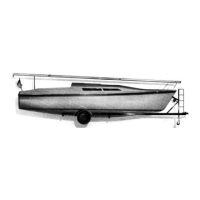
The cable that secures the boat to the trailer should be clipped
to the stainless eye on the nose of the boat and fastened
securely to the winch drum. The winch should be cranked
tight, pulling the nose firmly into the rubber block on the
trailer. Make sure the winch latch is secure to keep it from
unwinding. Don’t release the cable until the boat is in the
water.
BE EXCEEDINGLY CAREFUL WHEN SAILING IN
HIGH WINDS. LEARN BASIC SEAMANSHIP.
The Coast Guard Auxiliary Power Squadrons offer excel-
lent courses at low cost. This is an excellent investment.
ALWAYS SHUT OFF THE OUTBOARD MOTOR
WHEN THE BOAT IS NEAR PEOPLE IN THE WA-
TER. EVEN ON LOW HORSEPOWER MOTORS,
THE PROPELLER CAN DO SERIOUS DAMAGE.
NO PART OF THE WATER BALLAST VALVE (UN-
DER THE BOAT) SHOULD GO BELOW THE EXTE-
RIOR SURFACE OF THE HULL.
If the valve sticks out below the boat bottom, it can hang up
on the trailer as the boat goes on or off, causing damage to
the valve or to the hull.
EVERY TIME YOU LAUNCH THE BOAT. MAKE
SURE THAT THE WATER BALLAST VALVE IS
FLUSH AGAINST THE BOTTOM OF THE HULL.
THAT THE RUBBER SEAL IS CLEAN AND IN GOOD
SHAPE. AND THAT THE HULL UNDERNEATH THE
RUBBER SEAL IS CLEAN.
The valve must seat perfectly against the hull to prevent
leakage and loss of water ballast. Don’t leave it open when
the boat is in the water. Marine growth might get in between
the valve face and the hull, allowing leakage.
Frequently check the valve for damage.


 To Next Page