Need help?
Do you have a question about the Maier DQ Series and is the answer not in the manual?
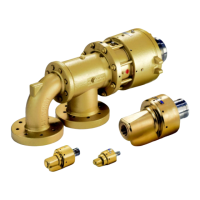
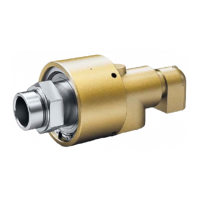
This document describes the DQ/DQL and ND 150 rotary joints manufactured by Christian Maier GmbH & Co. Maschinenfabrik. These rotary joints are designed for various industrial applications, facilitating the transfer of fluids (such as water, steam, or thermal oil) between a stationary supply and a rotating machine part.
The rotary joint's primary function is to maintain a sealed connection while allowing rotational movement. It consists of several key components working in conjunction to achieve this. The core mechanism involves a rotating sealing unit (100) that interfaces with a stationary counter ring (102). This interface is crucial for preventing fluid leakage during operation.
The rotary joint is equipped with tapered roller bearings (200, 202) that support the rotating components and ensure smooth, low-friction rotation. These bearings are pretensioned using springs (270) and secured by a grooved nut (240). A shaft sleeve (170) with O-ring (340) connects the rotating part to the rotor (80), further enhancing the sealing integrity.
Pressure springs (110-40) are incorporated to maintain constant contact between the sealing surfaces, compensating for wear and minor misalignments. Various O-rings (110-50, 110-60, 340, 350) and flat packings (360, 370) are strategically placed throughout the assembly to provide multiple layers of sealing and prevent fluid escape.
The design includes a main housing (30) and a cover (120) that enclose the internal components, protecting them from the external environment and containing the fluid. The assembly is secured using screws (400, 410, 450) and locking brackets (180).
The document references specific part numbers, indicating a modular design. Key components include:
The ND 150 designation likely refers to a nominal diameter or size specification for the rotary joint, indicating its capacity or the size of the pipe it connects to. The materials used for sealing surfaces are critical for performance and are often specified for different fluid types and operating conditions (e.g., carbon graphite, silicon carbide).
The rotary joints are designed for applications requiring continuous fluid transfer to rotating machinery. They are suitable for various media, including water, steam, and thermal oil, depending on the specific configuration and sealing materials chosen.
The modular design, indicated by the detailed parts list and assembly instructions, allows for customization and replacement of individual components. This contributes to the longevity and adaptability of the rotary joint across different industrial settings.
The assembly process emphasizes precision, particularly regarding the pretensioning of bearings and sealing units, to ensure optimal performance and prevent premature wear or leakage. The instructions highlight the importance of clean sealing surfaces and proper alignment during installation.
The document provides comprehensive instructions for repair and maintenance, focusing on disassembly and reassembly. This indicates that the rotary joints are designed to be serviceable, allowing for component replacement rather than full unit replacement in many cases.
Disassembly:
Reassembly:
Spare Parts Recommendation:
Overall, the design and documentation emphasize ease of maintenance, extended service life through component replacement, and reliable performance when proper installation and maintenance procedures are followed.
 General
| Brand | Maier |
|---|---|
| Model | DQ Series |
| Category | Plumbing Product |
| Language | English |


 To Next Page