3-58
IT
EN
NL
648747 IT-EN-NL (29/08/2013)
For these operations, consult your agent or dealer.
G3 - Check the internal chains for wear
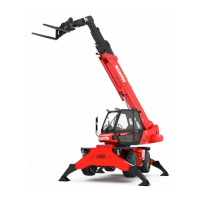
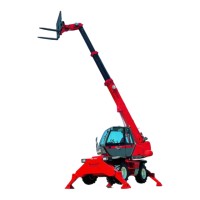
MRT 1840 ST3B (360°)
The wear on these chains appears:
1) On the joints, resulting in lengthening of the chain.
2) On the profile of the plates due to contact with the
pulleys and the guide systems.
3) On the sides of the external plates and on the heads of
the pins due to contact with the flanges of the pulleys or
with guide devices, if any.
G4 - Check the extension for wear
MRT 1840 ST3B (360°)
To keep the stretching of the chain under control it is
advisable to provide an adjustment module as attachment.
Since the wear will most probably not be uniform along the
entire length, the measuring must be done in sections
(divide the total length in 5 – 15 sections) which must be
appropriately identified.
The initial measurement must be taken which serves as
reference for the successive measurements, and it is
necessary to take into account that all successive
measurements must be done on the same sections.
After a few measurements, it is possible to identify the
sections which are most subject to wear, and successive
measurements can therefore be limited to these sections.
The measurement can be done using a sufficiently long
sliding calliper or a millimetre ruler. The reference may be
the head of the pins or the profile of the plate.
The measurement must be done with the chain taut (keep
the boom extension lever pressed for a few seconds) in the
rectilinear section.
The maximum extension limit is fixed at 2% taking into
account the weakening due to removal of material from
parts which influence the features of resistance of the chain
and due to wear of the hard surface layers (for cemented
pins).
).
Raadpleeg voor deze handelingen uw agent of dealer.
G3 - De slijtage van de interne kettingen
controleren
MRT 1840 ST3B (360°)
De slijtage aan deze kettingen vindt plaats:
1) Op de geledingen met verlenging van de ketting ten
gevolg.
2) Op het profiel van de platen door contact met de
kettingschijven en de geleidesystemen.
3) Op de zijkanten van de buitenplaten en op de koppen
van de pennen door contact met de flenzen van de
kettingschijven of met eventuele geleidesystemen.
G4 - Verlenging door slijtage controleren
MRT 1840 ST3B (360°)
Om de verlenging door slijtage onder controle te houden is
het raadzaam een registratieblad te gebruiken zoals in
bijlage.
Daar de slijtage waarschijnlijk niet over de hele lengte
gelijk zal zijn, moet de meting per stuk ketting uitgevoerd
worden (verdeel de totale lengte in 5 - 15 stukken) die
naar behoren geïdentificeerd moeten worden.
De aanvankelijke maat moet opgemeten worden ter
verwijzing voor de daaropvolgende metingen en deze
metingen moeten op dezelfde stukken worden verricht.
Na enkele metingen kunt u zien welke delen het meest
aan het slijtageverschijnsel zijn blootgesteld en dus kunt u
de daaropvolgende metingen beperken tot deze delen.
De meting kan gemaakt worden met een schuifmaat of
met een in millimeters verdeelde liniaal. Als verwijzing kan
de kop van de pennen of het profiel van de plaat gebruikt
worden.
De meting moet gemaakt worden met gespannen ketting
(de hendel voor het uitschuiven van de arm enkele
seconden ingedrukt houden) op het rechtlijnige stuk.
De maximale limiet voor de verlenging is 2% rekening
houdend met de verzwakking door de verwijdering van
materiaal van delen die de weerstandseigenschappen van
de ketting beïnvloeden en door de slijtage van de harde
oppervlaktelagen (voor gecementeerde pennen).
Per queste operazioni consultate il vostro agente o
concessionario.
G3 - Controllare l’usura delle catene interne
MRT 1840 ST3B (360°)
L'usura su queste catene si manifesta:
1)Sulle articolazioni con conseguente allungamento della
catena.
2)Sul profilo delle piastre per contatto con le pulegge e i
sistemi di guida.
3)Sui fianche delle piastre esterne e sulle testate dei perni
per contatto con le flange delle pulegge o con eventuali
dispositivi di guida.
G4 - Verifica allungamento per usura
MRT 1840 ST3B (360°)
Per tenere sotto controllo l'allungamento per usura è
consigliabile predisporre un modulo di registrazione come
allegato.
Poichè verosimilmente l'usura non sarà uniforme lungo
tutta la lunghezza, la misurazione deve essere effettuata
per tratti (suddividere la lunghezza totale in 5 - 15 tratti)
che vanno opportunamente identificati.
Deve essere rilevata la misura iniziale che serve di
riferimento per quelle sucessive, e va tenuto presente che
tutte le sucessive misurazioni devono avvenire sugli stessi
tratti.
Dopo alcune misure è possibile
identificare quali tratti sono maggiormente sottoposti al
fenomeno di usura e quindi le misurazioni successive
possono essere limitate solo a questi tratti.
La misura può essere fatta o con calibro corsoio
sufficientemente lungo o con riga millimetrata. Il
riferimento può essere o la testa dei perni o il profilo della
piastra.
La misurazione deve essere fatta con la catena in tensione
(tenere premuto per qualche secondo la leva sfilo braccio)
nel tratto rettilineo.
Il limite massimo di allungamento è fissato al 2 % tenendo
conto dell'indebolimento dovuto all'asportazione di
materiale da parti che influiscono sulle caratteristiche
resistenziali della catena e dal consumo degli strati duri
superficiali (per perni cementati).



 To Next Page
 Loading...