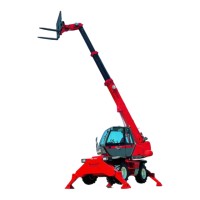
Inclinare sufficientemente il carico
all’indietro per assicurarne la stabilità
(perdita del carico durante la frenata)
facendo però attenzione a non modificarne
l’equilibrio.
- Se possibile (Fig. J), abbassare il carico
senza spostare il carrello elevatore. Alzare
il braccio (1) per allontanare il carico, far
rientrare (2) e abbassare il braccio (3) per
portare il carico in posizione di trasporto
(Fig. L).
- Se ciò non fosse possibile, arretrare il
carrello elevatore (Fig. K). Manovrando
molto dolcemente e con estrema
prudenza (Vedi paragrafo : E - VISIBILITÀ
nel capitolo : ISTRUZIONI PER LA
MOVIMENTAZIONE relativo alla visibilità
sul percorso), arretrare il carrello elevatore
(1) per allontanare il carico, far rientrare
(2) e abbassare il braccio (3) per portare il
carico in posizione di trasporto (Fig. L).
D - Posare un carico in alto su
pneumatici.
È tassativamente vietato depositare un
carico se il carrello elevatore non è in piano
(Vedi paragrafo : G - ORIZZONTALITÀ DEL
CARRELLO ELEVATORE, nel capitolo :
MOVIMENTAZIONE DI UN CARICO).
Tilt the load sufficiently backwards to ensure
its stability (loss of load on braking) without
upsetting the balance of the load in so doing.
- If possible (Fig. J) lower the load without
shifting the lift truck. Lift the jib (1) to
release the load, retract (2) and lower the
jib (3) to bring the load into the transport
position (Fig. L).
- If this is not possible, back the lift truck up.
(Fig. K) Manoeuvring very gently and
carefully (See paragraph : E - VISIBILITY in
the chapter : HANDLING INSTRUCTIONS
for visibility of the road), back up the lift
truck (1) to release the load, retract (2) and
lower the jib (3) to bring the load into the
transport position (Fig. L).
D - Laying a high load on tyres
Under no circumstances should you lay down
a load if the lift truck is not a horizontal
position. (See paragraph : G - HORIZONTAL
POSITION OF THE LIFT TRUCK in the chapter :
LOAD HANDLING).
Hel de last voldoende achterover om de
stabiliteit ervan te garanderen (verlies van de
lading bij het remmen) let er wel op het
evenwicht ervan niet te veranderen.
- Indien mogelijk (Fig. J), de lading laten
zakken zonder de heftruck te verplaatsen.
De arm (1) optillen om de lading van de
stapel af te halen, dan de arm intrekken (2)
en laten zakken (3) om de lading in de
transportstand te zetten (Fig. L).
- Als dit niet mogelijk is, de heftruck iets
achteruit rijden (Fig. K). Uiterst voorzichtig
en langzaam te werk gaan (zie paragraaf: E
- ZICHT in hoofdstuk: AANWIJZINGEN
VOOR DE VERPLAATSING met betrekking
tot het zicht op het traject), rijd de heftruck
achteruit (1) om de lading te verwijderen,
trek de arm in (2) en zet hem omlaag (3)
om de lading in de transportstand te
brengen (Fig. L).
D - Een last hoog neerzetten met de
heftruck op banden.
Het is ten strengste verboden een lading neer
te zetten als de heftruck niet vlak staat (zie
paragraaf: G - HORIZONTALE STAND VAN DE
HEFTRUCK in hoofdstuk: VERPLAATSEN VAN
EEN LADING).
1-26
IT EN NL
648747 IT-EN-NL (29/08/2013)
J
K
L



 To Next Page
 Loading...