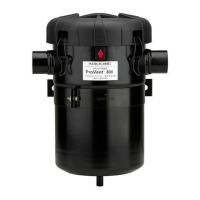
The ProVent® 200, Series 39 310 70 550, is a crankcase ventilation system designed and manufactured by MANN+HUMMEL. This device is engineered to manage blow-by gases in internal combustion engines, offering solutions for both open (oil separation only) and closed (recirculation of blow-by gases and crankcase pressure regulation) ventilation systems.
Function Description:
The core function of the ProVent® 200 is to separate oil from blow-by gases, which are a mixture of combustion gases and unburnt fuel that escape past the piston rings into the crankcase. By effectively separating oil, the system prevents oil mist from entering the intake system, which can lead to deposits, reduced engine efficiency, and increased emissions. In a closed system configuration, the ProVent® 200 also regulates crankcase pressure, ensuring optimal engine operation and preventing potential damage from excessive pressure buildup or vacuum. The system achieves this through a combination of a housing with an integral pressure control valve, a cover with a bypass valve, and an oil separator element. The pressure control valve maintains the desired crankcase pressure, while the bypass valve provides an alternative path for gases if the primary separation path is restricted or during specific operating conditions.
Important Technical Specifications:
- Weight: Approximately 450g.
- Blow-by Flow Rate: Capable of handling a maximum of 200 L/min. This indicates its suitability for a range of engine sizes and applications.
- Crankcase Pressure: Designed to operate within a crankcase pressure range of -15 mbar to a maximum of +5 mbar. This narrow operating window is crucial for maintaining engine health and performance.
- Bypass Valve Opening Pressure: The blow-off valve (bypass valve) opens at 50 mbar. This safety feature ensures that excessive pressure can be released, protecting the engine and the ProVent® unit itself.
- Temperature Range: The device is built to withstand a wide operating temperature range from -35°C to +120°C. It can also tolerate short-term temperatures up to +140°C, making it robust for various environmental and engine operating conditions.
- Mounting Flexibility: The ProVent® 200 offers significant flexibility in installation. It can be positioned in its support at twelve increments of 30° rotation and at four different height settings, allowing for adaptation to diverse engine bay layouts. The mounting bracket should be tightened to a torque of 9 ± 2 Nm.
- Connections: Features tangential inlet and outlet connectors, along with an oil drain back connection, designed for hose line attachment using hose clamps.
- Spare Parts: The primary replaceable component is the oil separator, identified by part number 39 310 50 950. The O-ring for the cover is part number 23 079 32 171.
Usage Features:
The ProVent® 200 is designed for ease of integration and reliable performance. Its robust construction and wide operating parameters make it suitable for various industrial and automotive applications where effective crankcase ventilation is critical. The ability to function as either an open or closed system provides versatility, allowing users to select the configuration best suited to their specific emission regulations and engine requirements. The flexible mounting options simplify installation in confined or complex engine compartments. To ensure safe operation, it is recommended to protect the ProVent® from dirt by fitting splash guards. The device is intended to be used only in perfect condition and in accordance with its technical specifications and operating instructions. Any faults, especially those affecting safety, must be rectified immediately.
Maintenance Features:
Maintenance of the ProVent® 200 primarily involves the replacement of the oil separator element.
- Maintenance Intervals: The oil separator must be replaced according to the device manufacturer's specifications or, at the latest, after 1000 operating hours. Operating conditions may necessitate shorter intervals. A key indicator for replacement is when oil leaks through the bypass valve (assuming the O-ring is intact), signifying a worn oil separator.
- Removal of Oil Separator: To remove the oil separator, the cover is rotated approximately half a turn anti-clockwise and lifted off. A tool, such as a screwdriver, may be used if the cover is stiff. The used oil separator is then pulled upwards for removal and should be disposed of according to local waste regulations.
- Assembly: Before installing a new oil separator, the housing, cover, and sealing surfaces should be cleaned. The O-ring (item 2 in the customer drawing) must be changed and lightly lubricated with engine oil. The new oil separator, also with a new, slightly oiled O-ring, is then slid into the housing. Finally, the cover is placed back on and turned clockwise until it latches securely into place.
- Safety Precautions: All maintenance work must be performed only when the engine is switched off. It is crucial never to start the engine without the oil separator and/or cover in place. Caution is advised due to the potential for hot air to escape, and the housing, cover, and hoses can become very hot, posing a burn risk. High-pressure cleaners should not be used on the device, as they can damage the valves and introduce water into the oil circuit.
- Regular Checks: Regular inspection for damage and external soiling is recommended to ensure optimal performance and longevity of the ProVent® 200.


 To Next Page

 General