LOW VS HIGH FREQUENCY:
CRITICAL INFORMATION |
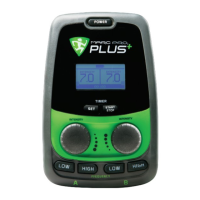
In the default pre-set mode the low frequency
button will deliver a frequency of 2Hz and the high
frequency button will deliver a frequency of 60 Hz.
When and How to use Low:
Low frequency will create relaxing rhythmic muscle
contractions. Although the contractions can get very strong,
they should remain comfortable and are completely non-
fatiguing; this makes them ideal for moving nourishment
and waste–the keys to conditioning and recovery
(but remember Marc Pro Plus’s unique low frequency
technology can also really help soreness as well).
It’s hard to go wrong with low frequency, as it can
benefi t all major muscle groups, but use common sense.
No need to try to pump low frequency through a knee
or ankle joint; there’s just not much muscle to contract.
Instead, contract the largest muscles around your
target to bring nourishment in and get waste out. The
stronger the contractions the better, as long as it remains
comfortable and within your tolerance.
A 30-60 minute session is great, but there’s no time limit
on low frequency, as it won’t fatigue your muscles and
keeps helping the more you use it.
When and How to use High:
High frequency will create a strong, but soothing and
constant buzzing sensation (no contractions). This is
ideal for shutting down more nagging soreness and
pain that’s not responsive to low frequency.
You must take more care in choosing electrode
placement with high frequency.
High frequency is typically not recommended for
many major muscle groups such as quads, calves,
hamstrings, traps, biceps, triceps, and forearms.
These muscles are likely to tetanize (fully contract
and hold) when the intensity is turned up. Allowing
the muscles to tetanize for any duration of time
will likely cause muscle fatigue. When using high
frequency we advise to never allow the muscle to
tetanize, which may require avoiding high frequency
in that location or lowering the intensity level.
High frequency is very effective at shutting down
soreness of the joints and muscle groups that are
very resistant to tetanization and fatigue, such as the
low back muscles. Other examples include ankle, knee,
hip, shoulder, wrist, low back, mid back and neck.
When you use high frequency you want to feel the
buzzing right where the pain is; if that’s not the
case, move the electrodes (if the pain is in a muscle
that will tetanzie, like the quads or calves, use low
frequency). Once it’s buzzing right where the pain
is, turn the intensity strong enough to block the pain
signals, but always stay within your tolerance.
A 30 minute high frequency session will typically
provide lasting relief. To avoid skin irritation, we
recommend not performing high frequency for
more than 60 minutes at one time.
Low and High Frequency Together
As you’ll see in the following examples, it is
common to combine settings. For example, channel
A will use low frequency on the quad to recover
(moving nourishment and waste), while at the same
time channel B is sandwiching the knee shutting
down any residual extremity pain using high
frequency.
14
MPRO_19-003_MPP_MANUAL_FINAL_IMAGES_C8.5.indd 14MPRO_19-003_MPP_MANUAL_FINAL_IMAGES_C8.5.indd 14 9/1/20 5:43 AM9/1/20 5:43 AM


 To Next Page
 Loading...