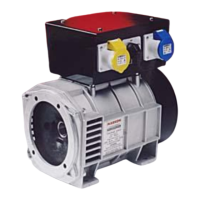
The document is an Installation, Service & Maintenance Manual for Markon SAW FUJI generators, specifically covering models BL, NL, SL, TL, and CL, with various suffixes (105A, 105B, 105C, 105D, 105E, 105F, 105G). The manual, published in March 2000 (Publication No. M2/0/025ED6E), provides comprehensive information for the safe and efficient operation, installation, and maintenance of these generators.
General Device Description:
The Markon generators described in this manual are designed for power generation applications, suitable for various environments including portable (open and enclosed), containerized, ship-borne, commercial vehicles, rail transport, industrial vehicles, fixed installations (industrial, residential, commercial, light industrial, home/office/health), energy management (combined heat and power, peak lopping), and alternative energy schemes. They are manufactured to Q.A. procedures conforming to BS EN ISO 9002 and comply with the EC Machinery Directive 89/392/EEC (as amended by 91/368/EEC), EMC Directive 89/336/EEC, and Low Voltage Directive 73/23/EEC (as amended by 93/68/EEC). The generators are designed to meet 'industrial' emissions and immunity standards, with factory consultation recommended for residential, commercial, and light industrial standards.
Specific Model Descriptions and Technical Specifications:
-
BL105 Generator:
- Function: Self-exciting brushless generator, designed for single-phase loads at or near a power factor of 1.0.
- Principle of Operation: An auxiliary winding, in conjunction with an excitation capacitor, induces current in the rotor (field) windings, which is rectified to produce a direct current field.
- Technical Specifications: Main stator winding designed for series/parallel connection to provide dual voltage output. No voltage adjustment is possible.
- Usage Features: Primarily for single-phase power generation.
- Maintenance Features: Fitted with sealed-for-life bearings, requiring no regular mechanical maintenance.
-
NL105 Generator:
- Function: Self-exciting rotating field design generator.
- Principle of Operation: Auxiliary winding provides excitation power through a choke and rectifier into the rotating field via sliprings.
- Technical Specifications: Main stator winding designed for series/parallel connection, offering dual voltage output, primarily for unity power factor loads. Some models include a d.c. auxiliary output winding.
- Usage Features: Suitable for single-phase power generation, especially for unity power factor loads.
- Maintenance Features: Requires regular inspection of brushes and sliprings at 500-hour intervals. Brushes should be replaced when worn to a depth of 8mm and bedded with a medium-grade abrasive cloth. Sliprings, if pitted, should be lightly skimmed after rotor removal.
-
SL105 Generator:
- Function: Self-exciting, Automatic Voltage Regulator (AVR) controlled, rotating field design generator.
- Principle of Operation: Auxiliary winding provides excitation power through a choke and rectifier into the rotating field via sliprings. The AVR diverts excess excitation at low loads to maintain the main stator winding output voltage within close limits.
- Technical Specifications: Designed for single-phase loads, with close regulation and capability of operation at 0.8 power factor. Main stator winding designed for series/parallel connection, providing dual voltage output with voltage adjustment.
- Usage Features: Offers precise voltage regulation for single-phase applications. Voltage can be adjusted via the 'volts adjust' potentiometer (VR1) on the AVR board. Stability can also be adjusted.
- Maintenance Features: Similar to NL105, requires regular inspection of brushes and sliprings. AVR is accessible by removing the cover of the black, side-mounted box.
-
TL105 Generator:
- Function: Self-exciting, Automatic Voltage Regulator (AVR) controlled, rotating field three-phase generator.
- Principle of Operation: Aux stator winding provides excitation power through the AVR, which controls the excitation level passed via sliprings into the field winding (rotor). The AVR senses the main stator winding output voltage and adjusts excitation to maintain it within close limits under varying loads.
- Technical Specifications: Designed for balanced and unbalanced three-phase loads at power factors between 0.8 and 1.0. AVR input voltage must be in the range of 100-120V. Voltage range is approximately 5% (e.g., 380-415 volts). May be supplied with a 12-lead winding for series/parallel connection.
- Usage Features: Provides stable three-phase power with voltage adjustment via the 'SET VOLTS' control potentiometer on the AVR.
- Maintenance Features: Similar to NL105 and SL105, requires regular inspection of brushes and sliprings. AVR access is gained by removing the cover of the black, side-mounted box.
-
CL105 Generator:
- Function: Self-exciting three-phase generator with current compounded excitation control, specifically designed for vehicle refrigeration equipment.
- Principle of Operation: Excitation control (generator-mounted or remote) consists of a linear reactor (LR) for no-load excitation and a current transformer (CT) for increased excitation under load. The frequency-sensitive nature of the LR and CT enables proportional control of output voltage with respect to speed (or Hz). Excitation power from LR and CT is vectorially summed, rectified, and fed via sliprings into the main field (rotor) winding.
- Technical Specifications: Capable of operation over a wide speed range (1800 to 3600 r.p.m.), delivering output voltage of 250 to 500 volts at frequencies of 30 to 60 Hz. The neutral of the windings is connected to the frame earth terminal.
- Usage Features: Designed for demanding vehicle refrigeration applications, maintaining output voltage within limits despite varying load and speed. Factory-set, but no-load voltage can be adjusted by modifying the linear reactor's airgap.
- Maintenance Features: Similar to NL, SL, TL models, requires regular inspection of brushes and sliprings. Air gap adjustment of the linear reactor should be made in small increments by qualified personnel using non-magnetic packing material.
Common Technical Specifications and Features:
- Standards: Designed to comply with most International Standards, suitable for operation in ambient temperatures up to 40°C.
- Airflow: Requires unrestricted cooling air intake and exhaust to prevent overheating.
- Direction of Rotation: Suitable for either direction of rotation.
- Drive Arrangement: Designed for SAE J609a Flange A Extension 5 (3/4" Taper) or Flange B Extension 6 (7/8" Taper) engines. Two-bearing arrangements are available with a 22mm diameter, 45.5mm long shaft extension. Minimum pulley pitch diameter for belt-driven applications is 118mm (max side load 700N, 1000N for road vehicle generators).
- Bearings: BL models have sealed-for-life bearings. Two-bearing machines use standard sealed-for-life ball bearings. Road vehicle generators feature larger bearings, with the drive end bearing clamped and the non-drive end bearing in a steel housing with an 'O' ring.
- Earthing: Stator windings are isolated from the frame. An earth terminal is provided on the bearing support for bonding to the generating set frame. Access to the earth terminal requires removal of the end cover. The installer is responsible for providing suitable bonding to earth.
- Loading: Suitable for continuous supply of most load types, not exceeding the nameplate current. Engine power must be sufficient (approx. 2 HP per 1kW electrical load). Motor starting currents should be considered: total current should not exceed twice the full-load current for BL105, 1.5 times for SL105/TL105, and 3 times for CL105.
- Electrical Connections: Supplied with flying leads from main stator windings. BL105, NL105, SL105 can be permanently connected or switched for desired output voltage(s). Installer must provide overload protection. CL105 may have flying leads terminated in a socket with separate excitation control components or a complete package in a generator-mounted box. Interconnection for separate components uses multipin sockets and plugs, requiring adequate ventilation.
- Voltage Selection: Main stator windings are in two sections for series (higher voltage, e.g., 230V) or parallel (lower voltage, e.g., 115V) connection. BL105 models can provide 110V CTE output from a centre tap in series connection.
Maintenance Features (General):
- Safety Precautions: Emphasizes reading manuals, ensuring proper installation by qualified electricians, not operating with covers removed, disabling engine starting circuits during maintenance, and disabling closing circuits/placing warning notices on circuit breakers.
- Inspection: Upon receipt, check against Advice Note, remove dust/packing. Report damage/missing parts immediately. Installer is responsible for fitting nameplates if supplied separately.
- Periodic Inspection: Generators must be periodically inspected, and dirt/oil accumulation removed. Air inlet/outlet openings must be unobstructed.
- Insulation Resistance Check: Recommended after storage or long idle periods (refer to subsection 4.2).
- Bearing Replacement: Recommended during generating set overhaul (refer to Section 5).
- Brush and Slipring Maintenance: For NL, SL, TL, and CL models, inspect at 500-hour intervals. Replace brushes when worn to 8mm depth and bed new brushes. Skim pitted sliprings.
- Dismantling/Assembly Procedures: Detailed instructions are provided for assembling the generator to the engine, dismantling the stator frame, withdrawing the rotor, and removing/replacing specific components like capacitors (BL models), diodes/varistors (BL models), AVR (SL/TL models), diode bridge (SL/NL models), choke (SL/NL models), radio interference suppressor (SL/TL models), bearings, and brushes/brushbox/brush caliper assemblies (CL, SL, TL, NL models). Torque settings are also provided.
- Spares and After Sales Service: Includes recommended spares and contact information for after-sales service. Parts identification diagrams are provided for various models and bearing configurations.
- Warranty: Warranty details are located inside the back cover of the manual.

 Need help?
 General

 To Next Page