Měřící Energetické Aparáty
38
As well, powers are evaluated in each of the measuring time intervals T
m
. e following
formula is applied to compute the active power:
(3)
where K = 320. From the values u
1
(k) and i
1
(k), the active power P
1
in phase 1 is obtained,
from the values u
2
(k) and i
2
(k) the active power P
2
in phase 2 is obtained, from the values
u
3
(k) and i
3
(k), the active power P
3
in phase 3 is obtained.
From the RMS phase voltage value U and from the RMS current value I in the same
phase and the same measuring time interval T
m
, the apparent power is evaluated.
S = U I (4)
Particularly S
1
= U
1
I
1
, S
2
= U
2
I
2
, S
3
= U
3
I
3
.
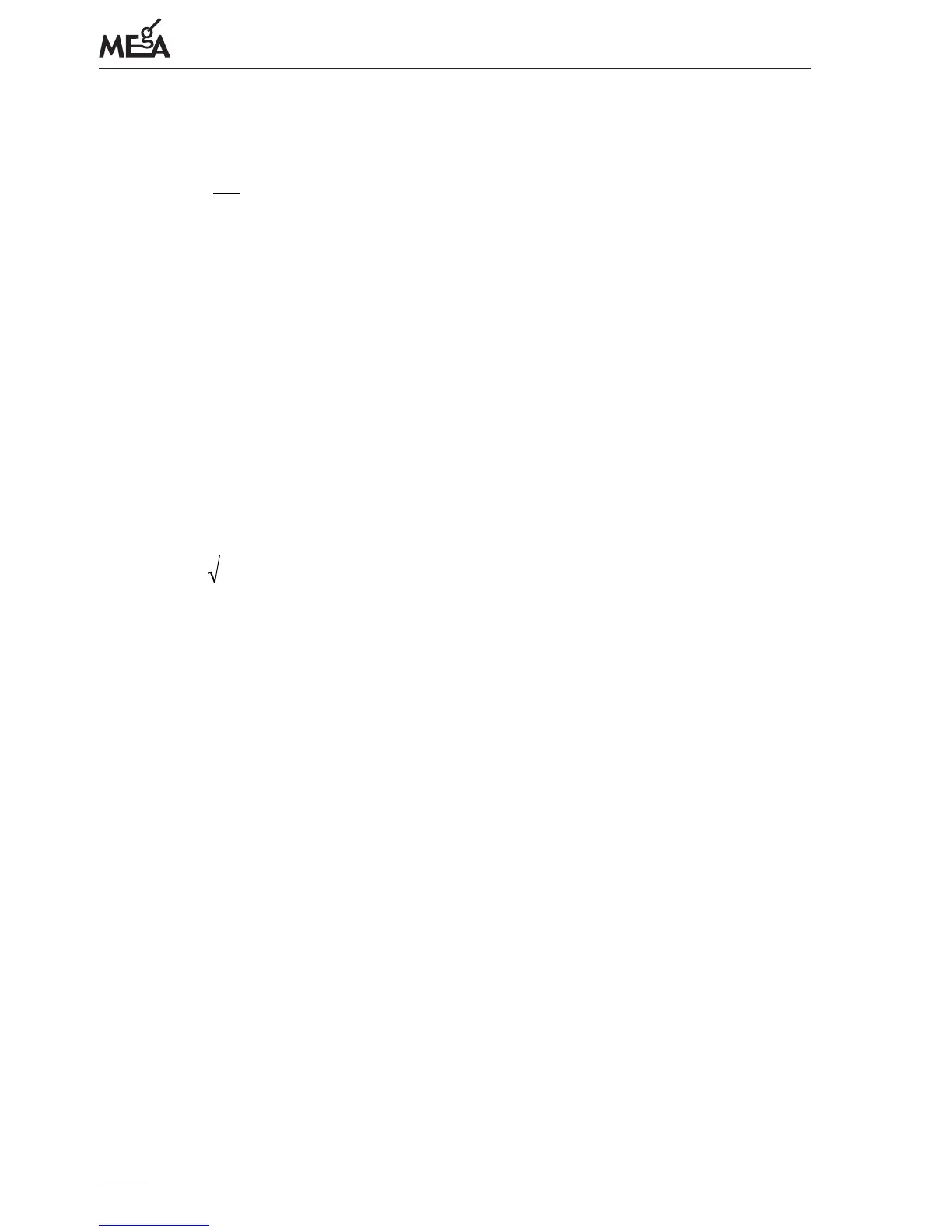
e reactive power (including the deformation one) in each phase and in the same
measuring time interval T
m
is determined according to the formula
(5)
So Q
1
is obtained from S
1
and P
1
, Q
2
from S
2
and P
2
, Q
3
from S
3
and P
3
.
To assess the electrical power eciency in each phase, the coecient of performance (true
power factor) is used:
(6)
particularly η
1
, η
2
, η
3
.
e total outlet powers result from the powers in the individual phases.
In case of long-term measurements, a high number of data is obtained in the follow-
up measuring time intervals T
m
for each voltage and current. Recording of all of these
data would be demanding on the monitor memory and would not provide any general
overview of measurement results. erefore, time aggregation of the mentioned data is
used. e recording interval T
z
is selected, containing L measuring time intervals T
m
,
i.e. T
z
= L T
m,
where L is a natural number. From data measured in the measuring time
intervals T
m
for the individual voltages, currents and powers, simple data are derived
characterizing voltage, current and power values in the individual recording intervals T
z
.
If for the given voltage, the RMS values U(l) were obtained in the measuring intervals T
m
and with the serial numbers l = 1, 2, … L, the following total RMS value is corresponding
in the recording intervals T
z
.
22
PSQ −=


 To Next Page
 Loading...