Brake Inspection
The brake levers and the brake pads are the two main
components that need to be checked to ensure your brakes
are functioning effectively. Positioning of the brake levers
should be checked to ensure they can be easily reached by
the rider’s hands and alterations made as necessary. Some
brake levers have a screw adjuster to change the distance
between the lever and the handlebar grip. This should be
checked for tightness every three months. Similarly, at least
every three months the brake levers should be tested to
ensure they do not move on the handlebars and each brake
lever moves freely when compressed.
Prior to every ride inspection of the brake pads is recom-
mended. The brake pads must be centered, with approxi-
mately 1.5mm – 2mm clearance between each pad and
the rim when the brakes are not in use. Test that when the
brakes are applied that the brake pads squeeze the rims
suffi ciently to stop the bike. Replace the brake pads if the
grooves or pattern has worn away from the surface. Ensure
that the brake pads are fi rmly secured before every ride
and at least every three months check the tightness of the
numerous bolts and nuts supporting the brake pads.
44
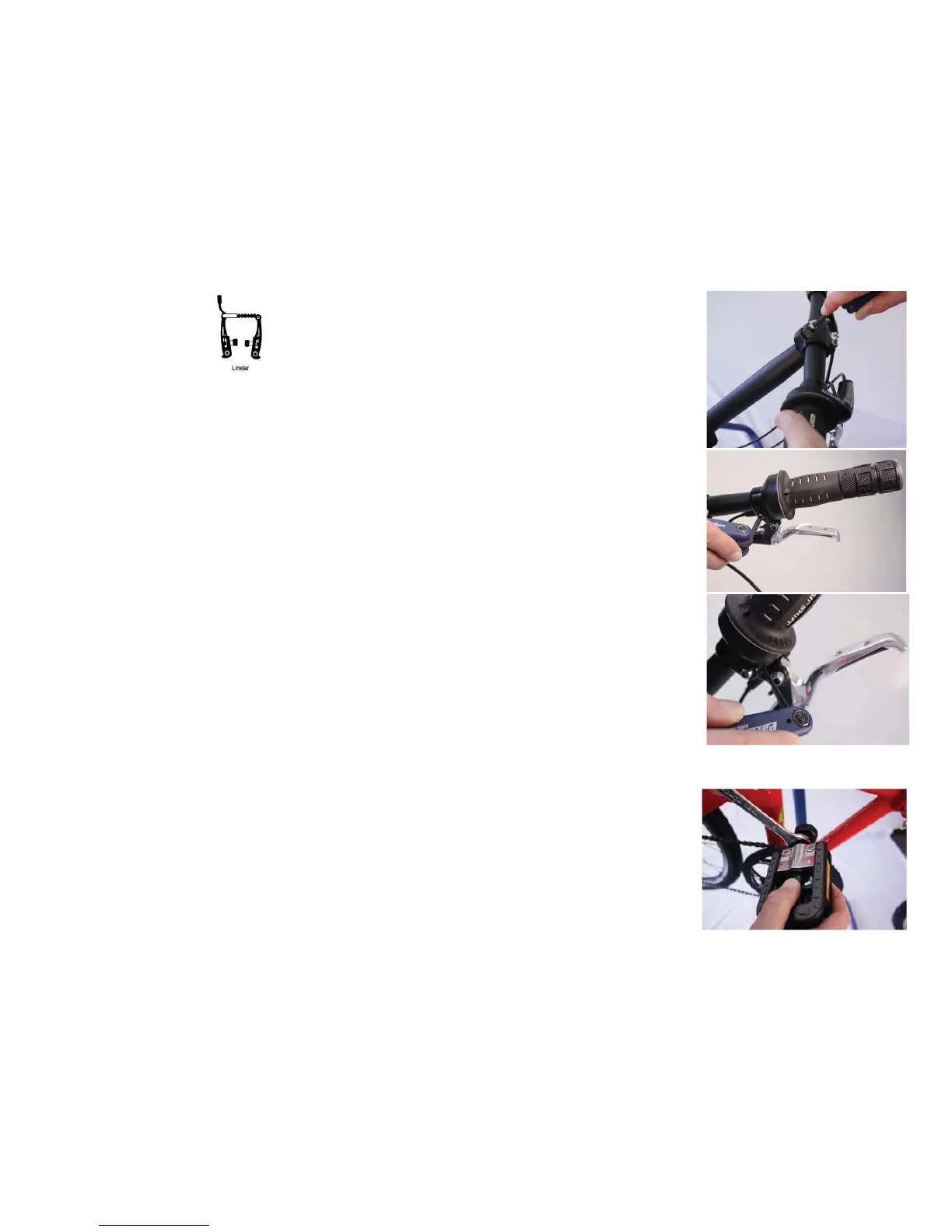
Check the positioning
of the handlebars. The
sweep (handlebar curve
towards the seat) should
be coming straight
back, not upwards or
downwards-unless you
like it that way? To adjust
the angle of the handle
bars, loosen the (2) 5mm
adjustors at the top of
the stem. To adjust the
angle of the (2) brake
levers; loosen the 5 mm
adjustor under each lever.
To adjust the angle of the
SRAM grip shift indicator,
loosen the 2.5mm adjus-
tor.
Install the pedals into
the crank. Each pedal is
labeled for left or right
side (R,L) on the end of
their bolts. Use a 15mm
wrench to fi rmly tighten
the pedals by moving the
wrench toward the front
of the bike on both sides.
17



 To Next Page