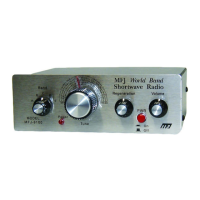
MFJ-8100
World Band Receiver
16
The purpose of the following information is to give newcomers
a general idea of what to expect to hear in each of the 5
frequency ranges tuned by your receiver.
First, please understand that the frequency markings on the
tuning dial can be only approximate. They indicate the
"general neighborhood'' of major frequency bands and have an
accuracy only within a few hundred KHz. (If you are
wondering what it would take to make the dial perfectly
accurate, imagine an adjustable trimmer capacitor AND an
adjustable coil for EACH band! The process of making these
many adjustments is called alignment and also requires the
use of frequency measuring equipment far more costly than the
receiver.)
Whenever you hear a broadcast of special interest to you
which you would like to be able to find again, make a note of
the time, frequency band, and approximate dial position. In
fact, such notes are called a "Shortwave Listening Log.'' A
sample log page is printed in this book which you may copy to
make your own logbook. Or, use your computer to design the
style of logging pages best for you.
Range A: 3.5 to 4.3 MHz.
The primary purpose of this tuning range is to make it very
easy for you to listen to ham radio stations at night on what
is known as the 80/75 Meter band. From 3.5 to 3.8 MHz,
you'll hear mostly Morse Code signals. From 3.8 to 4.0 MHz,
you will hear SSB voice conversations from all around the
nation. You'll hear both sides of most conversations.
You may hear occasional shortwave broadcasts mixed in among
the hams in the 3.9 to 4.0 MHz region and possibly in the 90
Meter band, 3.2 to 3.4 MHz.
Range B: 5.85 to 7.40 MHz.
The main purpose of this tuning range is to give you lots of
strong shortwave broadcasts in late afternoon and throughout
the
night on the 49 meter band, 5.95 to 6.2 MHz.
The 40 meter ham radio band is 7.0 to 7.3 MHz, and you will
also hear foreign broadcasts among the ham CW and SSB
signals.
Range C: 9.5 to 12.00 MHz.
This band lets you tune all of the popular 31 meter broadcast
band, 9.5 to 9.9 MHz. You can also find the WWV time
standard signal at 10.0 MHz (or on Band D at 15.0 MHz.) The


 To Next Page