EasyManua.ls Logo

MGA CS-2015R - Page 4

Default Icon
28 pages
Print Icon
To Next Page IconTo Next Page
To Previous Page IconTo Previous Page
Loading...
15
16.
17.
.
Overloading
Do
not
overload
wall
outlets
and
extension
cords
as
this
can
result
in
a
risk
of
fire
or
electric
shock.
Object
and
Liquid
Entry
Never
push
objects
of
any
kind
into this
TV
receiver
through
openings
as
they
may
touch
dangerous
voltage
points
or
short-out
parts
that
could
result
in
a
fire
or
electric
shock.
Never
spill
liquid
of
any
Kind
on
the
TV
receiver.
Outdoor
Antenna
Grounding
If
an
outside
antenna
or
cable
system
is
con-
nected
to
the
TV
receiver
be
sure
the
antenna
or
cable
system
is
grounded
so
as
to
provide
some
protection
against
voltage
surges
and
built-up
static
charges.
Section
810
of
the
National
Electrical
Code,
ANSI/NFPA
Na.
70
-
1984,
provides
informa-
tion
with
respect
to
praper
grounding
of
the
mast
and
supporting
structure,
grounding
of
the
lead-in
wire
to
an
antenna
discharge
unit,
size
of
grounding
conductors,
location
of
antenna-discharge
unit,
connection
to
ground-
ing
electrodes,
and
requirements
for
the
grounding
electrode.
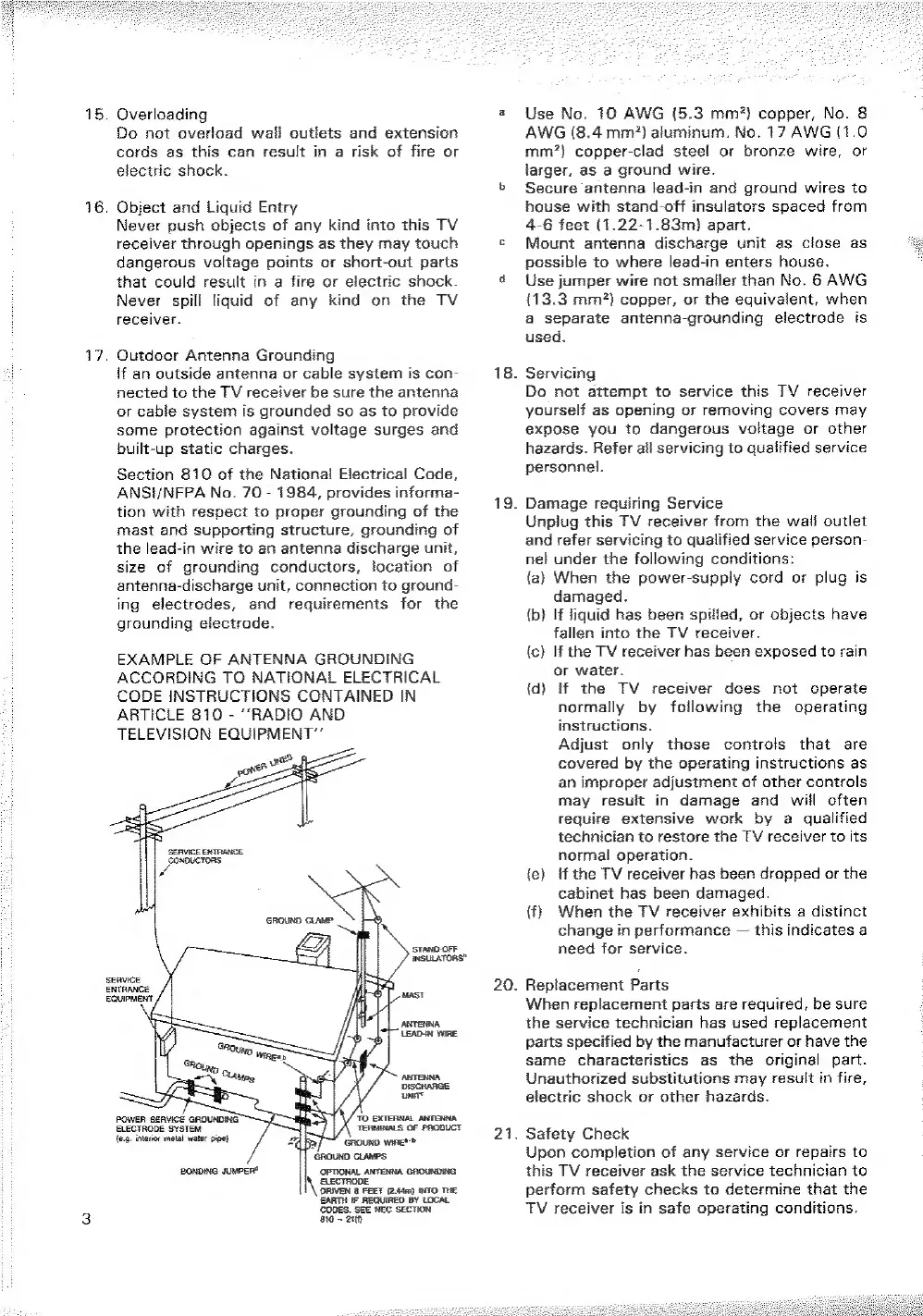
EXAMPLE
OF
ANTENNA
GROUNDING
ACCORDING
TO
NATIONAL
ELECTRICAL
CODE
INSTRUCTIONS
CONTAINED
IN
ARTICLE
810
-
“RADIO
AND
TELEVISION
EQUIPMENT’
SERVICE
ENTRANCE
CONDUCTORS
SERVICE
ENTRANCE
EQUIPMENT
POWER
SERVICE
GROUNDING
By
SLECTRODE
SYSTEM
(ea.
interior
metal
waler
pipe)
i
‘GROUND
CLAMPS
BONDING
JUMPERS
OPTIONAL
ANTENNA
GROUNDING
DRIVEN
@
FEET
(2.4m)
INTO
THE
EARTH
IF
REQUIRED
BY
LOCAL
CODES.
SEE
NEC
SECTION
ato
2H
18.
19.
Use
No,
10
AWG
(5.3
mm?)
copper,
No.
8
AWG
(8.4
mm?)
aluminum.
No.
17
AWG
(1.0
mm?)
copper-clad
steel
or
bronze
wire,
or
larger,
as
a
ground
wire.
Secure
antenna
lead-in
and
ground
wires
to
house
with
stand-off
insulators
spaced
from
4-6
feet
(1.22-1.83m}
apart.
Mount
antenna
discharge
unit
as
close
as
possible
to
where
lead-in
enters
house.
Use
jumper
wire
not
smaller
than
No.
6
AWG
{13.3
mm?)
copper,
or
the
equivalent,
when
a
separate
antenna-grounding
electrode
is
used.
Servicing
Do
not
attempt
to
service
this
TV
receiver
yourself
as
opening
or
removing
covers
may
expose
you
to
dangerous
voltage
or
other
hazards.
Refer
all
servicing
to
qualified
service
personnel.
Damage
requiring
Service
Unplug
this
TV
receiver
from
the
wali
outlet
and
refer
servicing
to
qualified
service
person-
nel
under
the
following
conditions:
{a}
When
the
power-supply
cord
or
plug
is
damaged.
(b}
If
liquid
has
been
spilled,
or
objects
have
fallen
into
the
TV
receiver.
{c}
If
the
TV
receiver
has
been
exposed
to
rain
or
water.
if
the
TV
receiver
does
not
operate
normally
by
following
the
operating
instructions.
Adjust
only
these
controls
that
are
covered
by
the
operating
instructions
as
an
improper
adjustment
of
other
controls
may
result
in
damage
and
will
often
require
extensive
work
by
a
qualified
technician
to
restore
the
TV
receiver
to
its
normal
operatian.
if
the
TV
receiver
has
been
dropped
or
the
cabinet
has
been
damaged.
{f}
When
the
TV
receiver
exhibits
a
distinct
change
in
performance
this
indicates
a
need
for
service.
id}
fe)
.
Replacement
Parts
When
replacement
parts
are
required,
be
sure
the
service
technician
has
used
replacement
parts
specified
by
the
manufacturer
or
have
the
same
characteristics
as
the
original
part.
Unauthorized
substitutions
may
result
in
fire,
electric
shock
or
other
hazards.
.
Safety
Check
Upon
completion
of
any
service
or
repairs
to
this
TV
receiver
ask
the
service
technician
to
perform
safety
checks
to
determine
that
the
TV
receiver
is
in
safe
operating
conditions.