
 Need help?
Do you have a question about the Middle Atlantic SRSR Series and is the answer not in the manual?
Host enclosure must be secured to floor or wall to prevent falling forward.
Procedure to remove and reattach the rack from its base using wing nuts.
Guidance on routing and securing cables for the rotating rail system.
Steps for applying the optional gasket to fill gaps between rack and millwork.
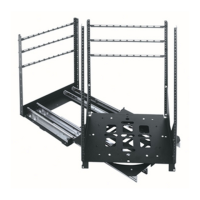
The SRSR Series Rotating Sliding Rail System is a specialized rack system designed to provide convenient access to the rear of installed equipment, making it ideal for various applications such as millwork, cabinets, and flush in-wall installations. This system enhances accessibility and simplifies maintenance by allowing the rack to slide out and rotate, offering a comprehensive view and easy reach to connections and components.
The core function of the SRSR Series is to facilitate the rotation and sliding of a rack frame, enabling users to access the rear of equipment without having to remove it from its installed position. This is achieved through a robust base and sliding carriage mechanism that supports the rack. The system includes a rotating tab and a lockout lever, which allow the rack to be pulled out, rotated to specific angles (60° and 90°), and then locked in place for service. When service is complete, the lockout lever is pushed down, and the rack can be slid back into its closed position.
The design incorporates features that ensure stability and security. For instance, the host enclosure (cabinet) must be adequately secured to the floor or wall to prevent tipping when the rack is pulled out. The system is engineered to distribute weight effectively, recommending that at least half of the equipment's weight be mounted in the lower third of the rack to maintain balance.
The SRSR Series also offers a unique rack removal feature, allowing the rack frame to be detached from its base. This is particularly useful for in-shop integration of equipment and on-site installation, as it allows for easier handling and pre-configuration of the rack before final placement. To remove the rack, it is extended, and four wing nuts on the bottom of the frame are unfastened. The rack can then be lifted from its sides using integrated handles. Reattachment involves extending the slides, aligning the rack's studs with holes on the base, and securing it with the wing nuts.
Cable management is a critical aspect of the SRSR Series. The system includes cable management supports and lacer bars designed to organize and secure cables. Users are advised to determine the direction of rack rotation and route cables accordingly, typically dedicating one side for signal cables and the opposite for power cables. Cables should be laced as shown in the instructions, ensuring they are taut but not pinched, to create a service loop that accommodates the rack's movement without strain. The system is designed such that once cabling is complete, the rack will only rotate in the direction originally selected, preventing accidental damage to connections.
For installations requiring a clean finish or gap filling, an optional gasket (Model # BG17) is available. This gasket is designed to fill gaps between the rack and millwork, providing a neat appearance and preventing dust and debris ingress. Its installation involves cleaning the rack surface, removing the paper backing from the gasket, and adhering it along the bottom, sides, and top of the rackrail, trimming any excess length.
The SRSR Series is designed for ease of use and flexibility in various installation environments. Its primary usage feature is the ability to provide easy access to the rear of equipment, which is crucial for troubleshooting, maintenance, and making changes to connections. The sliding and rotating mechanism allows for a full 90-degree rotation, offering unobstructed access to the back of all installed components.
Installation begins with attaching cable management supports and lacer bars to the rack frame. The lacer bars are installed with their flat side on top and aligned with the outside edge of the rackrail, using included rackscrews. Rackrails are sorted by side (left and right) and attached to the front and rear of the sliding section using flange nuts. For larger SRSR systems (25 rackspace or more), front-to-rear braces are also included and attached with flange nuts for added stability. Squaring panels are installed approximately one-third of the way down from the top of the front and rear rackrail using Phillips rack screws. These panels should remain in place until some equipment is loaded to help maintain the rack's squareness.
The base of the SRSR system is positioned and centered in the millwork with a desired setback. Preliminary mounting holes are used to initially attach the SRSR base to the millwork. It is crucial to remove the "Locking Trim Panel" and test the sliding operation to ensure there is no interference with the millwork. Fine-tuning the mounting location may be necessary by loosening the preliminary mounting points and adjusting as required. Once the sliding carriage is extended to its outermost position, the base is fully attached to the host enclosure using customer-supplied hardware, utilizing all designated mounting points for maximum stability.
The rotating tab is a key operational feature, allowing users to pull and rotate the bay. The bay conveniently locks at 60° and 90° positions, providing stable open service positions. To slide the rack back into its closed position, the lockout lever must first be pushed down.
The rack removal feature is a significant usage benefit, particularly for integrators. It allows for off-site equipment integration, meaning the rack can be populated with equipment in a workshop setting and then transported to the installation site for final placement. This streamlines the installation process and reduces on-site labor.
The optional gasket, when used, contributes to the aesthetic and functional integration of the rack into its environment. It ensures a professional finish by closing any gaps between the rack and surrounding millwork, which is especially important for visible installations.
The design of the SRSR Series inherently supports easy maintenance of the installed equipment. By providing full access to the rear of the components, technicians can perform tasks such as cable changes, component swaps, and diagnostic checks without having to pull out individual pieces of equipment or struggle with limited space. This reduces the time and effort required for maintenance activities.
The cable management system, with its lacer bars and supports, helps maintain an organized cabling structure. This organization is vital for efficient troubleshooting and maintenance, as it allows for quick identification and access to specific cables. The instruction to ensure cables are "fairly taut" and form a service loop prevents tangling and strain, which can lead to cable damage over time. Proper cable management also minimizes the risk of accidental disconnections during rack movement or service.
The rack removal feature also aids in maintenance. If a major overhaul or extensive work is required on the equipment, the entire rack frame can be easily detached from its base and moved to a more convenient workspace. This allows for more comfortable and thorough maintenance, especially for complex systems.
The robust construction and clear assembly instructions contribute to the longevity and maintainability of the SRSR system itself. The use of flange nuts, rackscrews, and specific mounting procedures ensures that the system remains stable and functional over time. Regular checks of these fasteners, particularly after initial installation and during routine maintenance, can help prevent loosening and ensure continued smooth operation.
The optional gasket, while primarily an aesthetic and protective feature, also contributes to maintenance by preventing dust and debris from entering the rack enclosure. A cleaner environment for electronic equipment can extend its lifespan and reduce the need for internal cleaning, which can be a time-consuming task.
In summary, the SRSR Series Rotating Sliding Rail System is designed to simplify the installation, usage, and maintenance of rack-mounted equipment by providing unparalleled access to the rear of components through its innovative sliding and rotating mechanism, robust construction, and thoughtful cable management features.
 General
| Material | Steel |
|---|---|
| Color | Black |
| Series | SRSR |
| Category | Racks & Stands |
| Mounting | Floor |
| Compatibility | 19" equipment |
| Finish | Powder-coated |

 To Next Page