Empfohlener Trennungsabstand zwischen tragbaren und mobilen
HF-Kommunikationsgeräten und dem Propulse
Das Propulse ist für den Gebrauch in einer elektromagnetischen Umgebung bestimmt, in der HF-Störungen
kontrolliert sind. Der Kunde oder Benutzer des Propulse kann helfen, elektromagnetische Störungen zu verhindern,
indem ein Mindestabstand zwischen tragbaren und mobilen HF-Kommunikationsgeräten (Transmitter) und dem
Propulse, wie unten beschrieben, eingehalten werden, gemäß
der maximalen Ausgangsleistung der Kommunikationsgeräte.
Maximale
Ausgangsnennle
istung des
Transmitters
(W)
Trennungsabstand gemäß der Sendefrequenz
(m)
150 kHz bis 80 MHz
d = 1,17 v P
80 MHz bis 800 MHz
d = 1,17 v P
800 MHz bis 2,5 GHz
d = 2,33 v P
Für Transmitter, deren maximal abgegebene Leistung oben nicht angegeben ist, kann der empfohlene
Trennungsabstand d in Metern (m) mit der für die Frequenz anzuwendende Gleichung berechnet werden, wobei p die
maximal abgegebene Leistung des Senders in Watt (W) nach Angaben des Senderherstellers ist.
HINWEIS 1: Bei 80 MHz und 800 MHz trifft der Trennungsabstand für den höheren Frequenzbereich zu. HINWEIS 2:
Diese Richtlinien treffen nicht in allen Situationen zu. Die Ausbreitung elektromagnetischer Wellen wird durch
Absorption und Reflexion von Strukturen, Objekten und Menschen beeinträchtigt.
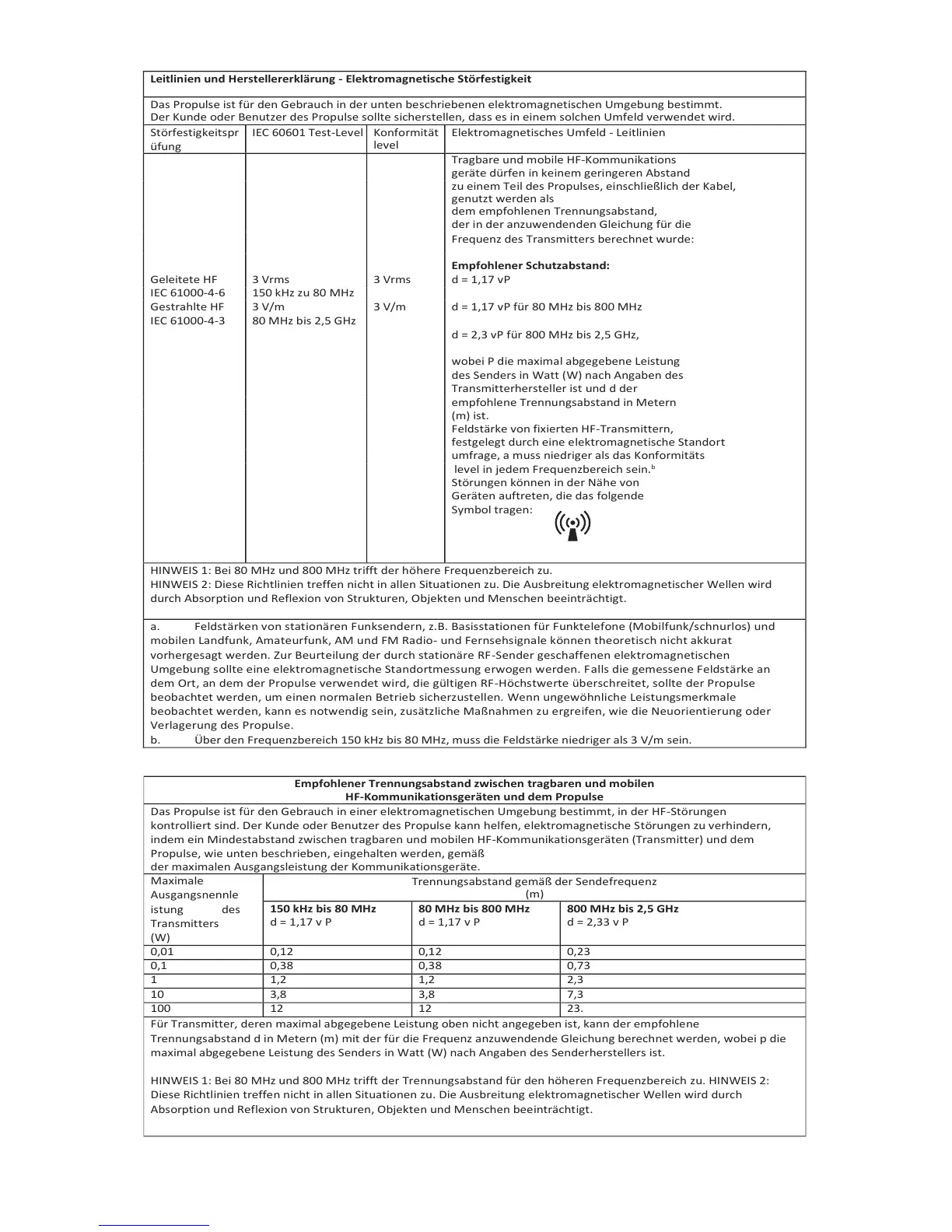
Leitlinien und Herstellererklärung - Elektromagnetische Störfestigkeit
Das Propulse ist für den Gebrauch in der unten beschriebenen elektromagnetischen Umgebung bestimmt.
Der Kunde oder Benutzer des Propulse sollte sicherstellen, dass es in einem solchen Umfeld verwendet wird.
Elektromagnetisches Umfeld - Leitlinien
Tragbare und mobile HF-Kommunikations
geräte dürfen in keinem geringeren Abstand
zu einem Teil des Propulses, einschließlich der Kabel,
genutzt werden als
dem empfohlenen Trennungsabstand,
der in der anzuwendenden Gleichung für die
Frequenz des Transmitters berechnet wurde:
Empfohlener Schutzabstand:
d = 1,17 vP für 80 MHz bis 800 MHz
d = 2,3 vP für 800 MHz bis 2,5 GHz,
wobei P die maximal abgegebene Leistung
des Senders in Watt (W) nach Angaben des
Transmitterhersteller ist und d der
empfohlene Trennungsabstand in Metern
Feldstärke von fixierten HF-Transmittern,
festgelegt durch eine elektromagnetische Standort
umfrage, a muss niedriger als das Konformitäts
level in jedem Frequenzbereich sein.
b
Störungen können in der Nähe von
Geräten auftreten, die das folgende
HINWEIS 1: Bei 80 MHz und 800 MHz trifft der höhere Frequenzbereich zu.
HINWEIS 2: Diese Richtlinien treffen nicht in allen Situationen zu. Die Ausbreitung elektromagnetischer Wellen wird
durch Absorption und Reflexion von Strukturen, Objekten und Menschen beeinträchtigt.
a. Feldstärken von stationären Funksendern, z.B. Basisstationen für Funktelefone (Mobilfunk/schnurlos) und
mobilen Landfunk, Amateurfunk, AM und FM Radio- und Fernsehsignale können theoretisch nicht akkurat
vorhergesagt werden. Zur Beurteilung der durch stationäre RF-Sender geschaffenen elektromagnetischen
Umgebung sollte eine elektromagnetische Standortmessung erwogen werden. Falls die gemessene Feldstärke an
dem Ort, an dem der Propulse verwendet wird, die gültigen RF-Höchstwerte überschreitet, sollte der Propulse
beobachtet werden, um einen normalen Betrieb sicherzustellen. Wenn ungewöhnliche Leistungsmerkmale
beobachtet werden, kann es notwendig sein, zusätzliche Maßnahmen zu ergreifen, wie die Neuorientierung oder
Verlagerung des Propulse.
b. Über den Frequenzbereich 150 kHz bis 80 MHz, muss die Feldstärke niedriger als 3 V/m sein.
99
Guidance and Manufacturer's Declaration - Electromagnetic Immunity
The Propulse is intended for the use in the electromagnetic environment specified below.
The customer or the user of the Propulse should assure that it is used in such an environment
Immunity test IEC 60601 test level Compliance
level
Electromagnetic environment – guidance
Conducted RF
IEC 61000-4-6
3 Vrms
150 kHz to 80 MHz
3 Vrms
Radiated RF
IEC 61000-4-3
3 V/m
80 MHz to 2,5 GHz
3 V/m
Portable and mobile RF communications
equipment should be used no closer to any
part of the Propulse, including cables, than
the recommended separation distance
calculated from the equation applicable to
the frequency of the transmitter:
Recommended protection distance:
d = 1.17 vP
d = 1.17 vP for 80 MHz to 800 MHz
d = 2,3 vP for 800 MHz to 2.5 GHz
where P is the maximum output power rating
of the transmitter in watts (W) acc. To the
transmitter manufacturer and d is the
recommended separation distance in meters
(m).
Field strengths from fixed RF transmitters, as
determined by an electromagnetic site
survey, a should be less than the compliance
level in each frequency range.
b
Interference
may occur in the vicinity of equipment
marked with the following symbol:
NOTE 1: At 80 MHz and 800 MHz, the higher frequency range applies.
NOTE 2: These guidelines may not apply in all situations. Electromagnetic propagation is affected by
absorption and reflections from structures, objects and people.
a. Field strengths from fixed transmitters, such as base stations for radio (cellular/cordless)
telephones and land mobile radios, amateur radio, AM and FM radio broadcast and TV broadcast
cannot be predicted theoretically with accuracy. To assess the electromagnetic environment due to
fixed RF transmitters, an electromagnetic site survey should be considered. If the measured field
strength in the location in which the Propulse is used exceeds the applicable RF compliance level
above, the Propulse should be observed to verify normal operation. If abnormal performance is
observed, additional measures may be necessary, such as reorienting or relocating the Propulse.
b. Over the frequency range 150 kHz to 80 MHz, field strengths should be less than 3 V/m.
Recommended Separation Distance between portable and mobile
RF Communications Equipment and the Propulse
The Propulse is intended for use in an electromagnetic environment in which radiated RF
disturbances are controlled. The customer or the user of the Propulse can help prevent
electromagnetic interference by maintaining minimum distance between portable and mobile RF
communications equipment (transmitters) and the Propulse as recommended below, according to
the maximum output power of the communications equipment.
Rated maximum
output power of
transmitter (W)
Separation distance according to the transmit frequency
(m)
150 kHz to 80 MHz
d = 1.17 v P
80 MHz to 800 MHz
d = 1.17 v P
800 MHz to 2,5 GHz
d = 2.33 v P
0.01 0.12 0.12 0.23
0.1 0.38 0.38 0.73
1 1.2 1.2 2.3
10 3.8 3.8 7.3
100 12 12 23.
For transmitters rated at a maximum output power not listed above, the recommended separation
distance d in meters (m) can be estimated using the equation applicable to the frequency of the
transmitter, where p is the maximum output power rating of the transmitter in watt (W) according
to the transmitter manufacturer.
NOTE 1 At 80 MHz and 800 MHz, the separation distance for the higher frequency range applies.
NOTE 2 These guidelines may not apply in all situations. Electromagnetic propagation is affected by
absorption and reflection from structures, objects and people.


 To Next Page
 Loading...