62
Managing Kaleido-X Systems
Key Concepts
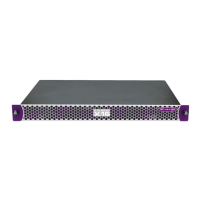
Kaleido-IP The Kaleido-IP can monitor and display HD and SD television programs
distributed over IP, across two HDTV displays. It supports MPEG-2 and
H.264/AVC compressed video, and the AAC, AC-3, MPEG-1, MPEG-2,
MPEG-4 AAC LC, and MPEG-4 HE-AAC compressed audio formats, within
unencrypted DCII, DVB, or ATSC streams. In the case of HD signals, the
Kaleido-IP X300 models support concurrent decoding of up to 24
MPEG-
2, or up to 16
H.264 video programs. In the case of SD signals, they
support concurrent decoding of up to 64
MPEG-2, or up to 32 H.264
programs. The compact Kaleido-IP X100 model supports concurrent
decoding of up to 8
HD MPEG-2, up to 6 HD H.264, up to 24 SD MPEG-2,
or up to 12
H.264 programs. In XAdmin and XEdit, a Kaleido-IP X100 or
Kaleido-IP X300 with two network adapters is identified as Kaleido-IP-2,
while a Kaleido-IP X300 with four network adapters is identified as
Kaleido-IP-4, and a Kaleido-IP X300 with six network adapters is
identified as Kaleido-IP-6.
Kaleido-XQUAD The Kaleido-XQUAD is a standalone quad-split multiviewer that is ideal
for truck and studio monitoring. It is available in two versions: the
Kaleido-XQUAD features four 3Gbps/HD inputs and a single multiviewer
output (HDMI/HD-SDI), and the Kaleido-XQUAD-DUAL offers eight
3Gbps/HD inputs and two multiviewer outputs. Both versions offer
exceptional display flexibility and outstanding space and energy
efficiency, using a 1RU half width frame with silent ventilation for
installation within studios. The multiviewer can be used for small
installations with one or two displays, and in much larger configurations
using multiple Kaleido-XQUADs. In XEdit, the Kaleido-XQUAD and
Kaleido-XQUAD-DUAL are identified as Kaleido-Modular. In XAdmin they
are identified as Kaleido-Modular KMV-3911.
XEdit XEdit is the Kaleido-X layout editor, a software intended to be run on a
remote computer. Its purpose is to define your Kaleido-X system
components, including external devices, create rooms, logical sources,
layouts, and RCP user definitions, and perform all the configurations
required for successful operation of the multiviewer. XEdit has two
modes of operation: you can work offline in a local workspace and then
apply your changes by exporting them to the multiviewer, or you can
connect to a multiviewer and work in online mode, directly on the
system. Changes made in online mode take effect immediately on the
monitor wall.
Database Layouts and related configurations for your Kaleido-X system are created
in XEdit. All this information is stored in a database. When you work in
offline mode, your load the appropriate database in a local workspace
on the PC where XEdit is used. XEdit can export such a database to a
multiviewer, or import the current layouts and configurations from a
multiviewer into the local workspace on your PC. For changes you make
in offline mode to take effect on the monitor wall, you must export the
database to a multiviewer. Conversely, any configuration change you
make in online mode must be imported from the multiviewer into your
local workspace if you wish to be able to make further changes in offline
mode.
Term Description


 To Next Page
 Loading...


