Page Number - 4
Form 824556
Extracting transmission uid through the dipstick tube
1. Operate the vehicle to warm the transmission uid to a normal operating temperature.
Caution: Do not attempt to extract uids at temperatures greater than 175° Fahrenheit
(80° Celsius).
2. Properly park the vehicle on level ground and turn the engine off.
3. Remove the transmission uid dipstick.
4. Insert the appropriate diameter dipstick tube into the dipstick ll hole until it reaches the bottom of the
transmission pan.
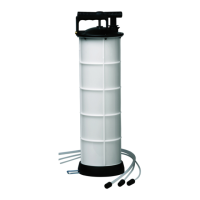
5. Connect the main suction tube to the dipstick tube.
6. Insert the rubber plug of the main suction tube into the reservoir adapter, and then insert the adapter into
the pour spout on the top of the reservoir. Ensure the tube connections are tight to prevent leakage.
7. Extract the used transmission uid by pumping the evacuator handle several times to create a vacuum.
Once the uid begins to ow into the reservoir, continue to operate the pump until all the uid has been
drained from the transmission pan.
8. Remove the reservoir adapter from the reservoir, pour the used transmission uid from the reservoir into
a suitable container, then dispose of the uid in an appropriate manner.
9. Rinse the evacuator reservoir, pump, adapter, and tubes with clean solvent or engine degreaser, and al-
low them to dry thoroughly.
10. Rell the transmission with new uid in accordance with a proper vehicle maintenance guide.
Extracting coolant from a radiator or expansion tank
1. Properly park the vehicle on level ground and turn the engine off.
2. Allow engine to cool completely. Caution: Do not attempt to extract uids at temperatures greater than 175°
Fahrenheit (80° Celsius).
3. Remove the radiator or expansion tank cap.
Never remove the cap from the radiator or expansion tank while the engine is at operating temperature. Al-
ways allow the engine to cool before removing the radiator cap or expansion tank cap. The cooling system
is under pressure. Failure to allow the engine to cool before attempting to remove the cap could result in
serious
injuries.
In some applications, this may require jacking or lifting the vehicle. Use appropriate safety stands
to avoid serious or fatal injury.
Extracting oil from a differential
1. Operate the vehicle to warm the differential to a normal operating temperature. Caution: Do not attempt
to extract uids at temperatures greater than 175° Fahrenheit (80° Celsius).
2. Properly park the vehicle on level ground and turn the engine off. If required, properly lift and support the
vehicle to allow access to the differential ll plug located on the differential housing or cover.
3. Remove the differential ll plug.
4. Insert the appropriate diameter dipstick tube into the ll hole until it reaches the bottom of the differential
housing.
5. Connect the main suction tube to the dipstick tube.
6. Insert the rubber plug of the main suction tube into the reservoir adapter, and then insert the adapter into
the pour spout on the top of the reservoir. Ensure the tube connections are tight to prevent leakage.
7. Extract the used oil from the differential by pumping the evacuator handle several times to create a vacuum.
Once the uid begins to ow into the reservoir, continue to operate the pump until all the uid has been
drained from the differential.
8. Remove the reservoir adapter from the reservoir, pour the used differential oil from the reservoir into a suit-
able container, then dispose of the oil in an appropriate manner.
9. Rinse the evacuator reservoir, pump, adapter, and tubes with clean solvent or engine degreaser, and allow
them to dry thoroughly.
10. Rell the differential with new oil in accordance with a proper vehicle maintenance guide.


 To Next Page
 Loading...