EasyManua.ls Logo

MOONRAYS 26245 - User Manual

MOONRAYS 26245
4 pages
Print Icon
To Next Page IconTo Next Page
Loading...
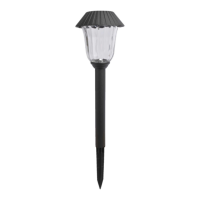
Solar Pathway
Lights
Assembly Instructions
IMPORTANT: Please read this manual carefully
before beginning assembly of this product.
Keep this manual for future reference.
Overview
This product is designed to the highest technical specifications and standards. It will supply years of maintenance-free use.
Please read these instructions thoroughly prior to installation, then store in a safe place for future reference.
About Your Solar Light
During the day your solar panel will convert the sun’s light and/or UV rays into electrical power that will charge the rechargeable
battery. When it becomes dark, the solar light will turn on using the power stored in the rechargeable battery as it will detect no
daylight. The unit’s light output strength and duration depends on how many hours and how much sunlight and/or UV rays your
panel absorbs throughout the day.
For maximum output place the solar panel in an area where there is direct sunlight for at least 8 hours in a given day. Do not
install your solar light in a shaded area. The selected location should not be near nighttime light sources such as porch lights,
street lights or pool lights, as these may cause the solar light to turn off prematurely.
model no. 26245, 26272
Question and Answer IconNeed help?

Do you have a question about the MOONRAYS 26245 and is the answer not in the manual?

Overview

This document describes the Moonrays Solar Pathway Lights, models 26245 and 26272, which are designed to provide ambient lighting using solar power. These lights are engineered to high technical specifications and standards, promising years of maintenance-free use.

Function Description:

The Moonrays Solar Pathway Lights operate by converting the sun's light and/or UV rays into electrical power via a solar panel during the day. This energy is then stored in a rechargeable battery. When darkness is detected, the solar light automatically turns on, utilizing the stored power. The strength and duration of the light output are directly dependent on the amount of sunlight and/or UV rays the solar panel absorbs throughout the day. For optimal performance, the solar panel should be placed in an area that receives direct sunlight for at least 8 hours daily. It is crucial to avoid installing the solar light in shaded areas or near other nighttime light sources such as porch lights, street lights, or pool lights, as these external light sources can cause the solar light to turn off prematurely.

Important Technical Specifications:

The device uses rechargeable batteries, which are charged by a solar panel. The specific battery type mentioned for replacement is nickel-cadmium or nickel-metal hydride. Users are advised to use only rechargeable batteries of the same size and to replace them annually for optimum performance. The manual explicitly warns against mixing old and new batteries, or mixing alkaline, standard (carbon-zinc), or rechargeable (Ni-Cad, Ni-MH, etc.) batteries. Batteries should not be disposed of in fire due to explosion or leakage risks, and should not be ingested.

Usage Features:

The assembly and operation of the solar pathway lights are straightforward.

  1. Assembly:
    • Insert the pole over the base of the lamp head until secure.
    • Insert the ground stake into the pole with the spiked end facing downward.
    • Carefully remove the top by turning it counter-clockwise until it separates from the lens.
    • Move the internal switch to the "ON" position.
    • Stake the fixture into the ground in an area that receives direct sunlight for two full sunny days to ensure initial charging.
    • Once fully charged, the solar light will automatically turn on when it gets dark.
  2. Battery Replacement:
    • Carefully remove the top by turning it counter-clockwise until it separates from the lens.
    • Remove the battery compartment cover.
    • Replace the battery with an equivalent, new solar rechargeable battery, ensuring correct polarity.
    • Reassemble the unit by reversing the above procedure.
  3. Troubleshooting: If the solar light does not turn on at dusk despite following instructions, users should:
    • Ensure the solar light is not affected by other light sources.
    • Verify the solar light is not in a shaded area all day.
    • Check if the batteries are installed correctly.
    • Consider replacing the battery if it's old or not holding a charge.

Maintenance Features:

To ensure the longevity and optimal performance of the Moonrays Solar Pathway Lights, several maintenance practices are recommended:

  1. Solar Panel Cleaning: Regularly clean any dirt and debris from the solar panel using a soft damp cloth or paper towel. Abrasive cleaning agents should be avoided as they can scratch or damage the UV coating, which would impede the panel's ability to recharge.
  2. Snow and Ice: In regions prone to snow and ice, if the light assembly is covered for an extended period, the batteries will require at least 8 hours of recharge once cleared.
  3. Winter Storage: To prolong the product's life, it is recommended to store the product indoors during winter months. The batteries should be removed and stored in a dry location.
  4. Battery Replacement: For optimum performance, replace the rechargeable battery with a new one of the same size each year.

The product comes with a 1-year limited warranty, covering defects in materials and workmanship from the date of purchase. Fusion Products Ltd., the registered trademark owner for MOONRAYS®, provides technical support and warranty inquiries.

MOONRAYS 26245 Specifications

General IconGeneral
BrandMOONRAYS
Model26245
CategoryLighting Equipment
LanguageEnglish

Related product manuals