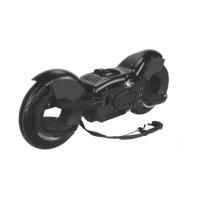
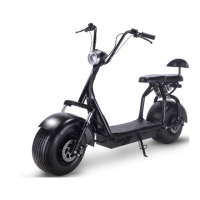
This document describes the "MINI" model electric scooter, highlighting its design, technical specifications, usage, and maintenance.
Function Description
The MINI scooter is designed for personal transportation, offering a blend of unique style, leisure structure, and practical features. It is an electric vehicle powered by a lithium battery, emphasizing environmental friendliness with no pollution during use. The scooter is built for ease of manipulation and comfortable riding, suitable for both sitting and standing positions.
Important Technical Specifications
I. Main technical parameters of the scooter:
- Product Size: 1380 * 870mm
- Height: 870mm
- Weight: 39kgs
- Tire specifications: 22.5/6 inch
- Maximum load: 200 kg
- Top speed: ≤20 km/h
- Range: 40 ~ 60 km
- Maximum torque: 95 N/M
- Maximum climbing: ≤35°
- Braking performance (20 km/h): Dry: ≤1 m; Wet: ≤2.5 m
II. Main technical parameters of battery:
- Battery type: 18650 lithium-ion batteries
- Capacity: 12AH~20AH
- Nominal voltage: 60V
III. Main technical parameters of motor:
- Motor models: Brushless DC motor hub
- Rated power: 800W
IV. Main technical parameters of controller:
- Current limiting protection value: 25 ± 1A
- Under-voltage protection value: 52 ± 0.5V
V. Charger main parameters:
- Input voltage (AC): 100-240VAC, 50/60HZ
- Output voltage (DC): 67.2 ~2.0A
- Charging time: 8 ~ 10 hours (depending on remaining power)
Key Components (referencing diagrams):
- Front: Horn (1), LED Front Light (2), LCS Display (3), Front Frame (1 on page 4), Shock Absorber (10 on page 3, 5 on page 4).
- Handlebar: Handle (5 on page 3, 3 on page 4), Brake Handle (1 on page 6), Head Light Switch (2 on page 6), Speed Mode (3 on page 6), Horn (4 on page 6), Accelerator (2 on page 6).
- Display: Speed Mode (1 on page 5), Speed (2 on page 5), Millage (3 on page 5), Battery Indicator (4 on page 5, 1 on page 5 bottom), Ignition Key (3 on page 5 bottom).
- Body: Seat (4 on page 3, 4 on page 4), Battery (9 on page 3, 8 on page 4), Removable Battery (1 on page 7 top).
- Rear: Shock Absorber (6 on page 3), Disk Brake (7 on page 3, 6 on page 4), Motor Hub (8 on page 3, 7 on page 4), Back Stand (1 on page 7 bottom), Rear Light (2 on page 7 bottom), Plate Place (3 on page 7 bottom).
Usage Features
Safe Driving Precautions:
- Always adhere to traffic rules and local speed limits.
- Familiarize yourself with the manual and practice in an empty field before riding.
- Avoid lending the vehicle to unfamiliar riders.
- Single-hand riding and drunk riding are highly dangerous.
- Exercise extreme caution in rainy and snowy conditions due to reduced grip and braking performance; avoid high speeds and sudden turns. Brake in advance on snowy days.
- Wear a helmet correctly, ensuring it is fastened securely.
- Wear appropriate clothing that allows free movement and low-heeled shoes.
- Do not exceed the maximum load of 200 kg, as heavy loads affect control.
- Note the frame and motor numbers for maintenance and service.
Correct Riding Method:
- Maintain a natural posture.
- Keep both hands on the steering bar and both feet on the vehicle.
- Accelerate slowly to avoid instability.
- Ride slowly on paved road surfaces.
- In rain and snow, ride slowly and avoid deep water to prevent battery box water damage and short circuits. Be aware of reduced braking performance.
Parking Method:
- Park carefully, especially around other vehicles and pedestrians.
- Park on a flat road, avoiding ramps.
Power Indicator (LCS Display):
- LOW: Lights indicate electricity usage up to 75% of rated capacity.
- HALF: Lights indicate electricity usage up to 35% of rated capacity.
- HIGH: Lights indicate power is less than 10%.
- When LOW lights flash, it's time to charge immediately.
Power Lock Key:
- Insert the ignition key to start the motor.
- Turn the key to shut off power.
- For parking, turn the power supply off clockwise and pull out the key.
Acceleration Handle (Speed):
- Rotate the accelerator to increase speed.
- Relax the accelerator to reduce speed.
Disc Brake Method:
- Brake clearance adjustment: Adjust the nut by 2 mm with a wrench to ensure proper gap between the disk and pads for comfortable braking.
- Brake pad replacement: Pads should be changed every six months or when wear exceeds 1 mm. Clean the brake pads with a clean environment and press the old pad out, replacing it with a new one. Adjust the brake lever screw back into the correct position for comfortable feel.
- Brake force: Practice to adjust braking force, as it increases over time.
- Oil change: Change disc brake oil every 2-3 years, using a syringe pump.
Disc Brake Attention:
- Do not use lubricating oil on disc brake pads and calipers, as it significantly reduces braking performance.
- New brake pads should not be exposed to water to avoid reducing lubricating oil in the assembly clearance.
- Practice using the hydraulic disc brake system in a safe place. Avoid aggressive braking to prevent wheel lock and injury.
Charger Usage:
- Method: Insert the battery box first, then plug into a 220V AC outlet. After charging, unplug the 220V AC plug, then the battery box plug.
- Indicator: Red light indicates normal charging; green light indicates full charge.
- Temperature protection: If a red light flashes, the charger is in temperature protection. Move it to a cool, ventilated place.
- Output test: When not connected to the battery, the charger output is less than 42V pulse voltage. To test the actual charging voltage, use a 1 kΩ resistance load in the output port.
Charger Attention:
- For indoor use only.
- Do not use in confined spaces, scorching sun, or high-temperature environments. Do not place the charger in barrels or boxes.
- Do not leave the charger connected to AC power for long periods without charging.
- If abnormal light, odor, or overheating occurs, stop charging immediately and send for repair or replacement.
- Do not open or fix the charger internally.
- Do not overcharge the battery.
- Do not use in a combustible gas environment.
- Keep the charger away from water or wet places to prevent fire or electric shock.
Battery Usage and Attention:
- Charging: Use only the company-supplied charger. Unauthorized chargers can shorten battery life or cause failure.
- Do not discharge the battery below 95%.
- Battery capacity reduces by about 5% after more than a month of storage.
- Charge in time to ensure mileage.
- Charger operation is normal as long as the temperature does not exceed 60°C.
Battery Discharge (Use):
- For use only in electric vehicles; no warranty for other uses.
- Battery management system provides automatic protection in case of short circuit. The power cord fuse will blow, protecting the battery. It will reset after about 2 minutes, allowing normal operation.
- Damage to the electric car's controller, motor, speakers, or lighting equipment, or unreasonable configuration, can cause large current discharge, leading to temporary protective stop output (resets in 10 seconds).
- Operating temperature range: -10 ~ 55 °C. Battery energy decreases at lower temperatures, which is normal.
- Do not discharge completely to avoid short circuits.
Battery Storage:
- For long-term storage (over a month), charge to 60-80%. Recharge every three months.
- Store in a cool, dry environment.
- Avoid conducting objects connecting the electrodes.
- Do not use near fire sources.
- Do not disassemble the battery.
- Do not modify batteries.
Battery Notes:
- If battery deformation or heat is found, stop use and contact the company or maintenance department.
- In case of fire, do not use water directly. Use sand, foam fire extinguisher, or thick cloth soaked with water.
- Damage due to incorrect storage or charging is not covered by warranty.
- Do not discard batteries arbitrarily.
Maintenance Features
III. Inspection, cleaning and maintenance
Regular/Daily Check Items:
- Vehicle Location: Ensure the vehicle is in a safe location.
- Abnormal Position: Check for any abnormal positions that might affect operation.
- Brake Braking Effect: Ensure the brake handle feels soft, with proper clearance, and normal braking.
- Tires:
- Check for cracks, damage, abnormal wear, metal, stone, glass, or other sharp objects embedded.
- Inspect the depth of tire grooves; replace tires when two-thirds worn.
- Check tire pressure based on the sag of the ground contact area. Normal pressure values are 1.5 kg/cm² for front and rear tires.
- Power Voltage: Verify the power voltage indicator (refer to Chapter 4, paragraph 2).
- Steering System:
- Check handlebar and front fork movement (up, down, forward, backward, left, right) for moderate elasticity and flexible steering.
- If there is a clattering sound, loose steering, or other issues, contact dealers for service.
- Axles: Ensure front and rear axles are not loose.
IV. Common Faults and Elimination Method:
| No | Performance | Reason

 Need help?

 To Next Page
 General